

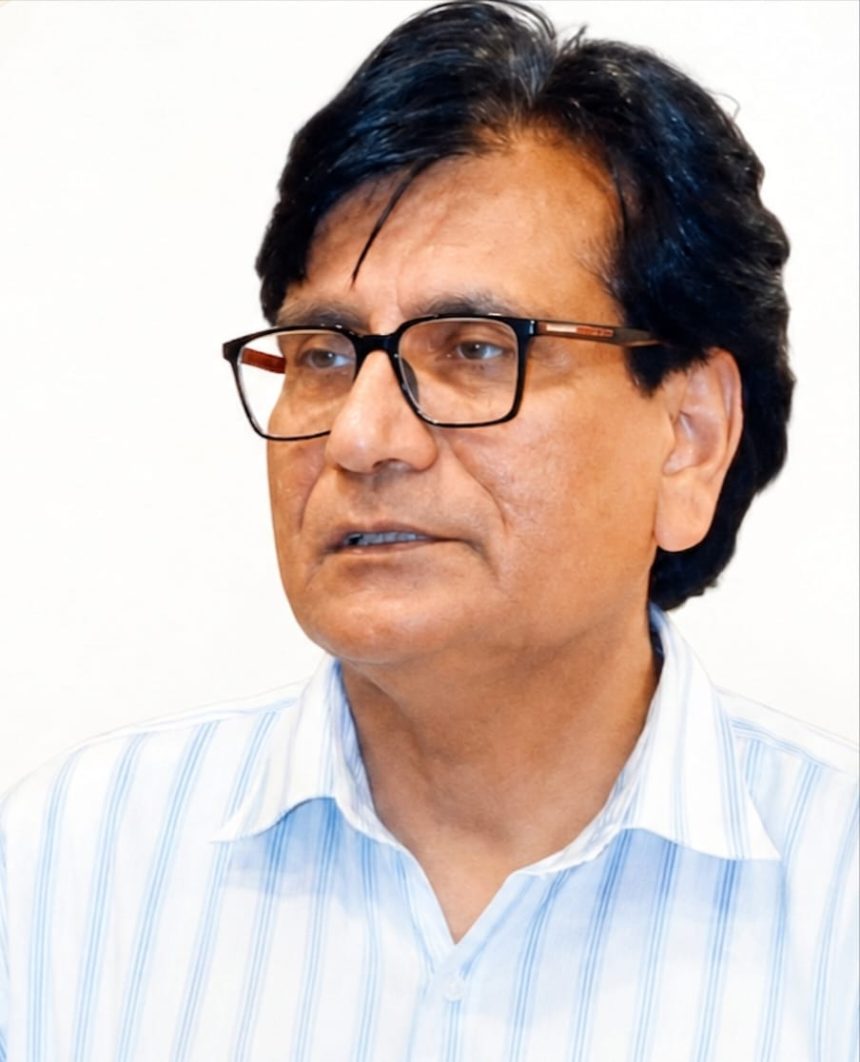
Written By:Dr. Nasser Hussyn Bukhari
Published By:ANI News Agency
A nation’s future is not written first in its parliament, stock exchange or military headquarters; it is written in its classrooms. The real wealth of a country is its human capital, and education is one of the three fundamental dimensions of the Human Development Index (HDI), alongside health and income. The experience of Asian countries demonstrates that sustained investment in education creates stronger economies, capable institutions and more cohesive societies.
Pakistan’s position should therefore be a national alarm bell. The UNDP Human Development Report 2025, based on 2023 data, ranks Pakistan 168th in the world with an HDI of 0.544. China stands at 78th, Iran at 75th, Sri Lanka at 89th, while India and Bangladesh are both ranked 130th. These differences cannot be attributed to education alone, but education remains central to human development because it determines the capabilities with which citizens participate in economic, political and social life.
Literacy presents an equally disturbing picture. Adult literacy in Iran is around 89 per cent, India around 78 per cent, while China and Sri Lanka have achieved substantially higher levels than Pakistan. Bangladesh has also made considerable progress in expanding basic education. Pakistan, meanwhile, continues to struggle with low literacy, poor learning outcomes and a huge population of children outside school.
According to Pakistan Institute of Education and UNESCO estimates, approximately 25 million children aged 5–16 are out of school. These figures represent much more than statistics. Children aged five to nine, who should be acquiring basic literacy and numeracy at primary level, are being excluded from classrooms. Those between roughly 10 and 12, corresponding to middle-school education, are dropping out, while many adolescents between 13 and 16 fail to reach or complete secondary education.
The crisis becomes particularly severe at higher levels. Pakistan Education Statistics indicates that approximately 35 per cent of children are out of school at primary level, around 28 per cent at lower-secondary level and nearly half at upper-secondary level. Thus, the higher a child progresses in the education system, the greater the probability of exclusion. A country that cannot retain its children through secondary education cannot expect to produce enough scientists, engineers, doctors, teachers, administrators, entrepreneurs and informed democratic citizens.
The responsibility cannot be placed on one political party or one province. Successive federal and provincial governments have announced education policies, constructed schools and launched programmes, yet the crisis continues. Punjab, Sindh, Khyber Pakhtunkhwa and Balochistan all face serious challenges in providing universal access and quality education. The federal government, too, has failed to provide the strategic coordination required for a national educational emergency.
One reason is that education produces political benefits slowly. Roads, bridges and visible infrastructure can generate immediate political publicity, whereas an educated child may contribute to society decades later. Short electoral cycles therefore discourage long-term investment. Another reason is the absence of a national consensus about what kind of citizen Pakistan wants its education system to produce.
Perhaps the greatest weakness is fragmentation. Pakistan has government schools, elite private schools, low-cost private schools, divisional public schools and thousands of religious seminaries. The problem is not necessarily the existence of different institutions; it is the enormous difference in curriculum, teaching quality, resources, language and educational objectives.
Consequently, two children born in the same country can grow up with entirely different understandings of Pakistan, democracy, citizenship, science, religion and patriotism. One may study advanced mathematics, computer science and English in an elite school; another may struggle with basic literacy in an under-resourced government school; a third may receive predominantly religious instruction in a seminary. Instead of creating one educated nation, our education system risks producing parallel social worlds.
This fragmentation has serious implications for national cohesion. Religious seminaries have an important place in society and many provide valuable religious education. However, where religious education remains isolated from modern science, social sciences, technology and critical inquiry, students may become disconnected from contemporary knowledge. This does not mean that seminaries themselves are responsible for extremism; rather, the absence of balanced modern education can create conditions in which sectarianism, intolerance and intellectual isolation flourish.
The same principle applies to Islamic Studies. Religious education should cultivate ethics, compassion, tolerance and intellectual curiosity rather than reinforce sectarian divisions. Pakistan must ensure that children are not educated primarily as members of competing sectarian identities. They should first understand that they are equal citizens of Pakistan, regardless of sect, religion, ethnicity, language or province.
Pakistan therefore needs a fundamental restructuring of its education architecture. The long-term objective should be one national education system based on common standards, equal opportunity and a shared civic foundation. Nationalisation should not necessarily mean confiscating every privately owned institution. Rather, the state should establish national standards for curriculum, teacher certification, access, assessment and accountability and bring all educational institutions, including seminaries, within a coherent regulatory framework.
Education up to higher-secondary level should be free for every child. No student should leave school because parents cannot afford fees, books, uniforms or transport. After completing intermediate education, young people should be able to choose universities, professional institutions, vocational education or specialised religious scholarship.
Madaris should be encouraged and legally regulated to enrol students who have completed intermediate education for advanced religious studies. This would help separate basic schooling from specialised religious scholarship and reduce the tendency to place children into sectarian educational environments at an early age. Muslim countries such as Türkiye and Malaysia demonstrate that religious education can coexist with modern education within regulated national systems. Pakistan can develop a model suited to its own constitutional, cultural and religious circumstances.
The most important reform, however, concerns teachers. No curriculum can succeed without competent teachers. Pakistan should establish Teachers Registration and Certification Authorities at federal and provincial levels. Every teacher in government, private and religious institutions should meet minimum professional standards and receive periodic certification.
Universities must redesign teacher-education programmes around educational psychology, pedagogy, digital learning, critical thinking, classroom management, inclusive education and subject expertise. Teaching should become a prestigious and financially attractive profession. Competitive salaries are not merely a welfare measure for teachers; they are an investment in the quality of the next generation.
Pakistan’s curriculum also requires fundamental revision. The present system relies excessively on memorisation and examination-oriented learning. Children must be taught how to ask questions, investigate evidence, solve problems, communicate ideas and think independently. Science and technology should be strengthened, but social sciences, history, philosophy, literature, civics and ethics are equally important for building a democratic society.
Another major obstacle is the rapidly expanding tuition mafia. Pakistan has developed an examination economy in which families increasingly pay private academies to compensate for weaknesses in schools. Medical, engineering and competitive examinations have become lucrative commercial markets. A talented student from a remote district whose family cannot afford expensive coaching is placed at a significant disadvantage against a student receiving months of specialised preparation.
The same problem increasingly affects CSS and other competitive examinations. When coaching becomes a prerequisite for success, competitive examinations cease to be genuinely competitive. They begin to reward purchasing power rather than intellectual ability. Entrance examinations must therefore test understanding, analytical ability and creativity rather than memorisation and coaching-centre techniques.
Pakistan needs an education revolution, not another education slogan. The government must significantly increase investment in education, provide free schooling through higher secondary level, establish common national standards, modernise curricula, certify teachers and ensure competitive salaries. Equal attention must be given to science, technology and social sciences so that Pakistan develops both technological capacity and a healthy social fabric.
The choice is ultimately straightforward. Pakistan can continue paying the economic and social price of ignorance, unemployment, intolerance and inequality, or invest in the children who constitute its greatest national asset.
Twenty-five million out-of-school children are not merely a statistic. They are Pakistan’s unfinished future.
If Pakistan genuinely wants to become democratic, tolerant, prosperous and technologically capable, it must begin where every successful nation begins: with a classroom, a trained teacher and a child given an equal opportunity to learn.

long awaited problem to address, very good article
Discovered this gem through a fellow player and I am so glad I did. The whole experience feels polished from the landing page to the payout confirmation. I tried their slot tournaments and the competition was fun yet fair. Withdrawal limits are reasonable and everything goes through smoothly. You really deserve to give this one a spin and see how enjoyable online gaming can be. tinkanetpe