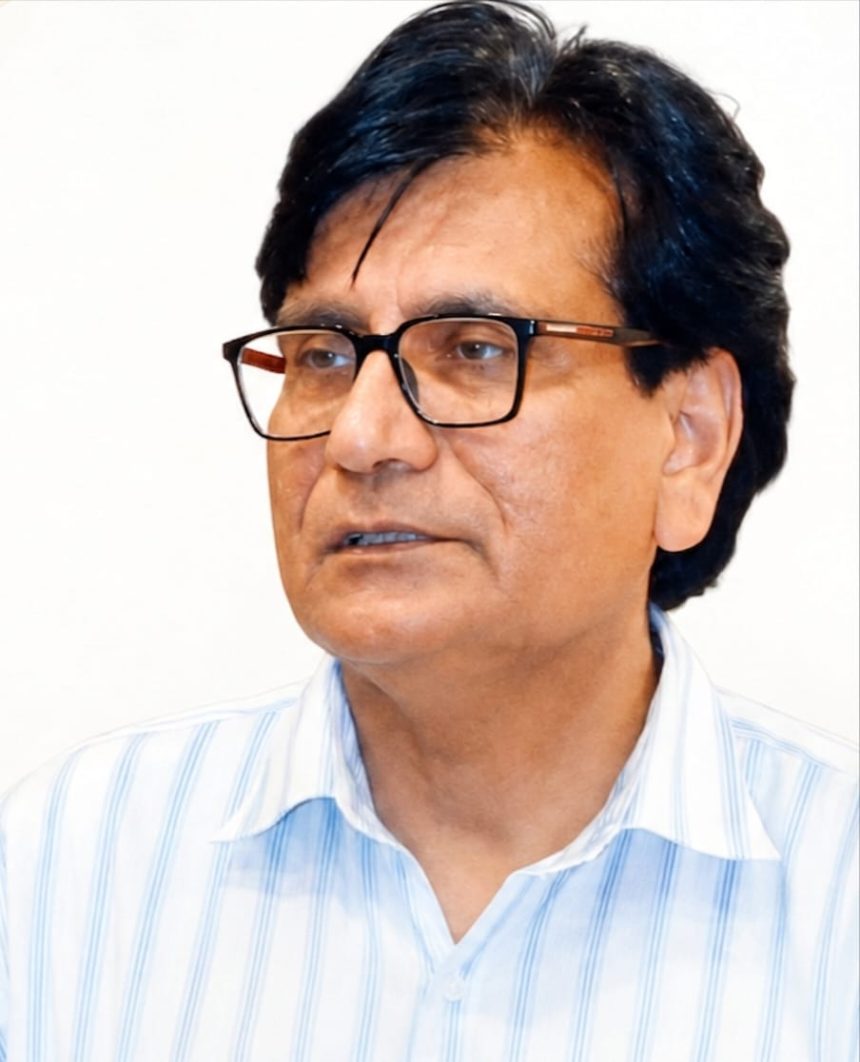
By: Dr Nasser Hussyn Bukhari
Published By:ANI News Agency
The result is finally out. A student sits before a mobile phone, refreshing the screen again and again. His hands are cold, his heart is racing. Then the numbers appear: 1,050 out of 1,100. For a moment, there is silence. Then comes relief. His parents congratulate him, relatives begin calling, teachers celebrate and the school prepares to display his result as another symbol of academic excellence.
But beneath the celebrations, the student may be asking himself a very different question: Was it enough? Could I have scored more? What if my friend has higher marks? What will happen when I apply for university?
The marks that were supposed to bring happiness can quickly become another source of anxiety.
And there is a more fundamental question that society rarely asks: What do those 1,050 marks actually represent? Do they demonstrate exceptional understanding, critical thinking and problem-solving ability? Can the student apply knowledge to an unfamiliar situation, explain an idea in his own words, question an assumption or solve a problem without being guided towards the expected answer? Or have we created an education system in which reproducing information has become more valuable than understanding it?
This is where Pakistan’s growing obsession with grades deserves serious examination.
Education is meant to develop the mind, character and capabilities of a young person. Yet education in Pakistan has increasingly become a race for marks. Grades are treated as a measure of intelligence, success and even social status. A high percentage can determine admission, scholarships and future opportunities, while a lower score can leave a student feeling that he or she has failed, even when genuine learning has taken place.
This phenomenon is commonly described as grade inflation: grades rise over time without a corresponding improvement in knowledge, skills or academic performance. A growing number of students obtaining exceptionally high marks may appear to indicate educational progress. But if those marks do not accurately reflect learning, they weaken the credibility of the entire system.
The consequences are particularly serious for students. When high grades can be achieved without equivalent competence, genuine academic achievement loses value. Students who work hard to understand concepts and develop skills may feel that their efforts are not being fairly recognized. More importantly, students begin to study for marks rather than for knowledge.
The psychological burden is considerable. Pakistani students often spend long hours in school before attending evening academies and tuition centres. They return home to complete assignments, prepare for tests and meet parental expectations. Their time for sport, recreation, independent reading, creativity and simply being young is steadily reduced.
For some, the pressure becomes unbearable. Parents may unintentionally communicate that anything less than an exceptionally high score represents failure. A child who cannot fulfil those expectations may experience fear, hopelessness and profound emotional distress. Students must be reminded that an examination result is a measure of performance in an examination; it is not a measure of their worth as human beings.
The academy and tuition culture has aggravated the problem. Many parents have come to believe that regular schooling is insufficient and that private tuition is essential for obtaining competitive marks. This has created a powerful commercial tuition industry and placed an additional financial burden on families. More seriously, excessive dependence on tuition can produce students who wait for prepared notes and model answers rather than learning to think independently.
A student trained primarily to memorize may perform impressively in an examination but struggle when confronted with an unfamiliar problem. Such a student may know the answer but not understand the question.
Pakistan’s examination boards therefore require serious scrutiny. At the matriculation and intermediate levels, exceptionally high scores have become increasingly common. When a candidate obtains more than 1,050 marks out of 1,100, the achievement deserves recognition. But the system must also be able to answer whether such marks genuinely represent exceptional learning or whether they partly reflect weaknesses in assessment and marking.
My own experience as a Head of Examiner for several years exposed me to weaknesses in the examination process. I encountered inconsistencies in the appointment and performance of examiners. In some cases, appointments appeared to depend on references rather than professional competence. Not all examiners seemed adequately familiar with modern assessment practices, marking standards and reliable evaluation.
An examination system is only as credible as its examiners. If marking standards vary, examination results cannot provide a reliable basis for university admissions, scholarships or comparisons between students. Eventually, when I could no longer accept practices that I believed were unfair to students, I decided to withdraw from this responsibility.
There is another dimension that cannot be ignored: inequality of opportunity. A student from Islamabad, Lahore or Multan may compete with a student from Sibi, Jacobabad or Jhal Magsi. On paper, the competition appears equal. In reality, it may not be.
The quality of school infrastructure, laboratories, libraries, technology and teachers varies enormously. So does the capacity of families to provide private tuition, computers, internet access and other educational resources. To judge every student exclusively by marks without recognizing these differences is to confuse equal competition with equitable opportunity.
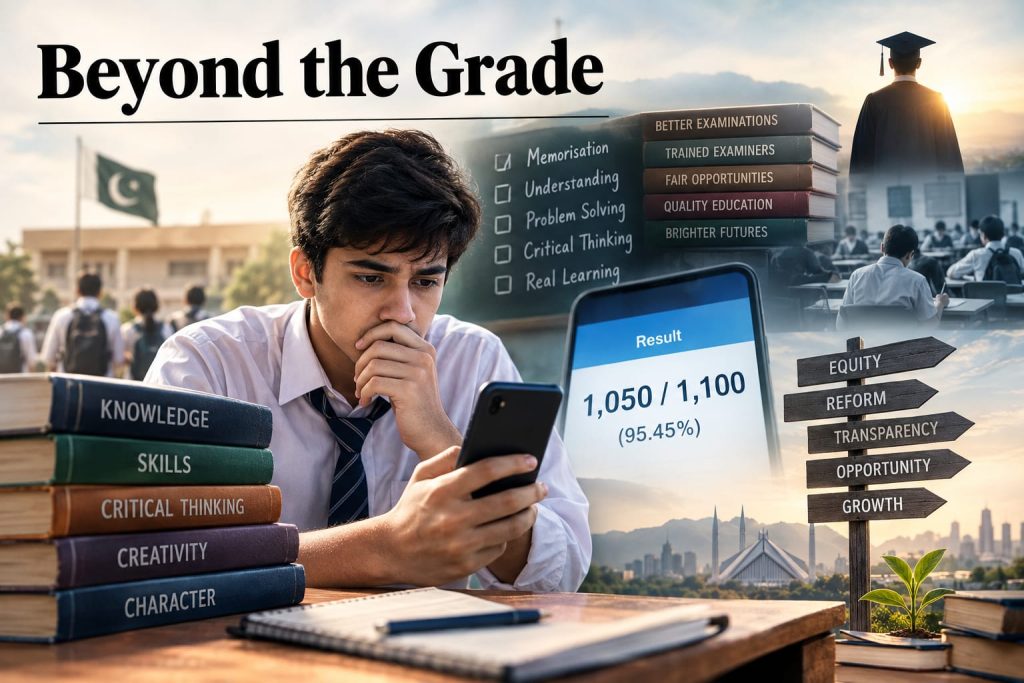
Pakistan therefore needs examination reform based on evidence, transparency and measurable outcomes. The first step should be a five-year national assessment baseline covering grade distributions, exceptionally high scores, examiner performance, rechecking outcomes and variations between examination centres. Boards should publish annual assessment reports so that rising grades can be examined rather than simply celebrated.
Examiner recruitment must become transparent and merit-based. Every examiner should receive compulsory training and certification in assessment, marking rubrics and examination ethics. Sample scripts should undergo independent moderation, while significant marking discrepancies should trigger investigation and retraining.
Question papers must also move beyond rote learning. Increasing emphasis should be placed on comprehension, application, analysis, critical thinking and problem-solving. The objective is not to reduce marks but to make marks more meaningful.
Reform should proceed in phases, beginning with assessment audits and examiner training, followed by pilot programmes in urban, rural and disadvantaged schools. Successful models can then be expanded nationally. University admissions should gradually move away from treating raw examination marks as the sole definition of merit and, where appropriate, consider subject knowledge, aptitude and contextual factors.
Schools must simultaneously strengthen classroom teaching so that students do not feel compelled to depend on private academies. Student wellbeing should become part of education policy, with reasonable workloads, counselling and mechanisms to identify excessive academic pressure.
Finally, Pakistan must redefine what it means to educate a child. Bloom’s learning domains remind us that education encompasses the cognitive, affective and psychomotor domains. Knowledge matters, but so do values, emotional maturity, creativity and practical skills. An examination that measures only memorisation captures only a fraction of a student’s potential.
Parents, too, must change the questions they ask. Instead of asking only, “How many marks did you get?”, they should ask: “What did you learn? What can you do with that knowledge? What did you discover?”
Pakistan does not need fewer high achievers; it needs more genuine learning. High grades should be the consequence of high achievement, not the definition of achievement.
Our children are not examination machines. They are human beings with intellectual, emotional and creative potential. The objective of reform should therefore be simple: less pressure, more learning; less memorisation, more thinking; less obsession with marks, more emphasis on merit and competence.
The real measure of an education system is not how many students obtain 90 or 95 per cent. It is whether they can think critically, communicate effectively, solve problems, act responsibly and continue learning throughout life.
Pakistan must move beyond the grade and build an examination system that measures what students genuinely know, understand and can do.