

By: Hurish Shah
Published By:ANI News Agency
A public university cannot demand respect for its rules while leaving serious questions about a statutory appointment unanswered. At Bahauddin Zakariya University (BZU), Multan, the controversy surrounding Ejaz Ahmad and the office of Acting Registrar has now been followed by a directive conveying the Governor/Chancellor’s concern about delays in filling such posts. The question is no longer whether the matter deserves scrutiny. It is whether the authorities will respond with records, reasons and action.
Daily Financial Times has raised these concerns before. On 22 June 2026, Hurish Shah’s column, “The Supreme Court Spoke. Did BZU Listen? Paragraph 39(c), the Six-Month Rule, the Rule of Law, and the Continuing Controversy Over the Acting Registrar at BZU Multan,” questioned the duration of the acting arrangement and whether a regular recruitment process had begun. On 3 August 2026, Ms. Hurish Shah’s “When Official Silence Becomes Institutional Failure: The Unresolved Challenge to Ejaz Ahmad’s Appointment, BZU’s Acting Registrar Arrangement, Withheld Records, and the Inaction of the Governor’s Secretariat, HED and HEC” examined the pending challenge to his earlier appointment, reported difficulties in obtaining official records and the absence of a clear decision. Both columns asked for an accountable response. Neither a newspaper column nor an allegation, however, is a finding that an appointment is illegal. That determination requires examination of the complete record by the competent authority.
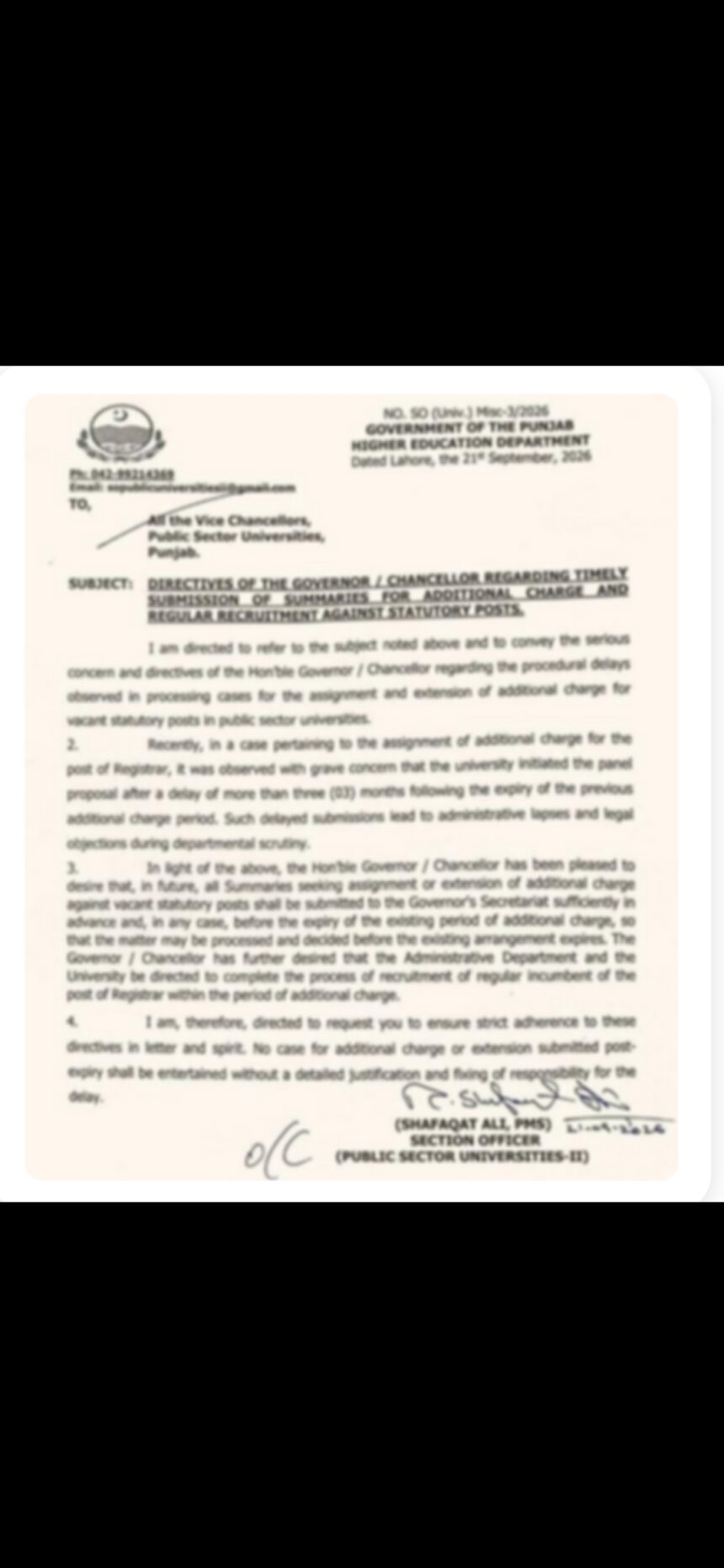
The latest official communication makes that examination more urgent. In a letter dated 21 September 2026, bearing the reference “NO. SO (Univ.) Misc-3/2026 GOVERNMENT OF THE PUNJAB HIGHER EDUCATION DEPARTMENT Dated Lahore, the 21st September, 2026,” the Punjab Higher Education Department conveyed the Governor/Chancellor’s serious concern about procedural delays in assigning or extending additional charge against vacant statutory posts. It described a Registrar case in which a university initiated a panel proposal more than three months after the previous additional charge period had expired. The letter does not identify that university by name. It would therefore be wrong to present this example as a proven finding against BZU. Its directions, however, were addressed to all vice chancellors of Punjab’s public sector universities, including BZU.
Those directions are plain. Summaries for additional charge or its extension must reach the Governor’s Secretariat sufficiently early, and before the existing period expires, so that a decision can be made in time. The university and administrative department are also to complete recruitment of a regular Registrar within the additional charge period. A proposal submitted after expiry will not be entertained without a detailed justification and responsibility being fixed for the delay.
Why should a university need such an instruction? The expiry date of an additional charge order is known from the day it is issued. Preparing a proposal on time and pursuing regular recruitment are basic administrative duties. When an acting arrangement continues without a transparent account of its authority and duration, uncertainty spreads through the institution. Staff, students and the public are entitled to know who lawfully holds a statutory office and what steps are being taken to fill it permanently.
BZU should now place the relevant facts on record. When did each additional charge period begin and end? When were extension or panel proposals sent to the competent authority, and what decisions were received? Has recruitment for a regular Registrar been advertised and progressed? The university should also address the pending challenge to Ejaz Ahmad’s earlier appointment through a reasoned decision, after giving those concerned a fair opportunity to respond. Requests for official records should be dealt with according to law, with any refusal explained in writing.
The Higher Education Department and Governor’s Secretariat have responsibilities of their own. Issuing a directive is necessary; checking compliance gives it meaning. They should establish whether the applicable orders and deadlines have been followed at BZU and ensure that any pending representation is decided on its merits. If an official delay is found, responsibility should be determined as the new directive requires. If the appointments and extensions are lawful, the documents and reasons should make that clear as well.
This controversy should end with a documented answer, not another round of silence. The media has asked difficult questions, and the Governor/Chancellor has now set out clear expectations for timely action. BZU and the oversight authorities must show, through the official record, that those expectations are being met.
2 responses to “BZU’s Acting Registrar Controversy: After Repeated Warnings, When Will a Regular Registrar Be Appointed?”
-
Well done
-
A clear breach of supreme court judgement. Mr. Ejaz Ahmed ha occupied the seat for more than eighteen months. Which force is playing his role behind the Ejaz Ahmed. Is that force is more than supreme court or Higher Education Deptt. Punjab





Leave a Reply