BY:Asghar Ali Mubarak: Published by ANI News Agency
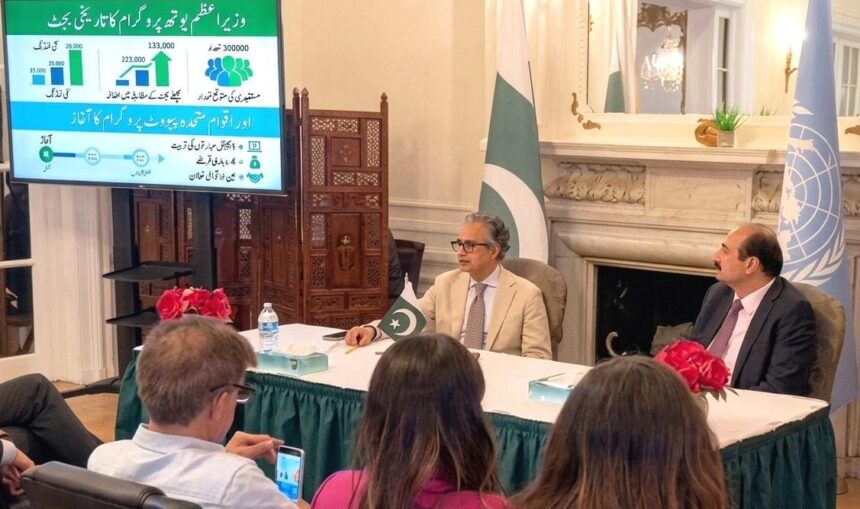
When our youth succeed, Pakistan succeeds. The Prime Minister’s Youth Program, in collaboration with the Permanent Mission of Pakistan to the United Nations, launched the Pivot Program at an event titled “Connection to Contribution: Pakistani Youth Diaspora Connect” held in New York. The program aims to provide a structured platform for Pakistani youth around the world to connect with Pakistani youth through mentorship, knowledge and experience exchange, professional networking, innovation and education, business opportunities and regular collaboration in the areas of skills.
The event was attended by young Pakistani professionals, business figures, researchers, students and community leaders from across the United States and expressed keen interest in mentoring, supporting and sharing knowledge with Pakistani youth through the Pivot platform. Remember that Pakistan’s youth represent the country’s single greatest national asset and the ultimate foundational pillar for long-term socio-economic growth. With nearly 70 percent of the national population currently under the age of 30, the strategic necessity of investing in young generations transcends basic social welfare. Under the governance of Prime Minister Muhammad Shehbaz Sharif, youth empowerment has been systematically placed at the absolute epicenter of the state’s federal development agenda. The overarching vision is structurally anchored around the principle of “Productive Employment,” a paradigm shift explicitly engineered to transition Pakistani youth from passive job seekers into proactive, high-yielding job creators.The Federal Budget for Fiscal Year 2026–27 stands as a historic milestone, reflecting the largest-ever public financial investment in domestic youth development. The state has allocated a monumental PKR 40.58 billion directly to targeted Prime Minister’s Youth Programme (PMYP) initiatives. To complement this baseline deployment, an additional PKR 21 billion has been synergistically allocated through various federal ministries for specialized youth-centric programs. This consolidated fiscal intervention demonstrates a rigorous, multi-sectoral strategy designed to institute cross-sectional equality of opportunity across higher education, digital skills acquisition, entrepreneurial financing, public innovation, athletic development, and civic leadership.Fiscal Allocation Breakdown: Tracking the PKR 40.58 Billion PMYP Core PortfolioThe youth-focused budgetary blueprint prioritizes high-impact operational nodes designed to yield measurable dividends in economic self-reliance, technical literacy, and social inclusion. The distinct budgetary lines are mathematically itemized as follows:Prime Minister’s Youth Business & Agriculture Loan Scheme (PMYBALS): PKR 22.4 billion. This represents the single largest financial cornerstone of the youth budget, explicitly channeled to stimulate micro-entrepreneurship, small-and-medium enterprises (SMEs), and modernized agricultural ventures.Youth Skills Development Programme: PKR 9.9 billion. These funds are directed entirely toward equipping the domestic workforce with market-driven, high-demand technical and professional capabilities.Pakistan Education Endowment Fund (PEEF): PKR 3 billion. A protective educational fund designed to provide sustainable, merit-based financial coverage and scholarships to exceptionally talented students originating from marginalized or socio-economically disadvantaged backgrounds.IT Startups and Venture Capital Support: PKR 3 billion. Direct state equity injected into the digital economy framework to accelerate home-grown technology startups and bridge local tech innovators with venture capitalists.Youth Development Centres: PKR 700 million. Dedicated to establishing localized physical infrastructure for youth engagement, career counseling, and community resource pooling.Talent Hunt Youth Sports League: PKR 500 million. Strategic institutional financing aimed at grassroots athletic talent identification across multiple sporting fields.National Volunteer Corps: PKR 400 million. A civil deployment budget utilized to systematically train and integrate youth into communal service pipelines.E-Sports Arenas and Training Centres: PKR 300 million. Targeted infrastructure spending to capture a sustainable share of the rapidly expanding global digital entertainment economy.National Innovation Awards: PKR 250 million. Fiscal rewards and operational grants aimed at recognizing and commercializing breakthrough research and engineering solutions designed by young Pakistanis.Green Youth Movement (GYM): PKR 50 million. Micro-grants and institutional backing for youth-led environmental conservation and eco-friendly grassroots operations.Beyond the direct PMYP structural umbrella, the federal framework has separately earmarked PKR 24.48 billion for the comprehensive expansion of the Daanish Schools Network. This targeted educational fund is engineered to expand access to premier-tier academic training for underprivileged segments of society, ensuring that structural poverty does not serve as a barrier to elite primary and secondary education.Strategic Pillar I: Entrepreneurship, Credit Dispersion, and Agricultural RevolutionThe flagship Prime Minister’s Youth Business & Agriculture Loan Scheme (PMYBALS) functions as the primary vehicle for driving economic self-determination. Backed by the budget’s largest single sub-allocation of PKR 22.4 billion, the scheme relies on the strategic deployment of interest-free and low-markup institutional financing. By mitigating the prohibitive cost of capital, the state lowers the entry barrier for early-stage entrepreneurs, enabling them to launch small-scale industrial startups, establish technology firms, and modernize traditional agrarian ventures.The historical data underscores the far-reaching operational footprint of this intervention. To date, PMYBALS has overseen the cumulative disbursement of PKR 365.5 billion to more than 625,740 distinct borrowers. Empirical labor market metrics confirm that this massive injection of credit has successfully generated approximately 1.96 million jobs across the national landscape. For the Fiscal Year 2026–27 cycle, the program introduces a strict 25 percent statutory quota reserved exclusively for women. This structural safeguard guarantees that young female entrepreneurs enjoy institutionalized, equal access to commercial financing, thereby driving gender parity within the nation’s active economic labor pool.Strategic Pillar II: High-Tech Skill Acquisition and Digital TransformationThe modern globalized landscape disproportionately rewards advanced technical specialized knowledge, rapid adaptability, and digital innovation. Recognizing this market reality, the state’s PKR 9.9 billion technical training budget under PMYP shifts away from obsolete manual vocations toward highly sophisticated, high-demand vertical fields. The program actively finances institutional training in crucial emerging technologies, including:Artificial Intelligence (AI) and Machine Learning models.Blockchain Engineering and decentralized database architectures.Data Science, big data analytics, and computational forecasting.The ultimate objective of this technical overhaul is to bridge the historical chasm dividing conventional academic education from modern corporate employer demands, preparing Pakistani professionals for highly lucrative remote or physical job opportunities both domestically and in international labor markets.Simultaneously, the Prime Minister’s Youth Laptop Scheme serves as the computational backbone for this digital transformation. The initiative has successfully distributed 600,000 laptops to higher education students across the four provinces, including the regions of Gilgit-Baltistan and Azad Jammu & Kashmir. The operational rollout of Phase-IV is currently executing the deployment of an additional 100,000 devices. Looking ahead, the program is slated to transition into its next evolutionary tier: the nationwide rollout of specialized Prime Minister’s Chromebooks. These cloud-optimized computing units will be targeted directly at underserved and grassroots student populations to ensure access to internet-based education.This hardware ecosystem is fully integrated with the Prime Minister’s Digital Youth Hub, Pakistan’s premier state-managed digital portal. Serving as a central marketplace for the program’s 4Es Framework (Education, Employment, Entrepreneurship, and Engagement), the hub has amassed over 800,000 registered users, generated more than 1.6 million mobile application downloads, and actively hosts over 114,000 vetted job listings. The digital tracking architecture ensures a completely transparent, merit-based pipeline for scholarships, internships, and corporate recruitment.Strategic Pillar III: Policy Frameworks for Structural Reform and Long-Term EngagementTo translate short-term budgetary allocations into permanent institutional gains, the state has rolled out comprehensive national policies targeting labor market reform, social protection, and systemic climate adaptation:1. The National Youth Employment Policy (NYEP)The NYEP addresses one of Pakistan’s most urgent demographic vulnerabilities: the estimated 32.4 million youth classified as NEET (Not in Education, Employment, or Training). The policy builds a sustainable bridge between industrial market demands and vulnerable populations by tracking high-growth economic sectors. The ultimate statutory target of the NYEP is to achieve a 100% absorption rate of all new domestic labor force entrants by the year 2030 while aggressively driving total female labor force participation to a minimum threshold of 35%.2. The National Adolescent & Youth Policy (NAYP)Spanning a critical development demographic of citizens aged 10 to 29 years, the NAYP serves as the primary masterplan for national social inclusion. The policy represents a highly participatory democratic exercise, formulated after structured field consultations with over 50,000 to 60,000 young people across more than 40 cities nationwide. It establishes the precise institutional framework governing long-term educational access, clinical health coverage, civic representation, and youth-led nation-building initiatives.3. Civic Mobilization and Climate ResilienceTo convert youthful demographic energy into systemic civic defense, the budget scales up public engagement through two primary programs:The National Volunteer Corps: Designed as a civilian crisis-response asset, this program is tasked with training 2 million young volunteers. The corps will deploy as a frontline resource specializing in regional climate resilience, localized natural disaster response management, and broad community service operations.The Green Youth Movement (GYM): Operating via thousands of institutionalized environmental cells, GYM systematically mobilizes students for physical environmental conservation, reforestation, and ecological protection campaigns. This specialized track prepares young professionals to seize early-mover advantages in the rapidly emerging global green economy.4. Sports Transformation and E-Sports IntegrationTraditional athletic development has seen a substantial overhaul, with more than 300,000 young athletes successfully processed through PMYP talent identification camps. The state is expanding its institutional support framework by scaling its covered athletic disciplines from 12 to 23 distinct sports, backed by the development of international-standard professional training complexes. Concurrently, the formal cabinet approval of Pakistan’s historic first National E-Sports Policy provides a clear legal and financial runway for local digital gamers. This framework enables Pakistani competitive gamers to secure institutional sponsorships, build standardized training facilities, and tap into the multi-billion-dollar global digital entertainment ecosystem.Conclusion: A Vision of Sustainable ProsperityThe Fiscal Year 2026–27 Youth Budget and its accompanying institutional policies represent a profound shift away from short-term political handouts toward sustainable, long-term human capital accumulation. Every distinct scholarship distributed via PEEF, every advanced computational device delivered under the Chromebook initiative, every tech startup accelerated through state-backed venture capital, and every job secured via the Digital Youth Hub represents an incremental step toward shielding Pakistan from economic vulnerability. By equipping nearly 70% of its population with corporate readiness, digital access, and entrepreneurial independence, the state ensures a resilient economic foundation. The guiding tenet of the PMYP remains clear: when the youth of Pakistan are structurally empowered to succeed, the collective federation of Pakistan succeeds.
Addressing the ceremony, Prime Minister’s Youth Program Chairman Rana Mashhood Ahmed Khan said that the launch of Pivot is indeed the beginning of a new chapter in the relationship between Pakistan and the Pakistani youth abroad, whose lives, although connected to different countries, civilizations and opportunities, still beat with Pakistan. Addressing the ceremony, Pakistan’s Permanent Representative to the United Nations, Ambassador Asim Iftikhar Ahmed said that the youth of Pakistan and the Pakistani youth abroad are an unparalleled treasure trove of knowledge, innovation, experience and skills. Strong connections between them will not only create new possibilities for guidance, business opportunities and learning, but will also give a new impetus to national development. The Government of Pakistan has allocated a historic total of Rs 61.58 billion in the budget for the fiscal year 2026-27 for the success of the country’s youth. Out of this total budget, Rs40.58 billion has been earmarked directly for projects under the Prime Minister’s Youth Programme (PMYP), while Rs21 billion will be spent on youth-specific programmes through other ministries. Recall that the Prime Minister’s Youth Programme is a special initiative launched by the Pakistani government in 2013 for students from less developed areas. The youth programme includes several schemes including the Prime Minister’s Youth Business Loan, Prime Minister’s Youth Business Loan, Prime Minister’s Youth Training Scheme, Prime Minister’s Youth Skill Development Scheme, Prime Minister’s Scheme for Provision of Laptops and Prime Minister’s Scheme for Fees. The total cost of the programme was Rs20 billion to be disbursed over a period of five years. On May 14, the government had approved loans worth Rs3.5 billion for interest-free loans of up to Rs50,000 to one million people across the country. Half of the beneficiaries will be women, while the loan disbursement will begin in the third week of June this year. These loans will be disbursed through the Pakistan Poverty Alleviation Fund (PPAF) and each federation unit will get its share as per the NFC award, with the primary focus on rural areas. Appropriate loan centers and business support centers will be established across the country to facilitate the deserving individuals. The Prime Minister Laptop Scheme was launched on May 23, 2014 to provide laptops to talented students. The Prime Minister Laptop Scheme and other schemes were discontinued by the Pakistan Tehreek-e-Insaf government in 2018,
The Government of Pakistan has allocated a historic fund of Rs 40.50 billion (Rs 40,500 million) for the Prime Minister Youth Programme (PMYP) in the federal budget 2026-27. The budget aims to provide education, employment, skills and innovative business opportunities to the youth of the country. The federal budget for 2026-27 has allocated Rs5.29 billion for imparting IT and digital skills to youth, under which 120,000 youth will be trained in modern skills. Empowering youth is central to the country’s long-term development agenda and the investment will help create economic and educational opportunities for future generations.
The government of Pakistan has allocated the largest budget in the country’s history for youth development, under which Rs40.58 billion has been directly allocated for the Prime Minister’s Youth Program.
In addition, another Rs21 billion has been allocated for youth-related programs of various ministries to provide equal opportunities in education, employment, skills and sports. According to the budget documents, the distribution of funds for youth welfare is as follows: Youth Business and Agriculture Loan Scheme: Rs22.4 billion, the largest allocation so that youth become self-employed instead of looking for jobs. Rs 24.48 billion for access to quality education. Rs 9.9 billion for teaching technical and digital skills according to market demand. Pakistan Education Endowment Fund: Rs 3 billion for deserving and talented students. IT Startups and Venture Capital: Rs 3 billion to promote the digital economy. Youth Development Centers: Rs 700 million. Talent Hunt Youth Sports League: Rs 500 million. National Volunteer Corps Rs 400 million. E-Sports Arenas and Training Centers: Rs 300 million. National Innovation Awards: Rs 250 million. Green Youth Movement: Rs 50 million. Loans for Business and Agriculture Under this scheme, more than Rs. 365.5 billion has been disbursed to more than 625,740 borrowers so far, creating about 1.96 million jobs. A 25 percent quota has been reserved in this scheme for the economic independence of women.