


Written By: Hurish Shah
Published By: ANI News Agency
Peshawar Board results raise serious questions about educational standards, accountability and the future of thousands of young people
The results of the Peshawar Board’s Intermediate Annual Examinations 2026 should not be treated as just another set of examination statistics. They raise serious questions about the quality of education being delivered to thousands of young people in Khyber Pakhtunkhwa.
According to the results announced on September 21, a total of 66,735 candidates appeared in Intermediate Part-II examinations. Of these, 35,103 were declared successful, while 30,878 failed. The overall pass rate stood at just 52.60 per cent.
In other words, almost half of the students who reached the final stage of intermediate education could not clear their examinations.
Behind every one of these numbers is a student, a family and years of effort. Parents spend considerable amounts on education with the expectation that their children will acquire the knowledge and qualifications needed to move into higher education or employment. When tens of thousands of students fail at the same stage, the matter deserves much more than a routine announcement of examination results.
The question that now needs to be asked is simple: Why are so many students failing?
Is the problem with classroom teaching? Are students receiving adequate academic support throughout the year? Are teachers sufficiently available in government institutions? Are students being properly prepared for the examination system? Or is there a growing gap between what is taught in classrooms and what is expected in board examinations?
These questions cannot be answered by blaming students alone.
The responsibility for education is shared among students, parents, teachers, educational institutions, examination authorities and the government. However, the government has a particular responsibility to examine the system when such a large proportion of students fail.
The current provincial Minister for Elementary and Secondary Education, Arshad Ayub Khan, therefore faces an important policy question: what does the department intend to do about these results?
The point is not to personally attribute every failure to the minister. Examination outcomes are influenced by numerous factors. But the minister and the education department are responsible for the broader policy environment, educational standards, monitoring and improvement of the system. The provincial government itself has repeatedly stated that improving the quality of education is a priority.
That makes the Peshawar Board results particularly important.
The provincial government has allocated Rs468.379 billion for education in the 2026-27 budget, according to an official statement by the Elementary and Secondary Education Department. The government has also announced initiatives including model schools, support for out-of-school children, free textbooks and measures aimed at improving low-performing schools.
With such substantial public resources being committed to education, the public has a legitimate right to ask whether these investments are producing measurable improvements in learning outcomes.
There is another striking feature of the results that deserves investigation.
While the Part-II pass rate was only 52.60 per cent, the reported overall success rate for Part-I was 99.60 per cent, with 31,169 students passing and 31,854 being promoted.
Such a large difference between the two stages warrants a proper academic and administrative review. It would be premature to assume a single cause, but the authorities should explain why the outcomes differ so dramatically.
The data also show significant differences between categories of institutions and students. Among male students in government institutions, 13,756 out of 35,227 candidates passed, while 21,135 failed, producing a pass rate of 39.05 per cent. Government college female students recorded a considerably higher pass rate of 74.73 per cent.
These figures should prompt the education department to conduct a detailed district-wise, institution-wise and subject-wise analysis.
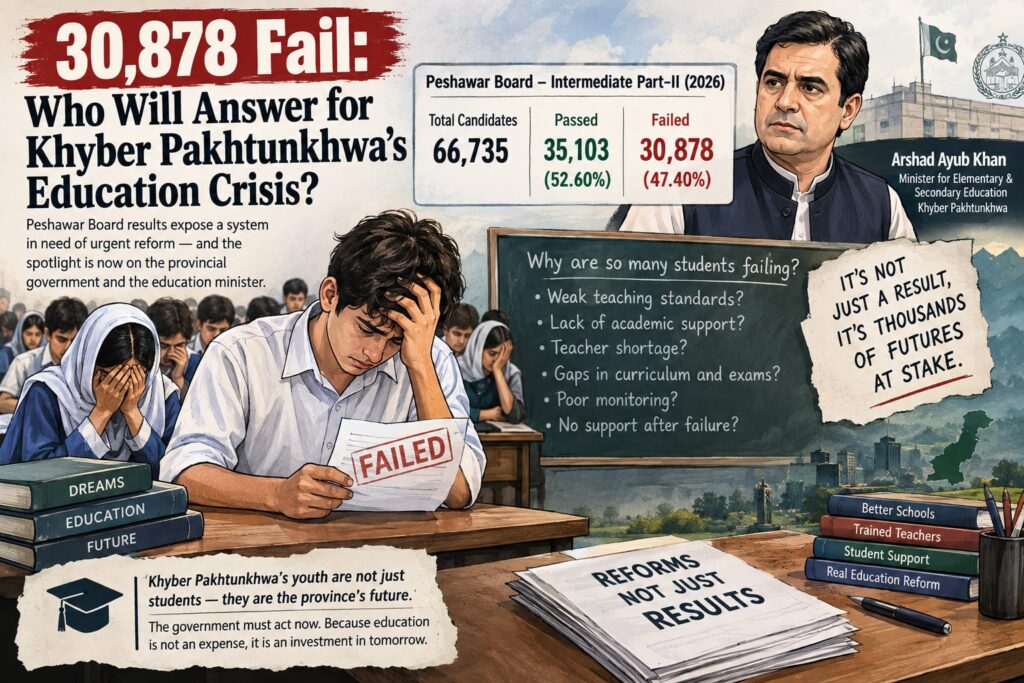
Which colleges are producing the weakest results? Which subjects have the highest failure rates? Are there institutions where poor performance has become a recurring pattern? Are teacher shortages contributing to the problem? Are students receiving remedial classes before examinations? And, perhaps most importantly, what happens to students after they fail?
A serious education policy cannot end with the publication of a result gazette.
Students who fail should not simply be left to repeat the same process without support. Remedial education, counselling, academic assistance and targeted programmes for weak students should become part of the response.
The government should also consider publishing a transparent assessment of the reasons behind the high failure rate. Parents deserve to know whether the problem lies primarily with attendance, teaching standards, curriculum delivery, examination preparation or other factors.
Khyber Pakhtunkhwa has a large and youthful population. Its young people are not merely students sitting for examinations; they represent the province’s future workforce, professionals, entrepreneurs and public servants.
Losing tens of thousands of students at the intermediate level is therefore not simply an educational statistic. It can become a social and economic concern if the underlying causes remain unaddressed.
The government has an opportunity to turn these disappointing figures into a reform agenda.
The education department should investigate the results, identify weak institutions, strengthen teacher support, introduce targeted remedial programmes and publicly report what corrective measures will be taken.
The question facing the provincial education leadership is not simply how many students passed or failed.
It is this:
If 30,878 young people have failed at one of the most important stages of their education, what will the government do differently to ensure that next year’s result tells a different story?
That is the question parents, students and taxpayers deserve to have answered



If the system does not in heritage an independent, fair and balance scrutiny system. This is is the result. All stake holders are responsible for such failure. The provincial government is in power over the decade. They must answer to the public about the outcome failures.