By FT Correspondent:
QUETTA—Balochistan Governor Jaffar Khan Mandokhail has hailed the improvement in the University of Balochistan’s ranking and scoring from 42 percent to 82 percent, describing it as a remarkable achievement that reflects effective leadership, improved administrative strategy, and continuous enhancement in academic standards.
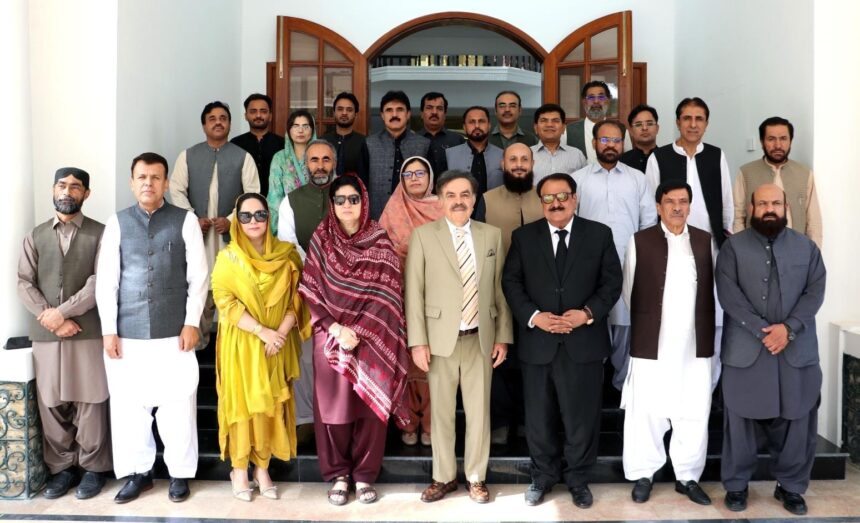
He expressed these views while chairing the 13th Senate meeting of the University of Balochistan, attended by Chief Justice of the Balochistan High Court Justice Kamran Khan Malakhail, Provincial Education Minister Raheela Hameed Khan Durrani, Vice Chancellor Dr. Zahoor Ahmad Bazai, senior government officials, and members of the university senate.
The Governor urged the Vice Chancellor and his team to continue focusing on improving academic quality, reducing unnecessary expenditures, and strengthening financial discipline. He noted that the University of Balochistan is the first university in the province to implement a completely paperless administrative system under its digital transformation initiative, calling it an environmentally friendly and exemplary achievement.
Mandokhail also announced plans to make the Governor’s Secretariat paperless and to extend the successful model to all public sector universities across Balochistan. He further emphasized the need to strengthen collaboration with industries, pharmaceutical companies, agricultural research institutions, and other sectors to increase the university’s revenue through research, innovation, and employment opportunities. He also announced a special letter of appreciation for Director IT Muhammad Salal Khan in recognition of his contribution to the digital transformation initiative.
Addressing the meeting, Chief Justice Justice Kamran Khan Malakhail said that while the introduction of the BS programme was an important step in modernizing higher education, the discontinuation of FA and BA programmes had deprived thousands of private candidates of access to higher education. He stressed the need to restore educational opportunities for private students so that everyone, regardless of financial or social circumstances, can pursue higher education.
The Senate meeting concluded with several important decisions and recommendations aimed at further improving the university’s academic, administrative, and financial performance