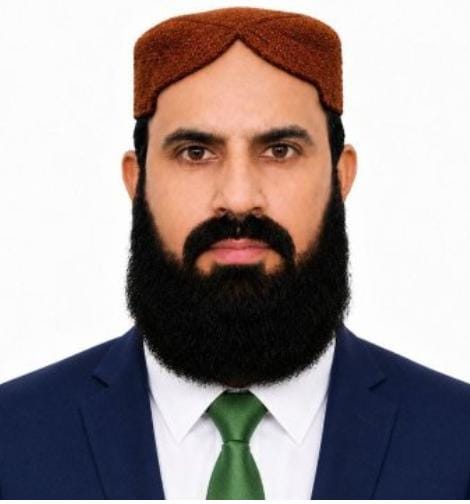
By: Mansoor Nizamani : Teacher and Columnist
In Pakistan’s politics, there are certain leaders who know how to maintain their political relevance, whether they are in government or in opposition. Maulana Fazlur Rehman is one such politician who holds an important position in the country’s political landscape because of his political strategy, parliamentary experience, and religious vote bank. Whenever tensions between the government and the opposition intensify, Maulana’s role is not limited to making statements; he also knows how to influence the direction of political developments. His strong stance on the imposition of governor’s rule and emergency rule in Khyber Pakhtunkhwa is another link in the political developments currently dominating the media.
Maulana Fazlur Rehman’s grievances against the federal government are not merely a protest against an administrative decision. They raise several questions concerning constitutional powers, provincial autonomy, law and order, and political interests. Among the most important questions are: First, what should be the solution if law and order deteriorate in a province? Second, can terrorism be eliminated by removing an elected government and imposing emergency or governor’s rule? Third, would such an extreme measure not deepen public distrust of the state? These questions are not limited to the politics of Khyber Pakhtunkhwa; they are also linked to the future of Pakistan’s federal system.
Maulana has repeatedly stated in the media that before taking extraordinary constitutional measures against an elected provincial government in the name of counterterrorism, a serious debate should have been held in Parliament. He argues that although maintaining law and order is the responsibility of the state, fulfilling that responsibility also requires respect for constitutional limits and the authority of elected representatives. If withdrawing powers from a provincial government is considered a solution to the problem, it must be clearly explained how such a step would practically contribute to eliminating terrorism.
Maulana’s questions about the situation in Balochistan have also become a subject of media debate. According to him, if the presence of terrorism is considered a justification for imposing governor’s rule in a province, why is the same standard not applied to Balochistan, where terrorist incidents have also been occurring at a serious level? However, this is Maulana’s position, and the circumstances of the two provinces, including their constitutional and administrative realities, may differ. Therefore, any decision should be assessed on the basis of facts and legal standards rather than emotional statements. The real need is for the federal government to clarify the constitutional grounds for such a measure and explain what results it expects to achieve.
In his political speeches, Maulana Fazlur Rehman also frequently refers to the sacrifices made by workers of Jamiat Ulema-e-Islam (JUI) in the struggle against terrorism. According to him, party workers have suffered casualties in the fight against terrorism, and it would therefore be unjust to view the entire party with suspicion or associate it with sympathy for terrorists. His argument deserves serious consideration because collective accusations against political parties should be avoided. Allegations must instead be based on specific incidents and credible evidence. At the same time, the sacrifices made by any political party in the fight against terrorism should be acknowledged. This is an important principle of democratic politics.
Maulana is also demanding an in-camera session of Parliament. He argues that many matters relating to national security cannot appropriately be discussed publicly in full detail. However, this does not mean that elected representatives should be kept unaware of the situation. Parliament should be taken into confidence regarding security policies, the outcomes of military operations, conditions in affected areas, and the strategies adopted to eliminate terrorism. Such a process could not only help build political support for government policies but also provide an opportunity to identify their weaknesses and shortcomings.
On the other hand, government members have accused Maulana of being unhappy because he was not given a share in the exercise of power. However, such allegations cannot be judged on the basis of political statements alone. Political leaders undoubtedly have their own interests, but it is equally inappropriate to dismiss every disagreement as a matter of personal resentment. Maulana’s position should be assessed on the basis of his demands, political activities, and constitutional arguments. If his objections are based on principles, the government should respond to them with reason and evidence. If political calculations are also involved, these too deserve consideration. Ultimately, the federal government is responsible for addressing the issues within its authority.
Maulana Fazlur Rehman’s increasingly sharp criticism of the federal government certainly signals a new phase of political tension in Pakistan. However, preventing this tension from turning into a national crisis is the responsibility of the country’s political leadership. The government should not dismiss the opposition’s questions as mere political resistance. At the same time, Maulana and other political leaders should present their positions through evidence, constitutional arguments, and practical proposals.
At present, Pakistan needs serious dialogue rather than accusations, the supremacy of law rather than displays of power, and national consensus rather than political confrontation. The fight against terrorism does not belong to any single government or political party; it is a struggle for the entire nation. Success in this struggle cannot be achieved through political retaliation but through a coordinated national strategy, political cooperation, and public trust. This is the need of the hour.