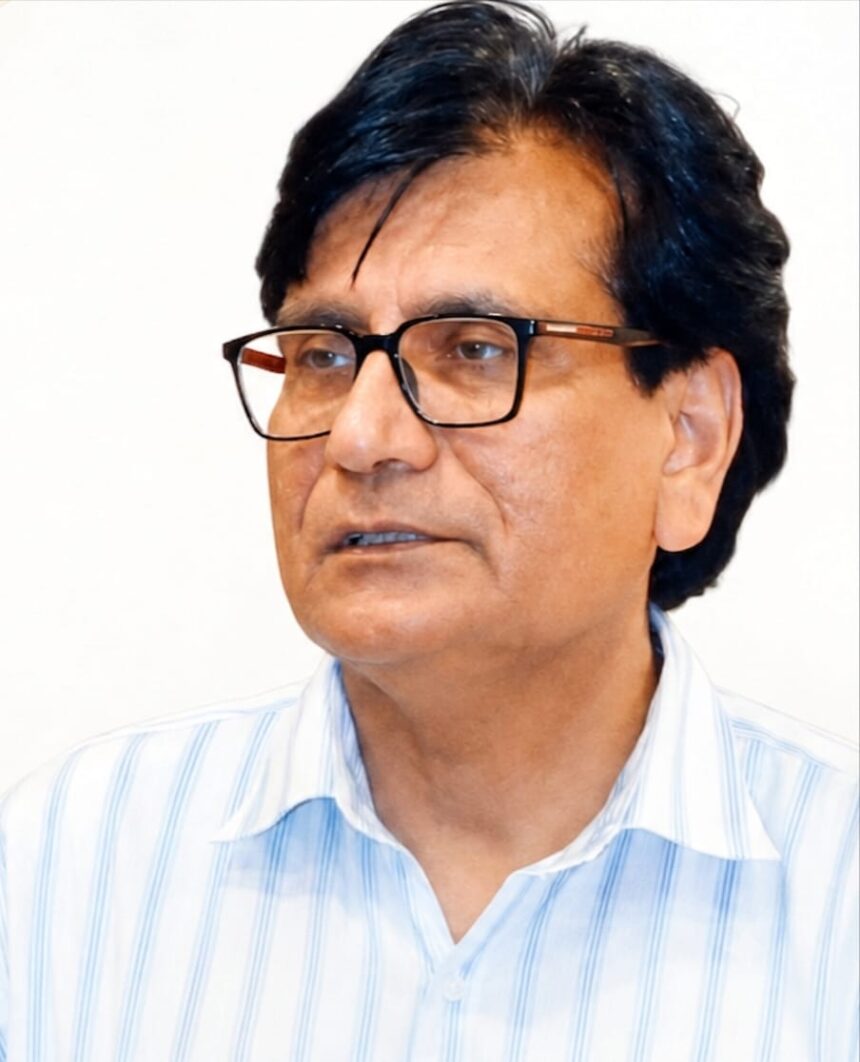
By: Dr Nasser Hussyn Bukhari
Published By: ANI News Agency
A nation can build motorways, airports and glittering towers without building prosperity. Concrete and steel are the visible symbols of development; the less visible foundations are the rule of law, institutional predictability, accountability and civic responsibility. Without those foundations, infrastructure remains an impressive shell rather than a durable engine of national progress.
My stay in China and Canada for my PhD, as well as my participation in international conferences in several other developed countries, gave me an opportunity to observe societies beyond their universities, laboratories and conference halls. What impressed me most was not simply their modern infrastructure, impressive buildings, advanced technology or material prosperity. It was the discipline behind everyday life: respect for law, adherence to rules, institutional predictability and a strong sense of civic responsibility.
These experiences often made me reflect on Pakistan. We frequently ask why countries such as Canada, the United States and China have achieved remarkable economic and institutional progress while Pakistan, despite its considerable human and natural resources, continues to struggle with governance, accountability and public order.
The answer does not lie simply in wealth. Nor does Pakistan lack talent. Our scientists, doctors, engineers, academics, entrepreneurs and professionals have excelled around the world. Pakistanis often perform exceptionally well when working within systems that reward merit and provide predictable rules.
The more fundamental difference is institutional.
In developed societies, laws are generally understood as the framework within which public and private life must operate. Citizens may disagree with particular regulations, but there is a broad recognition that rules cannot simply be ignored whenever they become inconvenient. Institutions are expected to enforce them, and individuals are expected to comply.
Pakistan has no shortage of laws. Our difficulty lies in their consistent implementation.
A traffic signal has little value if drivers regard it as optional. Building regulations become meaningless if violations can be regularised through influence. Tax laws cannot produce sufficient revenue if obligations can be avoided through connections. Anti-corruption measures lose their deterrent effect if accountability is perceived as selective.
This gap between law and practice is one of the most serious obstacles to Pakistan's development.
We have gradually developed a culture in which finding a way around a rule is sometimes regarded as cleverness rather than wrongdoing. A queue can be bypassed through influence. A government office can be approached through a personal contact. A regulation can be negotiated. Public property can be treated as though it belongs to nobody.
Individually, these acts may appear minor. Collectively, they weaken the foundations of the state.
When citizens believe that rules apply differently to different people, trust in institutions declines. When connections become more important than merit, capable people become discouraged. When regulations are unpredictable, businesses hesitate to invest. When public officials are not adequately accountable, citizens lose confidence in the state.
The rule of law is therefore not merely a constitutional or judicial issue. It is an economic necessity.
My experience in Canada made this particularly apparent. Everyday life functions with considerable predictability because people generally know what the rules are and expect them to be enforced. On roads, in offices, at universities and in public spaces, individual convenience is balanced against the collective interest. Canada is not without its challenges, but institutional predictability reduces uncertainty and allows citizens and businesses to plan with confidence.
China offers Pakistan a different but equally relevant lesson. Its political system is very different from those of Canada and the United States, yet its economic transformation demonstrates the importance of long-term planning, continuity, administrative capacity and implementation. The lesson for Pakistan is not to copy China's political model, but to recognise that national development requires policies that survive political cycles.
The United States provides another institutional lesson. Its political system is often contentious, but constitutional and legal mechanisms provide checks on public authority. Courts, legislatures and other institutions play important roles in holding power accountable. Again, Pakistan need not reproduce the American system. The broader principle is that institutions must be strong enough to restrain power and resolve disputes through lawful means.
These countries differ greatly, yet their experiences point towards a common principle: sustainable development requires institutions that function beyond personalities and governments.
Pakistan has spent too much time looking for individuals who can solve institutional problems. We repeatedly search for the strong leader or administrator who will transform the country. But no individual can permanently substitute for strong institutions.
A country cannot be built around personalities. It must be built around rules.
Pakistan's reform agenda must therefore become practical. Equality before the law should be enforced regardless of social or political status. Government procedures should be simplified and digitised to reduce unnecessary discretion and opportunities for rent-seeking. Police, local government and other public-facing institutions need professionalism, measurable performance and accountability.
Economic and development policies should have continuity beyond electoral cycles. Priorities such as education, exports, energy, water, industrialisation and human capital require long-term institutional ownership. Merit must guide recruitment and promotion in public institutions, while accountability should be timely, transparent and subject to due process.
Reform must also reach society itself. Schools should cultivate civic responsibility as a habit, not merely teach it as a chapter in a textbook. Respect for traffic laws, public property, queues, contracts, taxes and the rights of others should become part of everyday citizenship.
These changes may sound less dramatic than a motorway, a new airport or a major economic package. Yet they are more fundamental.
A motorway is not the full measure of progress if traffic rules are ignored on it. A new hospital means little if access depends upon influence. A new university is not enough if merit is compromised. An industrial zone cannot fulfil its potential if investors face unpredictable regulations. A modern government building is of limited value if citizens still require connections to obtain routine services.
Real development begins when ordinary people can trust institutions.
Pakistan possesses the talent, resources and ambition necessary to prosper. What it needs is a system capable of converting those strengths into sustained national progress. That requires equality before the law, institutional continuity, merit, accountability and a culture in which rules are respected even when breaking them appears easier.
My experiences in China, Canada and other developed countries have left me with a simple conclusion: the visible symbols of development are built with concrete, steel and technology, but the foundations of development are built with law, discipline, integrity and responsibility.
Pakistan's greatest national project should therefore be more than building infrastructure. It should be building institutions that citizens can trust.
The real test is simple: can an ordinary Pakistani obtain justice without influence, a public service without a connection, start a business without paying a bribe, compete on merit and expect the law to protect him or her equally?
If the answer gradually becomes yes, Pakistan will not merely look more developed. It will actually become more developed.
Only then can the country's enormous potential be converted into lasting prosperity.