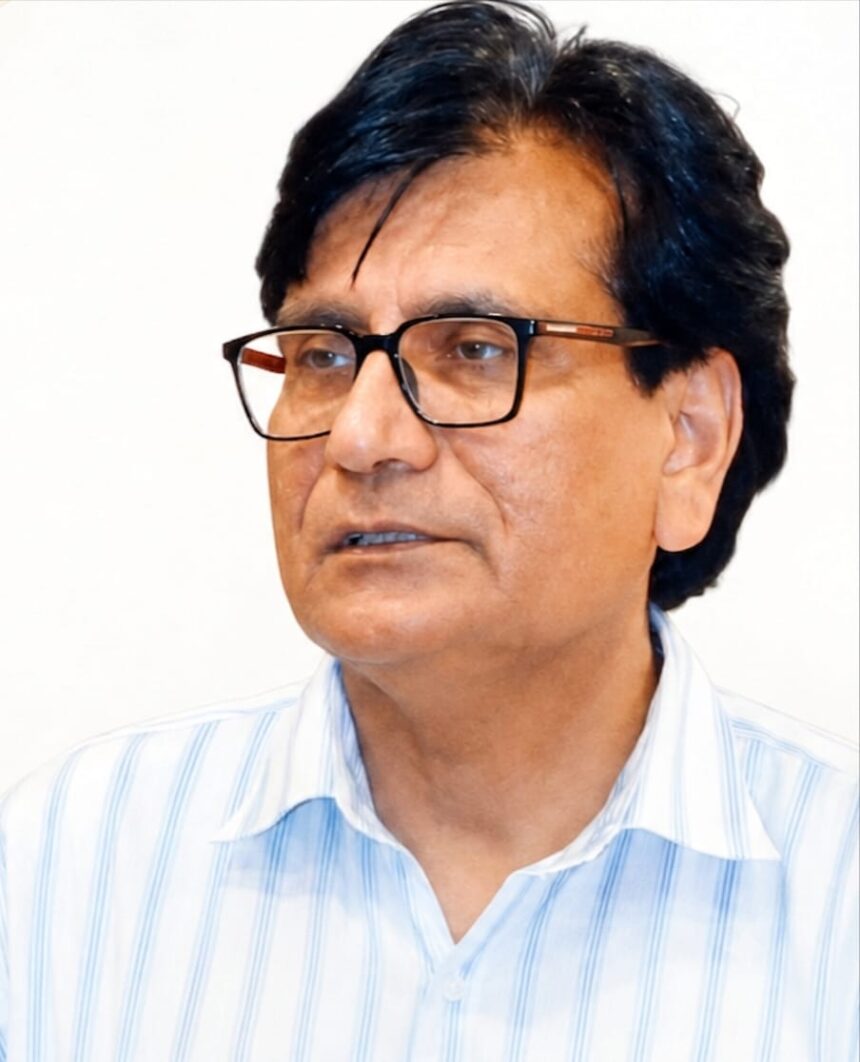
By: Dr. Nasser Hussyn Bukhari
Publishing By:ANI News Agency
My previous column entitled "When Narrative Becomes a Cage" highlighted that the young generation and students of Karachi are suffering due to the narrative of "superiority complex" instilled in their minds by a lingual political party. That argument, however, described only one layer of a larger problem. The latest examination data invite a more analytical question: why do so many confident, well-resourced candidates fail in competitive examinations, and why is the pattern not confined to a single city?
The figures are hard to ignore. Of 12,792 candidates who appeared in the CSS 2025, only 342 cleared the written stage and just 170 passed the interview. No Karachi candidate appeared among the first 150 positions, while rural Sindh secured a place in the top three, two in the top 50 and four in the top 100. Karachi's first successful candidate stood at 154th. In the MDCAT 2026, the city likewise missed the top 20. The quota system cannot explain this, since quotas operate only at the posting stage. Merit positions reflect individual scores alone.
Educational psychology offers a better explanation. The first concept is the Dunning-Kruger effect: people with limited mastery of a subject tend to overestimate their competence, precisely because they lack the knowledge needed to recognise their own gaps. A student repeatedly told he is destined for the civil service has little reason to test that belief against reality. The second is the illusion of fluency. Polished coaching notes and neatly packaged lectures make material feel familiar, and familiarity is mistaken for mastery. Research on retrieval practice shows that durable learning comes from effortful self-testing, not passive re-reading, yet passive consumption is exactly what many urban students are sold.
Third, Carol Dweck's distinction between fixed and growth mindsets is instructive. A candidate who has been taught that he belongs to a superior community, or is naturally brilliant, internalises ability as a fixed trait. Struggle then becomes a threat to identity rather than a normal part of learning, so he avoids difficult material and explains failure by blaming paper-setters or "the system." Finally, Bandura's work on self-efficacy distinguishes genuine confidence, earned through mastery experiences, from inflated confidence that has never been tested. The former sustains effort; the latter collapses on first contact with a demanding examination.
These dynamics are reinforced by what may be called the academy mafia. Across Karachi, Lahore, Islamabad, Rawalpindi and other urban centres, a lucrative coaching industry has grown around competitive examinations. Its business model depends on selling aspiration. Glossy advertisements display toppers' photographs, promise guaranteed success and portray the civil service as a birthright for the city's educated youth. Fees are steep, batches are crowded, and the product is often a bundle of memorised notes, guess papers and motivational speeches rather than analytical training. Because the academy profits from enrolment rather than outcomes, it has little incentive to deliver unwelcome news. A struggling student is encouraged to continue, to buy the next course and to attempt again.
The psychological consequence is serious. Candidates are fed false hopes and a sense of entitlement, and their expectations drift away from their preparation. Selective reporting compounds the problem, since the few who succeed are celebrated while the many who fail vanish from the record. Students therefore misjudge their odds, much like gamblers who recall only the winners. Confirmation bias does the rest: warnings about weak writing skills or shallow conceptual understanding are dismissed, while flattering feedback is remembered.
It would be wrong to confine this critique to Karachi. Urban candidates elsewhere share the predicament, and the explanation is structural rather than ethnic. Cities offer coaching centres, libraries and social capital, and these advantages generate a presumption of superiority. Yet resources are not results. A candidate from a small town or village, lacking glossy academies, often has no illusions about the odds. He studies longer, tests himself against past papers, and treats the examination as a mountain to be climbed rather than a formality. Hunger, in this case, is an educational asset.
Karachi, admittedly, carries an additional burden. Years of ethnic militancy, curfews and politicised institutions weakened its schools, and a narrative of cultural superiority took root in the vacuum. But that history should not become an alibi. The students of today did not inherit the guns; they inherited the complacency, and complacency can be unlearned.
What, then, should change? Parents should demand evidence of results from academies instead of trusting advertisements. Educators must teach analytical writing, conceptual reasoning and regular mock testing in place of rote preparation. Regulators should require coaching businesses to publish honest success rates. Above all, students need calibrated feedback, honest assessments of where they stand.
The conclusion is not that urban candidates lack talent or ambition. Successful candidates work deliberately to build their futures, studying with discipline and humility. Those who fail also strive for success, and many work hard. But overconfidence, nurtured by false narratives and commercial incentives, stands between them and the result they seek. Ambition without honest self-assessment is merely hope, and hope alone has never cleared a competitive examination.