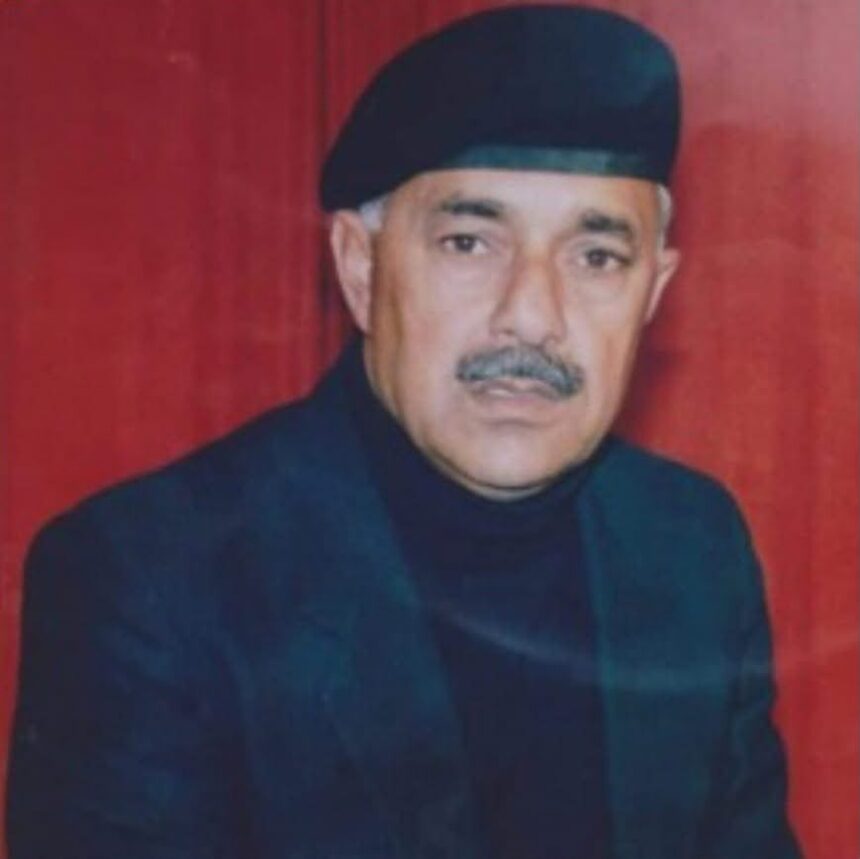
By: Rasheed Hasrat Rawalakot
Published By: ANI NEWS AGENCY
It must have been around March 1947. I was about six years old. I remember it like a dream that one day I was walking towards the city holding my father's hand, where he had his shop. In the bazaar I saw some uniformed men. Ordinary people were standing on the roofs of shops and houses around the bazaar, watching those uniformed men. There was more crowd in the bazaar than usual. I also climbed onto the roof of the shop with my father. My young age was unable to tell me what all this was about.
Suddenly a noise arose from one side, and a few jeeps were seen racing down the road. When those vehicles passed in front of us, I saw a very dignified man sitting in one jeep, with a small stick in his hand. Now whenever I see a very high-ranking army officer in uniform, I remember that dignified man from 1947 who was wearing a similar uniform.
My father, upon seeing that passing man, uttered a loud curse. The curse was muffled, heard only by me and one or two others. Looking at that dignified man with contempt, my father brought me down from the roof. When I asked, he told me that this is the ruler of Kashmir, Maharaja Hari Singh. What else my father said, I don't remember. I only remember that people were going towards the ground. What happened there, I also have no knowledge of.
A few days later, many people started coming to our house to meet my father, and he would talk to them for a long time. Father also started being absent from home frequently; in fact, sometimes when he went out, he even had a sword in his hand. Being a child, I could not understand what all this was. But I did have some feeling that something was happening, and what was happening, I was unable to understand at that time.
One morning early, two uniformed men came to our house… They called my father and took him away with them. In my consciousness there is only this much that he had been arrested. Because he was locked in the police station, which I know in this way that the servant who used to go to give him food, took me along with him two or three times. My father used to stroke my head standing behind thick iron bars. I remember that one day when I went to the police station, father was sitting in the veranda with many men. That day he loved me a lot. Perhaps because he had realized that he was loving his child for the last time. And perhaps he had also said that we are going to Poonch city, from where we will return soon. But I have been waiting for him for thirty years. He has not returned till now.
He said, "Don't be sad." And then he was seated in a closed vehicle and sent towards Poonch city. I remember that there was a white cloth on my father's face and he was telling us with hand gestures to go home. And perhaps there were tears in his eyes too. When I remember those ripe tears from his eyes, I writhe in pain.
On the third day after my father left, my uncle (taaya) was also arrested. I came to know much later that my uncle was an active member of the Muslim Conference and the Secretary General of Rawalakot. After my father's arrest, my uncle's arrest had such an effect on my grandmother's heart and mind that she could not bear the grief of separation from her children and after only eight days she passed away to meet her Creator. The distance from the graveyard to the police station was about two hundred yards. When my uncle got the news of my grandmother's death, he asked for permission to just see her face, which was not granted. Rather, even an attempt to bribe one hundred rupees per step was made, but those who used to take two rupees in bribe refused to take a large sum at that time, so that they could harass my elders as much as possible. And my relatives laid my grandmother to rest.
A few days later, there was a full-fledged rebellion in Rawalakot. The city was set on fire. Our houses also came under that fire. We had no choice but to flee from our homes and we fled in a state of destitution wherever we could. Where we stayed during this period, what happened to us, I do not remember well. But what I do remember is also a long story which has no connection with the present story, so I will keep it for another time.
My father was arrested. There were many people with him, many of whom returned after some time. Those who returned told that many of their companions were killed on the way by Sikhs and Dogras. From a few of those people it was learned that father is imprisoned in Poonch jail.
On April 28, 1948, a fellow prisoner of my father, Captain Afsar Khan of Horna Maira, brought a letter written in his hand, in which it was written that "We seven companions are still in Poonch jail. Some people have been released. Some have been transferred to Jammu and Srinagar jails. We do not know our fate. Only God knows better about us what our end will be. If life remains loyal, we will meet, otherwise goodbye."
Three days after this letter, information was received that Poonch jail has been vacated for soldiers and the prisoners have been sent to Jammu jail. After that we kept getting unconfirmed reports of my father being in those jails from Jammu, Kathua and Srinagar. We kept waiting, time passed, and in this way ten years passed. In 1958, a person came from Bombay who had stayed there at the time of partition of India. He said that I had met some people from that area in a government mill in Bombay, where those people had been sent for six months of hard labor. That person had never seen my father before. He was shown a group photo of our family, and in the blink of an eye he put his finger on one picture saying that I met this person there. He had put his finger on my father's picture. Then I wrote countless letters to the address told by that person. But in response to the letters, I got nothing but no answer. I could not go myself because the walls on the way were very high.
A year later, a few Pathans who had been arrested from the Sialkot border and imprisoned in Srinagar jail were released and came back, then through them our relative got information that some prisoners from Rawalakot are in Srinagar jail. I wrote several letters to the address told by them but I did not get a receipt for any letter.
Another year passed and I met a man who had been arrested while crossing the border from Nikial and was sentenced to six months imprisonment in Indian-occupied Kashmir, which he served in Srinagar jail. He told that he had met my father in jail. My father had also mentioned receiving my letters to him. But I could not contact my father in any way.
In 1962, the Government of Azad Kashmir sent an application regarding my father through the Ministry of Kashmir Affairs to the Pakistani Embassy in Delhi. Three months later, the reply to this application was received that there is no prisoner by that name in any jail of the state of Jammu and Kashmir. This reply snatched away our last hope that my father is alive.
After the 1971 war, the exchange of prisoners of war began, then a list of prisoners was sent by the Indian government to the Government of Pakistan, in which there were names of some old prisoners as well. During the same time, a letter from Mirza Afzal Beg was published in newspapers that a writ has been filed in the court for some prisoners from Poonch who have been in jails for a long time. I checked all the lists that were officially published. No doubt there were names of people who resembled my father's companions. But I still could not get correct information about my father and my disappointment began to touch the limits of distress.
After some time, hope once again stirred when information was received that on April 1, 1974, all civilian prisoners are arriving from India via Wagah to Pakistan.
I came to Lahore and reached Wagah with some friends. All relatives were waiting for some good news but that news could not be found. We were stopped a few miles before Wagah. We returned disappointed. When the prisoners started arriving in Lahore, we reached near the camp where the prisoners were to be kept. But here again we had to face failure. The police did not let us go near the camp. There were many people like me there who were searching for their missing loved ones. I also joined them.
I gave my name and address to a soldier from Kotli who was posted in the guard. He went inside the camp and after some time came back and told that Altaf Hussain, my father's name, is offering prayers. Come near the window, I will call him. I reached near the window when a police officer started using his stick to remove people from the window. Some people moved away. When he came near me and instructed me to leave the window with his stick, I held the police officer's stick in my hand and said, "Fear God, for 26 years these eyes have been yearning to see my father. Now some hope has arisen and you are so stone-hearted that you are not allowing me to stand here for a few minutes." The officer's reply was as expected: "Go away." But I had become emotional and the tears flowing from my eyes were representing my heart and mind. Hearing my reply that "Now only death can move me from this place," that officer moved away.
The police soldier came near the window and signaled to me that Altaf Hussain is coming just now. With a pounding heart, I held my father's photo in my hand so that it would be easy to recognize because in my mind there was a very blurred image of his face. Only a short time had passed when a man came and stood in the window and asked loudly who has come to meet Altaf Hussain and I moved forward in passion and frenzy. I looked at that man — his features, body, stature — nothing matched my imagination. As eagerly as I had moved forward, I retreated with as much disappointment. My eyes were filled with tears. A short while ago they were tears of joy and now of sorrow. I wiped my tears and said to that person, "Forgive me, I made a mistake, by the way, where are you from?" That person said that I am from Mandi Bahauddin, and I moved away from the window.
After some time, permission was granted to meet the prisoners. I went inside. Some people were from my area. I asked them about my father. Everyone answered that we have been in different jails in India but we have not seen any man of that name or appearance. One person was listening to our conversations separately. After hearing my story, he came near me. He told that there were four such prisoners with us whose appearance showed that they were from some area of Azad Kashmir but they could not tell anything about themselves. Their mental balance was not correct; rather they were also dumb and deaf. Our government refused to accept them because they could not tell anything about themselves. They have been handed back to India. I came back to my friends, but the whole night I was troubled by the thought of how much cruelty man has inflicted on man that some people could not maintain their mental balance. It is possible that their tongues were closed due to some torture and it is also possible that my father is also among those people.
This thought paralyzed my mind and I was lost in useless thoughts, one of which was that the government could have published pictures of those individuals. They could have been kept at the border and an announcement could have been made that those whose loved one is missing should try to identify those individuals. Perhaps one of them would turn out to be someone's light of eyes. Perhaps someone would find the lost crown of their head. Perhaps some helpless person would find some support. But who could think of those helpless humans whose mental balance undoubtedly did not remain because they were lovers of the freedom of their country and nation, whose tongues might have been branded only because they did not betray their nation… I wish someone, if not as a reward, would decide the fate of those individuals in the spirit of humanity. Sometimes I think of sending advertisements in the newspapers of occupied Kashmir and appealing in the name of humanity to those people who were part of the Poonch jail staff in 1948. Perhaps some of those people are alive who can tell what happened to those prisoners from Rawalakot — if they were martyred or died in some way, then where were they buried, so that someday standing on that heap of mud I can say that Baba, that mission is still incomplete for which you gave your life and if I cannot do anything else, at least I can raise two hands for fateha… I can offer a few flowers of devotion on his grave but…
Since I have gained consciousness, I have asked my mind many times why my father was made to disappear, why was he imprisoned, then I got the same answer that long before the partition of India, the people of the state were trying to get rid of slavery. The Dogra Raja had enslaved them. At the time of partition, the Raja wanted to hand over the state to India against the will of the people, so the people rebelled. In the Poonch area there was a majority of ex-soldiers. Here the movement against the Raja was very strong. A secret movement was also established. My father was holding an important position in this movement. To end this organization, a program of arresting and making its leading members disappear was started, and my father also fell victim to it. I have no desire for any reward for this great sacrifice of my father, but I do have this wish that I wish someone would tell me where my father is lost, in what environment he is lost… In this way perhaps my weak heart may get some peace.