Written By:Syed zulfiqar ali shah
Published By:ANI News Agency
For an ordinary Pakistani, falling sick is not only a medical problem. It can quickly become a financial, emotional and even social crisis.
For families who cannot afford expensive private hospitals, government hospitals are often the only realistic option. These hospitals are expected to provide affordable treatment to everyone, regardless of income. But for many patients, reaching a public hospital is only the beginning of another struggle.
Long queues, overcrowded wards, limited diagnostic facilities, unavailable medicines, poorly maintained equipment and shortages of doctors and other healthcare workers are problems that patients encounter far too often.
The issue is not that Pakistan lacks doctors or hospitals altogether. The deeper problem is whether the healthcare system is able to make those resources available to patients when and where they need them.
The Pakistan Economic Survey 2025-26 lists 1,934 hospitals and 5,746 basic health units in the country, while public health expenditure was only around 0.8 per cent of GDP in FY2025. The numbers show the size of the healthcare network, but numbers alone cannot tell us whether a patient receives timely and quality treatment.
Walk into a busy public hospital and the reality becomes much easier to understand.
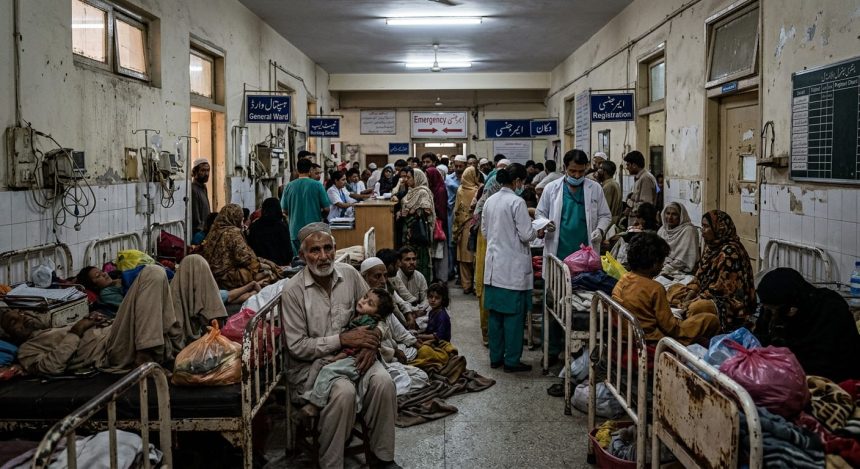
A patient may arrive early in the morning and still spend hours waiting to see a doctor. In emergency departments, dozens of people may be waiting at the same time. Doctors and nurses are expected to manage large numbers of patients, while families struggle to find beds, tests or medicines.
A 2026 study of selected tertiary hospitals in Rawalpindi found that public hospitals had a median emergency department patient volume of around 320 patients a day, compared with 210 in the private hospitals included in the study. The research also identified continuing gaps in diagnostic readiness and support services.
Behind every statistic is a person.
It may be an elderly man who has travelled from a distant village for treatment. It may be a mother waiting with a sick child. It may be a daily wage worker who has already lost a day’s income simply by coming to the hospital. For such people, spending hours waiting is not a minor inconvenience. It can mean losing wages, arranging transport again or delaying other essential responsibilities.
Then comes the issue of medical equipment.
A machine can be purchased with a large public investment, but if it is not maintained, repaired or operated properly, its value to the patient becomes almost meaningless. A patient who is told that a diagnostic test cannot be performed because equipment is unavailable or not functioning may have no option except to go to a private laboratory.
That is where affordability becomes a serious concern.
Pakistan has a large population of people who are neither extremely poor nor financially secure. They may be able to manage routine household expenses, but an unexpected medical bill can quickly consume their monthly income. When a government hospital cannot provide a required test, medicine or procedure, the family is pushed towards private healthcare, where costs can become overwhelming.
Cleanliness is another issue that should never be treated as secondary.
A hospital is supposed to be a place where patients recover, but poor sanitation and weak infection control practices can create additional risks. Research examining public-sector hospitals in Punjab has identified gaps involving staffing, cleaning systems, infection control monitoring and bed occupancy.
The problem, however, should not be reduced to blaming doctors.
Doctors working in public hospitals often face enormous pressure. A shortage of specialists, overcrowded departments, long working hours and limited resources can make it difficult for even committed medical professionals to provide the attention every patient deserves.
The government itself has acknowledged specialist shortages in Punjab’s public hospitals. Its Punjab Health Connect initiative specifically identifies persistent shortages of specialist doctors as a challenge and aims to bring additional specialists into public hospitals.
This points towards a larger issue: healthcare is not only about building hospitals. It is about keeping the existing system functional.
A new hospital may look impressive, but patients also need working diagnostic machines, sufficient doctors and nurses, medicines, clean washrooms, safe wards, reliable electricity, functioning laboratories and an effective system for maintenance and accountability.
Pakistan also needs to rethink how healthcare spending is prioritised. The country does need new hospitals where population growth demands them. But building new structures while existing hospitals struggle with maintenance, staffing and equipment does not solve the entire problem.
The government must now treat the condition of public hospitals as a matter of urgent public importance. Regular inspections, proper monitoring and a strong system of checks and balances are essential to ensure that hospitals are actually delivering the services for which public funds are allocated.
Hospital management should be held accountable for the condition of medical equipment, cleanliness, availability of medicines, attendance of doctors and staff, and the overall quality of patient care. Broken machinery should not remain unused for months, and shortages of doctors or essential medicines should not be allowed to become a routine matter.
There should also be a transparent mechanism through which patients can report problems and authorities can respond quickly. Monitoring should not be limited to paperwork or occasional visits. Government health departments need to regularly assess hospitals on the ground and take timely action where deficiencies are found.
Public healthcare requires continuous attention, not occasional announcements. If the government strengthens supervision, ensures accountability and allocates resources according to actual needs, government hospitals can provide the quality and dignity of care that ordinary citizens deserve.
What patients want is actually quite simple.
They want to know that when they reach a government hospital, a doctor will be available. They want the required machine to be working. They want essential medicines to be accessible. They want clean toilets and wards. They want to be treated with dignity rather than feeling that they are asking for a favour.
These are not luxury demands. They are basic expectations from a public healthcare system.
Pakistan’s healthcare debate should therefore move beyond announcements about new projects and large buildings. The real test is what happens inside those buildings every day.
A government hospital does not succeed because it has a large building or modern signboard. It succeeds when a poor patient enters its doors and receives timely, safe and dignified treatment without being forced to choose between healthcare and feeding the family.
For millions of Pakistanis, public hospitals are not simply another healthcare option. They are the last line of hope.
That is why improving them should not be treated as an administrative task. It should be regarded as a national responsibility.