BY:Asghar Ali Mubarak:Published by ANI News Agency
The armed forces of Pakistan regard the Kashmir cause as a fundamental pillar of the country’s foreign and security policy, consistently providing moral, diplomatic, and political support to the Kashmiri population.
The top leadership of the Pakistan Army categorically rejects India’s illegal and unilateral actions (abrogation of Article 370) of August 5, 2019. It has been reiterating its unwavering commitment to the Kashmir cause in every important meeting. The Kashmiris are given a clear message that the Pakistani nation and its army stand with them at every step in this struggle for freedom.
Remember that the stance of our military leadership on Kashmir has been firm. In the Corps Commanders’ Conference, we have always declared Kashmir as the jugular vein of Pakistan and have reiterated our continued moral and diplomatic support for the Kashmiris in accordance with the UN resolutions. According to the ISPR, while reviewing the situation in the region, the forum appreciated Pakistan’s positive role for dialogue and regional stability. Taking note of Indian rhetoric regarding the Indus Waters Treaty (IWT), the forum expressed its resolve to take all necessary steps to ensure Pakistan’s legitimate share of water, in line with the directives of the National Security Committee. Furthermore, the forum rejected human rights violations and Indian attempts to change the demographic balance in Indian Occupied Jammu and Kashmir (IIOJK), termed Kashmir as Pakistan’s jugular vein and reiterated its continued moral and diplomatic support to the Kashmiris in accordance with the UN resolutions.
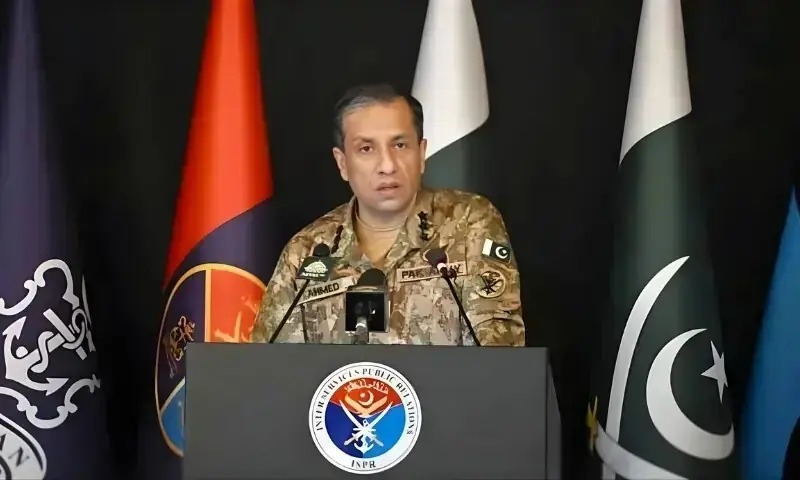
DG ISPR Lt. Gen. Ahmed Sharif Chaudhry has also made it clear in his media briefings that the resolution of the Kashmir issue in accordance with UN resolutions is essential for sustainable peace in the region. ISPR exposes the grave human rights violations, military siege and illegal detention of Kashmiri leadership in occupied Jammu and Kashmir to the world. Quaid-e-Azam’s calling Kashmir “the jugular vein” was not just an emotional statement, but it is a matter of Pakistan’s water security, geographical defense and survival. Pakistan’s military and diplomatic stance on the Kashmir issue in the United Nations (UN) is very solid, principled and in line with international laws.
Pakistan’s Foreign Ministry and Pakistani Missions to the UN have consistently emphasized that sustainable peace in South Asia is not possible without granting the Kashmiris their right to self-determination. Pakistan has also strongly reiterated this stance recently on the occasion of the annual report of the United Nations Security Council (UNSC). The most important military and diplomatic aspects of this long-standing position are as follows:
(Right to Self-Determination and UN Resolutions)
Pakistan’s basic position is that Jammu and Kashmir is a disputed territory. Its resolution should be through a free and fair plebiscite under UN Security Council resolutions.
(Reference to Article 25)
Pakistan has made it clear in the UN Security Council that India is violating Article 25 of the UN Charter, which obliges all member states to accept and implement the decisions of the Security Council.
(Shimla Agreement vs. UN Charter)
India often claims that this is a bilateral issue after the Simla Agreement. Pakistan, in response, cites Article 103 of the UN Charter, which states that obligations under the UN Charter take precedence over any bilateral agreement. (Demand for revocation of unilateral measures of 5 August 2019)
Pakistan has termed India’s move to abrogate the special status of occupied Kashmir (Article 370) as illegal at all UN forums.
Pakistan has made a strong case against the demographic changes in the occupied valley and Indian conspiracies to convert the local Muslim majority into a minority before the UN Human Rights Council and special observers.
(Defending the presence of UN observers)
Pakistan welcomes the United Nations Military Observer Group (UNMOGIP) along the Line of Control (LoC) and grants them full access.
India, for its part, has imposed restrictions on the movement of UN observers, which Pakistan terms an attempt by India to conceal the facts at international forums.
Pakistan maintains that the presence of UNMOGIP is proof that Kashmir is a globally recognized disputed issue.
(Response to aggression and strategic balance of the region, Military Position)
The Inter-Services Public Relations (ISPR) and the defense leadership of Pakistan are clear in their stance under the UN Charter that Pakistan has the full right to defend its territorial integrity.
Pakistan has termed the threats made by Indian defense ministers regarding Azad Kashmir as an attempt to sabotage the agenda of the UN Security Council.
Pakistan rejects Indian allegations and calls the ongoing struggle in occupied Kashmir not external terrorism but “internal and local resistance” (Homegrown Resistance), which is the legitimate right of the Kashmiris against decades of Indian occupation. Pakistani forces and diplomatic missions present the Kashmir cause with full force every year in General Assembly meetings, Security Council briefings, and on the platform of the Organization of Islamic Cooperation (OIC).
The roots of the current movement in Indian-administered Kashmir are linked to the struggle of the people for the exercise of the right to self-determination. New Delhi’s allegations of Pakistan’s assistance to the Kashmiris are baseless. Objective reports in foreign media bear witness to the fact that the Kashmiri protest is local. Pakistan upholds the right of the people of Jammu and Kashmir to self-determination as per the UN Security Council resolutions. These resolutions of 1948 and 1949 provided for a free and impartial plebiscite to be held by the people of Jammu and Kashmir to determine the future of the state. The Kashmir complaint was initiated by India in the Security Council. The Council, both explicitly and implicitly, rejected India’s claim that Kashmir is legally Indian territory. The resolutions established self-determination as the governing principle for the resolution of the Kashmir issue. This is the commitment of the world body to the people of Kashmir. The resolutions endorsed a binding agreement between India and Pakistan, brokered by the UNCIP, that the plebiscite would be held under mutually agreed and specified conditions. The Security Council rejected India’s claim that the Kashmiri people have exercised their right to self-determination by participating in “elections” that India has held from time to time in occupied Kashmir. Pakistan is abiding by UN resolutions. These are also binding on India. The Simla Agreement of July 2, 1972, to which Pakistan is also abiding, did not change the status of Jammu and Kashmir as a disputed territory: Para 6 of the Agreement lists “the final settlement of Jammu and Kashmir” as one of the questions awaiting settlement. Para 4 (ii) speaks of the “Line of Control” as distinct from the international boundary. Furthermore, it expressly protects “the recognized position of any party”. Pakistan’s recognized position is that which is generally recognized by the UN and the international community.
Article 1(iv) clearly refers to the Kashmir issue when it speaks of the “fundamental problems and causes of conflict which have deteriorated the relations between the two countries”. The Simla Agreement does not prevent the Kashmir issue from being raised in the United Nations. Paragraph 1(i) specifically provides that the Charter of the United Nations “shall govern” the relations between the parties. Paragraph 1(ii) provides for the settlement of differences by peaceful means and does not exclude the means of pacific settlement of disputes and differences provided for in the Charter of the United Nations. The issue of Kashmir continues to be a matter of concern to the Security Council of the United Nations, which is on the agenda of the Council. Articles 34 and 35 of the Charter of the United Nations specifically empower the Security Council to investigate any dispute independently or at the request of a Member State. These provisions cannot be made subordinate to any bilateral agreement. According to Article 103 of the Charter of the United Nations, the obligations of Member States under the Charter take precedence over obligations under a bilateral agreement. The presence of the United Nations Military Observer Group in India and Pakistan (UNMOGIP) on the Line of Control in Kashmir is a clear indication of the UN’s involvement in the Kashmir issue. Jammu and Kashmir is a disputed territory. It does not include the principle of respect for the unity and territorial integrity of states to which Pakistan adheres. Attempts to suppress the legitimate demands of the people of Jammu and Kashmir by force have failed. Similarly, threats of use of force have not affected Pakistan’s determination to uphold its principled position. Since the signing of the Simla Agreement, India has insisted that the issue is purely bilateral and should be resolved without any external intervention or mediation. India is so allergic to the issue in any international forum that it is necessary to recall India’s bitter reaction to Nelson Mandela’s mention of “Kashmir” at the 1998 NAM conference in South Africa. The issue came to the fore in May 1998, following nuclear explosions first by India and then by Pakistan, after which many had real hopes that international pressure would be brought to bear on India for a meaningful resolution of the Kashmir issue that has troubled both nations of the subcontinent and consumed their meager resources. One thing is clear: without the active interest of major powers in saving Kashmiris, India will never agree to any meaningful negotiations on Kashmir.