BY:Qurat ul Ain Ali Khawaja /
India is facing a moment of uncomfortable truth. For years, whenever political unrest, public dissatisfaction, terrorism, separatism, or social instability emerged within the country, the easiest explanation was often to point across the border and invoke Pakistan. But today, India is confronting a movement that is increasingly difficult to explain away through the familiar language of “foreign interference.” The streets are filled with India’s own students and young people.
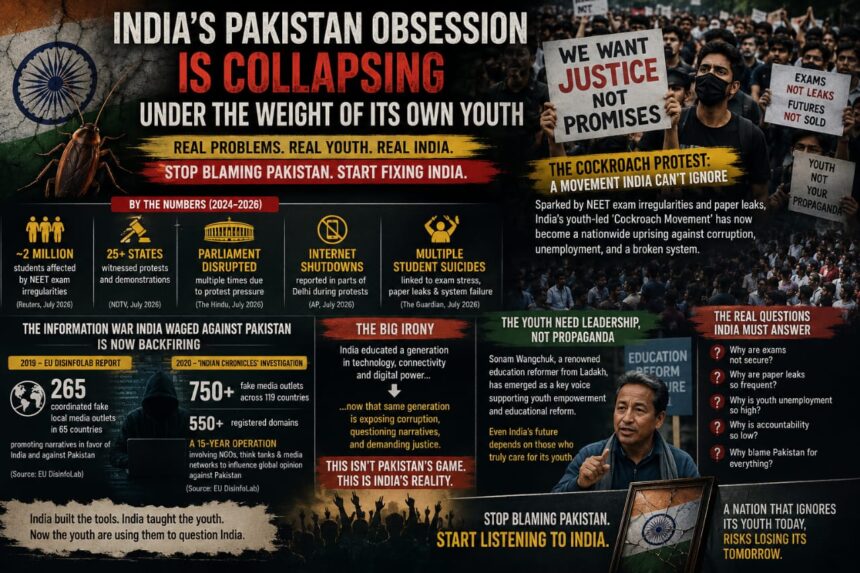
The questions are being raised by India’s own youth.And the crisis is unfolding within India’s own education and examination system. The ongoing “Cockroach” youth movement has emerged from anger over alleged irregularities and paper leaks surrounding highly competitive entrance examinations, particularly the NEET medical entrance examination. According to Reuters, the crisis has affected approximately 2 million students, while the protests have been linked to multiple student suicides and have evolved into a much broader movement demanding accountability, examination reform and action against systemic failures. The demonstrations have spread across major Indian cities, while reuters mentioned that the government has faced growing pressure from students, opposition parties and civil society.
The movement is no longer simply about one examination.
▪︎It is about trust.
▪︎It is about opportunity.
▪︎It is about the future of India’s youth.
▪︎Most importantly, it is about a generation that has grown up in the digital age one that can independently verify information, organise through social media, expose contradictions and communicate globally within seconds.
“This is precisely where India’s strategic miscalculation may lie. The Youth India Educated to Use Technology Is Now Using It to Question the System”.
India has invested heavily in portraying itself as a rising technological power. Its young population is increasingly connected, digitally literate and capable of organising beyond traditional political structures. But technology cannot be selectively controlled. A generation taught to use digital platforms, artificial intelligence, social media and online communication will eventually use those same tools to question institutions. This is the paradox India is now facing. The youth that was expected to become the country’s greatest economic and technological asset has also become its most powerful accountability mechanism.
The “Cockroach” movement reportedly began with online satire and digital mobilisation before developing into a nationwide youth-led protest movement. Demonstrations have expanded from examination grievances into wider concerns over unemployment, governance and economic opportunity. Reports indicate that authorities have responded with restrictions including metro closures and disruptions to mobile internet services in parts of Delhi, while protests have continued to attract national attention. The irony is striking: India spent years building a digitally empowered generation and now that generation is using the same digital power to demand answers.
“The Cost Is Not Merely Political—It Is Institutional and Economic”
The immediate consequences of prolonged unrest are visible in disrupted education, interrupted examinations, demonstrations, restrictions on movement and pressure on businesses. But the deeper cost is institutional. When millions of students lose confidence in the fairness of examinations, the damage extends far beyond one test cycle. Families invest years of preparation and substantial financial resources in coaching and education. When examinations are cancelled, retaken or questioned because of alleged leaks, the consequences affect students, parents, educational institutions and the wider economy.
The crisis has reportedly affected around 2 million students, and the protests have become significant enough to disrupt parliamentary proceedings and put direct political pressure on the government.
For a country that frequently presents itself as a global education and technology hub, such a crisis carries an obvious reputational cost. Investors look at institutional stability. Businesses look at the quality of human capital. Families look at the credibility of educational pathways. And young people look at whether merit actually leads to opportunity. When trust collapses in any of these areas, the consequences cannot simply be blamed on an external enemy.
The Pakistan Narrative Is Becoming a Strategic Liability. For decades, India has frequently accused Pakistan of involvement in unrest and instability inside India. Pakistan has consistently rejected many of these allegations and has itself accused India of interference and destabilisation. But the strategic problem for India is this: If every internal crisis is automatically attributed to Pakistan, then the government risks becoming blind to its own institutional failures. A government that constantly searches for an external enemy may eventually forget to investigate the internal weaknesses that allowed the crisis to develop.This is precisely what appears to be happening in the current education crisis. Instead of immediately asking:
▪︎Why are students angry?
▪︎Why have examination systems repeatedly faced allegations of irregularities?
▪︎Why has the credibility of institutions been questioned?
▪︎Why are young people losing faith in the system?
The conversation is once again being diverted toward the question of Pakistan.
But Pakistan did not conduct India’s examinations.
Pakistan did not design India’s education bureaucracy. Pakistan did not create India’s examination infrastructure. And Pakistan cannot be held responsible for every institutional failure occurring inside India. If there is credible evidence of foreign interference, it should be presented transparently and investigated independently. But accusations without evidence cannot replace accountability.
India’s Information War Against Pakistan Also Deserves Scrutiny
This argument becomes even more complicated when India’s own international information operations are examined. In 2019, the EU DisinfoLab reported uncovering a network of 265 coordinated fake local media outlets across 65 countries, which it said served Indian interests and amplified narratives primarily targeting Pakistan.
In its subsequent “Indian Chronicles” investigation published in 2020, the organisation described what it characterised as a 15-year influence operation, identifying more than 750 fake media outlets covering 119 countries, alongside more than 550 registered domain names and a network involving NGOs and other organisations. According to the investigation, the operation sought to influence international opinion and undermine Pakistan’s reputation. According to EU DisinfoLab, these findings are allegations and conclusions of the EU DisinfoLab investigation, rather than a judicial determination against the Indian state as a whole, but they remain an important part of the international debate surrounding information warfare in South Asia. This history raises a serious question: If sophisticated information networks have previously been documented by independent investigators as targeting Pakistan, why should every domestic Indian protest automatically be presented as a Pakistani conspiracy?
The answer is simple:
Because blaming Pakistan is politically easier than confronting institutional failure. But easier does not mean strategically wiser.
India’s Biggest Mistake Was Underestimating Its Own Youth
India may have spent years attempting to shape narratives about Pakistan, Kashmir and terrorism, but it appears to have underestimated one crucial factor: Its own young population. Young people are not passive consumers of government narratives anymore. They compare information.They communicate internationally.They record events. They challenge official claims. They create their own media ecosystems. And when they believe that their future is at stake, they mobilise. The present movement demonstrates this transformation.
A protest that began around examination irregularities has reportedly grown into a wider challenge over unemployment, governance and accountability. Student leaders have continued to demand structural reforms rather than accepting temporary political assurances. That is why the current crisis should not be dismissed as a “Pakistan-sponsored protest.” Doing so risks missing the real story. The real story is that India’s youth are demanding ownership of their future. “Sonam Wangchuk” and the Uncomfortable Question of Educational Reform. There is another irony that India should consider. One of the prominent figures associated with education reform and youth mobilisation in the current movement is Sonam Wangchuk, an education reformer from Ladakh whose work has long focused on transforming education and empowering young people. His involvement underscores a larger reality: India’s education crisis is not merely a political dispute between India and Pakistan. It is an internal challenge that requires serious reform, innovation and accountability.
The fact that a prominent Ladakhi education reformer has become involved in a movement demanding better opportunities for India’s youth should encourage India to look inward rather than outward.
The question is no longer:
“Who is Pakistan supporting?”
The question is:
“Why do India’s own students feel compelled to protest for a fair education system?”
The Real Battle Is for Credibility.
India cannot simultaneously aspire to be a global technological and economic power while allowing public confidence in critical institutions to deteriorate.
A modern state cannot build world-class technology while failing to guarantee credibility in its examination system. It cannot promote digital empowerment while attempting to suppress digital dissent. It cannot demand international respect while dismissing legitimate questions from its own citizens.And it cannot blame Pakistan for every internal challenge while ignoring the institutional weaknesses that produced those challenges.
The current youth movement should therefore be seen as a warning not simply to the Indian government, but to any state that repeatedly substitutes external blame for internal reform. Pakistan does not need to manufacture India’s education crisis. Pakistan does not need to create India’s unemployment problem.
Pakistan does not need to organise India’s students. India’s own circumstances are sufficient to explain the anger visible on its streets.
“India Must Stop Looking Across the Border and Start Looking in the Mirror”
The strategic lesson for India is clear. Stop blaming Pakistan for every crisis. Start investigating institutional failures. Start rebuilding trust in examinations. Start protecting the future of students. Start listening to young people before frustration becomes alienation. And most importantly, start accepting that a country cannot become a global power by winning information wars while losing the confidence of its own citizens. The real defeat is not when another country criticises you. The real defeat is when your own youth stop believing in your institutions.
India now has a choice. It can continue searching for Pakistan behind every protest, every hashtag and every dissenting voice. Or it can finally acknowledge that its biggest challenge is not necessarily across the border. It may be standing right in front of it in the form of millions of young Indians demanding a future they can trust. Perhaps the time has come for India to stop blaming Pakistan and start confronting its own institutional failures. Because when a government spends years pointing fingers across the border, it may eventually forget to look at the cracks appearing at home. And today, those cracks are no longer hidden.
They are protesting in the streets.