BY: ANI Correspondent:
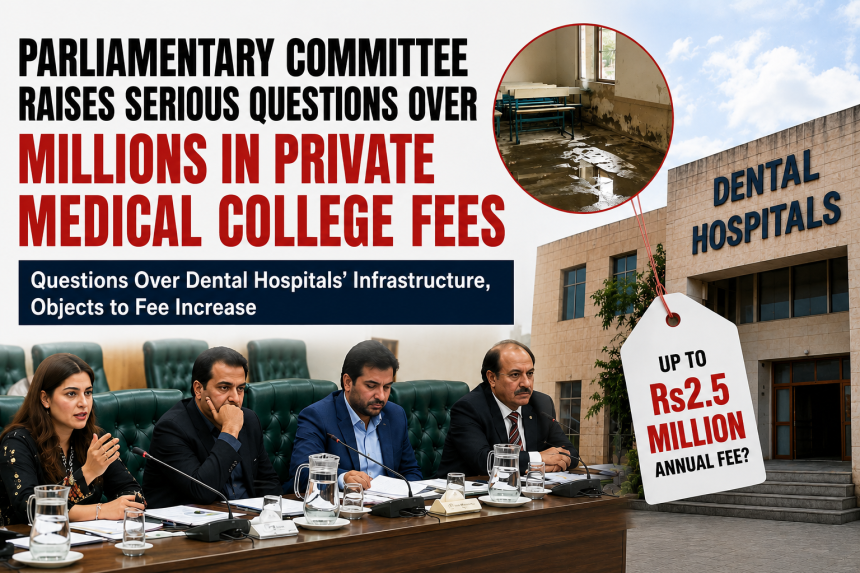
ISLAMABAD — A heated discussion was held at the National Assembly Standing Committee on National Health Services over high fees charged by private medical and dental colleges, with lawmakers questioning how ordinary families can afford annual fees running into millions of rupees.
Committee member Aliya Kamran objected to allowing fee increases for institutions whose facilities and records allegedly do not meet required standards. Referring to Rawal Institute of Health Sciences, she cited photographs showing alleged poor infrastructure and standing water in classrooms, questioning how such an institution could qualify for a fee increase.
The committee was informed that 61 private medical colleges had sought permission to charge above the Rs1.8 million baseline fee. After reviewing balance sheets, third-party audit reports and inspection reports, 35 colleges were declared eligible for fee enhancement. However, not all were permitted to charge Rs2.5 million, with fees for some institutions set at Rs1.9 million, Rs1.95 million and Rs2 million.
A disagreement also emerged over the link between high fees and vacant seats. PMDC officials said high fees were not the only reason for vacant seats, pointing out that some colleges charging Rs3.5 million had filled their seats. However, the Vice Chancellor of Jinnah Sindh Medical University said around 8,000 students who passed the MDCAT could not take admission because they could not afford the fees.
Committee member Gul Asghar Khan said private-sector medical education involved investment with expectations of returns and could therefore be considered a business. Other members disagreed, arguing that fees running into millions of rupees were beyond the reach of ordinary families.
Federal Minister for National Health Services Syed Mustafa Kamal defended differences in fees, saying institutions had varying facilities and educational standards. He added that some colleges hired foreign professors and provided additional practical training, resulting in higher operating costs.
The committee was also informed that the BDS programme is being extended from four to five years to meet international recognition requirements, which would place an additional financial burden on students. Members expressed concern that the additional year of fees could further increase vacant seats in dental colleges.
Aliya Kamran also questioned incomplete documentation and audit reports submitted by some colleges seeking fee increases. Committee Chairman Dr. Mahesh Kumar Malani directed the relevant authorities to provide complete details regarding fees, college standards, audit reports and vacant seats.
The committee stressed that reducing private medical college fees could enable more students to pursue medical education and help address the growing issue of vacant seats.