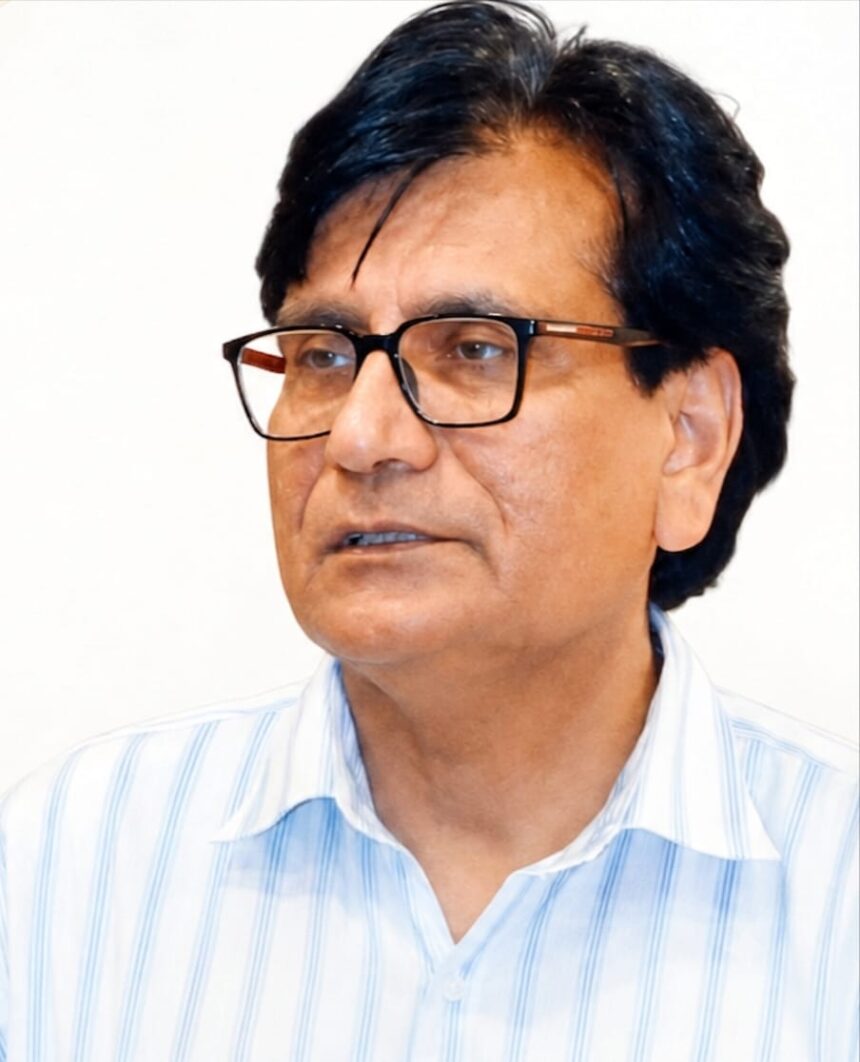
Dr. Nasser Hussain Bukhari : Published by ANI
On its 59th founding day, the Pakistan Peoples Party has reason for both remembrance and reckoning. Since its creation, the PPP has been a vehicle of struggle for democratic process, the supremacy of the Constitution, the sovereignty of Parliament, and the principle that the masses are the true source of power. Few parties in South Asia have paid so heavily for these ideas. Shaheed Zulfiqar Ali Bhutto went to the gallows, his sons Shahnawaz and Murtaza were lost to untimely and violent deaths, and Shaheed Benazir Bhutto was assassinated while campaigning for the people's mandate. The courage of Begum Nusrat Bhutto, who stood against dictatorship while her family was jailed, exiled and bereaved, deserves equal remembrance.
The PPP was founded on 30 November 1967 in Lahore because Pakistan's politics had hardened into rule by bureaucrats, generals and a narrow elite, while workers, peasants and the poor had no real voice. Its foundation documents condensed a vision into four principles: Islam is our faith, democracy is our polity, socialism is our economy, and all power rests with the people. Bhutto imagined a state where bread, clothing and shelter were treated as rights, where citizenship meant dignity rather than deference, and where politics belonged in the street and the village, not only in the drawing rooms of the powerful.
Judged by what he built in a few years, Bhutto's record is formidable. Politically, he gave ordinary Pakistanis a sense of ownership of the state, and workers and farmers entered public life. His government's crowning constitutional achievement was the unanimous 1973 Constitution, which established a parliamentary federation and fundamental rights. In education, he expanded access and founded institutions meant to reach those left behind, while in industry he laid foundations such as the steel mill and heavy engineering projects and strengthened labour's bargaining position. His foreign policy was boldly independent. After the 1971 trauma he secured the return of some 93,000 prisoners of war through the Simla Agreement, deepened friendship with China, brought the Muslim world together at the Lahore Islamic Summit of 1974, and set Pakistan on the path to strategic deterrence. Critics rightly note that nationalization was sometimes clumsy and that his government was not free of authoritarian excess. But the scale of his ambition remains unmatched.
When Zia-ul-Haq seized power in 1977 and Bhutto was judicially murdered in 1979, the question was whether the party would survive its founder. It did, because workers refused to surrender. Jiyalas endured lashes, jail and gallows, and families were broken in the name of "discipline." Under Begum Nusrat Bhutto and then Benazir Bhutto, the party became a movement of resistance whose central purpose was to keep the legacy of Shaheed Bhutto alive and restore the people's right to govern themselves.
Benazir Bhutto's personal ordeal under Zia was severe: imprisonment, solitary confinement in punishing conditions, house arrest and exile. Yet she returned on 10 April 1986 to a reception in Lahore of a size that dictatorship could not ignore. Elected Prime Minister in 1988, she became the first woman to lead a Muslim-majority country. In her two terms she promoted women's participation, with the Lady Health Workers programme and women's police stations as examples, expanded electrification and brought private investment into energy, and pursued reconciliation with a politically hostile establishment, though both governments were cut short. Under General Musharraf she again chose exile and then confrontation, and on 18 October 2007 she came home to a vast welcome in Karachi, only to face a terrorist attack on her procession. She continued campaigning anyway. On 27 December 2007 she was martyred in Rawalpindi, giving her life, like her father, for the democratic cause.
President Asif Ali Zardari's tenure from 2008 delivered the party's most enduring institutional legacy. The 18th Amendment restored the parliamentary spirit of the 1973 Constitution, stripped the presidency of the power to dissolve assemblies, and devolved authority to the provinces. Along with the 7th NFC Award, it recognized provincial rights that had long been denied. The Benazir Income Support Programme gave the poorest households a safety net. No honest critic can deny that the PPP strengthened Pakistan's federation. But reforms of this order are measured also by their administration, and the party's governance record, particularly in Sindh, invites hard questions about delivery.
Then came the emergence of Bilawal Bhutto Zardari, who as foreign minister projected a confident, articulate image of Pakistan abroad and spoke plainly about terrorism, climate disaster and multilateralism. Yet here lies the paradox of the PPP's story. A party with such a record of constitutional reform has gradually lost its stronghold in Punjab and Khyber Pakhtunkhwa, where it once commanded the loyalty of a generation. Constitutional achievement alone does not win votes; people respond to being heard, protected and respected. In these provinces the PPP is not absent but dormant, a presence on paper whose workers have grown disillusioned.
The way back is neither mysterious nor new. If Bilawal wants to revive the party, he must follow the legacy of Shaheed Bhutto and Shaheed Benazir in practice. That means respecting the workers, whose sacrifices built the party, and trusting sincere, tested leaders over those who flatter. It means reaching out seriously to Pakistan's Gen Z, a young, connected, impatient generation that wants jobs, merit and a voice, and meeting them with ideas rather than nostalgia. It means closeness to intellectuals and academia, whose engagement gave the party its early intellectual vitality. And it means restoring the founding balance between the capitalist class and the proletariat, because a party of the poor cannot be captured by the interests of the wealthy.
Shaheed Bhutto's advice to his daughter was that heaven lies under the feet of the masses. That is the party's compass. Bilawal's most valuable asset is not a title or a famous surname but the dormant army of workers who still carry the Bhutto name in their hearts. Too often, a circle of courtiers stands between leader and workers, keeping him from his real strength. If he breaks that distance and walks in the footsteps of the founder, the PPP can be revived where it is present but inactive. If he does not, the party risks becoming a heritage brand in a country that is moving on. On the 59th founding day, that is the choice before the PPP.
Dr. Nasser Hussain Bukhari is President of the Peoples Professors Forum Pakistan, a Member of the Research Working Group of PPP Central Punjab, and an analyst who writes on geopolitics and on global and national issues.