By: Sobia Ali
Published By: ANI News Agency
KARACHI: Karachi never sleeps, never waits and rarely looks back. Yet on a few old roads, time seems to slow down, allowing the city to remember its past.
Lined with old trees and graceful historic buildings, these streets have preserved their heritage through generations, even as the city around them continues to change. Here, old Karachi still breathes through arched windows, sun-worn stone and trees that have stood for decades. Its buildings have witnessed empires fade and generations pass, quietly holding on to the stories they have gathered along the way.
Follow one of these streets a little further, and an unassuming doorway leads to a flight of old stairs. Climb them, and they seem to guide you gently into another time. At the top, a small, old-fashioned door opens onto a space filled with the fragrance of books, art and free-thinking minds.
This is Theakada, and it welcomes you.
In an age when everyone seems busy and attention spans have shrunk to the length of a social media reel, this little room asks for something we have almost forgotten how to give: the time to sit still, put our phones away, watch an entire film together and then discuss it as if ideas still matter. Here, they do.
Theakada is the creation of Kulsoom Aftab, one of Pakistan’s respected dramatists, a poet, actor, director, academic and social activist who has spent more than two decades in the performing arts. She served at the National Academy of Performing Arts (NAPA) for 20 years, headed two of its departments and established Pakistan’s first theatre masterclass. She also translated Konstantin Stanislavski’s An Actor Prepares into Urdu, voiced a character in 3 Bahadur, Pakistan’s first animated feature film, and directed the award-winning documentary Our Jacob.
Two principles underpin her work: original content and empowerment. Both are reflected in Theakada, which describes itself as Pakistan’s only woman-led film and theatre academy offering an integrated, practice-based curriculum. Its small groups learn through practical experience, encouraging a community in which participants create together rather than simply observe.
Its latest initiative, Theakada Film Screenings, brings independent films to audiences seeking stories beyond the mainstream. Yet perhaps its greatest achievement is the space itself.
In an atmosphere where opinions can feel unwelcome and people often learn to keep their thoughts to themselves, Kulsoom has created a place where progressive, open-minded people can sit together and speak freely without fear of judgement. Housed in an old building steeped in history, Theakada offers a quiet warmth that is immediately felt upon entering. The existence of such a space is a credit both to the institution and to the woman who dared to create it.
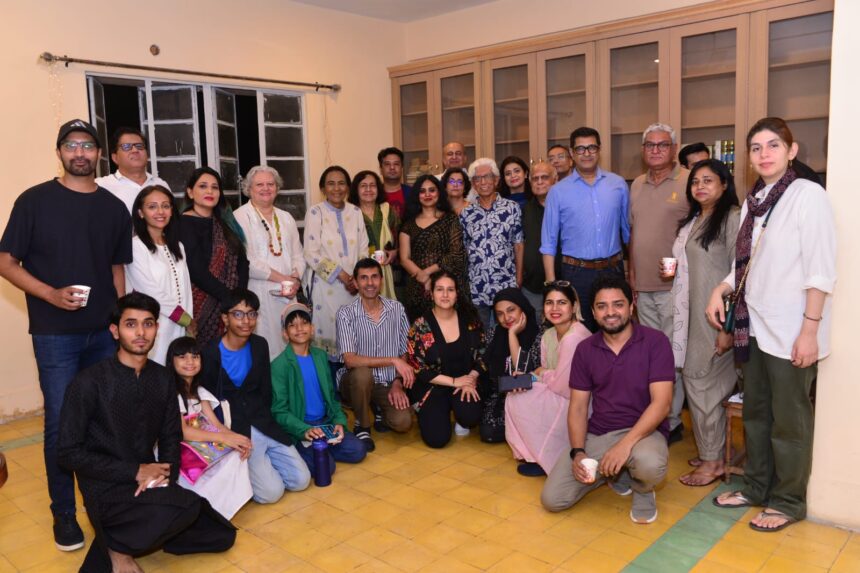
On Sunday evening, those old stairs led visitors to the Pakistan premiere of Crones: A Celebration, a feature documentary by Joshinder Chaggar.
Among the guests were Mahnaz Rahman, veteran journalist and women’s rights activist who led the Aurat Foundation in Sindh, and Ameena Saiyid, former managing director of Oxford University Press Pakistan, director of the Adab Festival and founder of Lightstone Publishers. Others attending included personalities from the worlds of art and film, among them Jami, Saima Saleem, Mahera Omar, Aquila Rehman, Niilofer Farrukh, Ajmal Kamal, Talha Ahmed, Maria Rubab and Sobia Ali.
What they watched was a quiet act of rebellion against one of society’s oldest stereotypes: that a woman has an age limit and, beyond a certain point, should retire from her own life. She is expected to stay at home, abandon her ambitions and stop wanting more. Her dreams are dismissed as outdated, her body judged to be past its prime, and her place in public life gradually diminished.
Crones challenges this assumption. Its makers describe it as “a joyful and defiant celebration of ageing and visibility”.
The title itself represents an act of reclamation. Today, the word “crone” is often used as an insult, evoking the wicked old woman of fairy tales. Yet words such as “crone” and “hag” once carried associations with wisdom and power. The crone was the experienced older woman whose knowledge served her community. Over time, prejudice transformed that respect into ridicule.
The film reclaims the word and, with it, the dignity that once accompanied it.
The prejudice at the heart of the film is known as ageism, and it extends far beyond individual experience. According to the Global Report on Ageism, published in 2021 by the World Health Organization and other United Nations bodies, one in every two people worldwide holds ageist attitudes.
For women, the burden is often doubled. A grey-haired man may be described as distinguished, while a grey-haired woman may be considered past her prime. In Pakistan, as across South Asia, older women may be respected as elders while being overlooked as individuals with ambitions, desires and lives of their own.
Perhaps the most damaging form of ageism is the kind women internalise themselves: the quiet voice that tells them, “I am too old for this,” long before anyone else has said it.
Filmed over five years beginning in March 2020, Crones: A Celebration unfolds against the colourful worlds of Bollywood dance and Melbourne’s independent theatre scene. The 67-minute documentary follows three women whose lives develop before the camera, showing how one woman’s decision to pursue her dream can inspire others to reconsider their own possibilities.
Karin Kuusk, 72, an amateur Bollywood dancer, has carried one dream since childhood: to stand before the Taj Mahal. When the film first introduces her, the dream still seems distant. Through a weekly dance class and the friendships it nurtures, she gradually regains her health, energy and enthusiasm for life. In October 2023, well into her seventies, she finally travels to India.
Her journey provides some of the film’s most moving moments, capturing the uncertainty, determination and emotion involved in pursuing a long-held ambition. Her story becomes, in the filmmakers’ words, a testament to “the power of a dream, at any age”.
The second central figure, Natalie Gamsu, 62, is no stranger to the stage. Born in Namibia and trained in drama at the University of Cape Town, she developed a following in South Africa through her solo cabaret performances. She subsequently spent a decade in New York, singing at venues including the Oak Room and the Russian Tea Room, and won the Backstage Bistro Award and a MAC Award for Outstanding Female Vocalist.
Her career in Australia has included appearances in Mary Poppins, Barrie Kosky’s Women of Troy and Baz Luhrmann’s Strictly Ballroom. She has also played Jan Barton in the television soap Neighbours and Fatima in the film Ali’s Wedding.
Despite this experience, opportunities begin to dry up as she enters her sixties, reflecting an entertainment industry that frequently sidelines older women.
Rather than waiting for someone to offer her a role, Gamsu writes and stages her own one-woman show. With humour, creativity and determination, she challenges the assumptions that restrict older women’s opportunities in theatre. The documentary follows her journey from the first ideas to opening night, while also exploring her questions about identity, purpose and self-worth.
Around these two women is a lively supporting cast: a Bollywood dance class for senior women in Melbourne. Dressed in bright Indian costumes, these energetic women gather every week to dance, stay fit and enjoy one another’s company.
Through intimate and unhurried conversations, they reflect on the meaning of the word “crone” and ultimately claim it for themselves. The camera follows them in the classroom and backstage, capturing the everyday gestures of care, companionship and solidarity that bind them together.
Their stories challenge familiar stereotypes: that older women are necessarily frail, that their dreams have expired and that the stage belongs exclusively to the young.
The final story belongs to the woman behind the camera herself.
In her late forties, Joshinder Chaggar pursued her long-held ambition of making a feature film. In doing so, she demonstrated the very message her documentary seeks to convey: that creativity and ambition do not have an expiry date.
For Karachi, Chaggar’s story carries a particularly meaningful connection. Born in India and raised in Nigeria and Australia, she once lived and worked in the city, teaching movement at NAPA and choreographing for television and music videos, including Zeb and Haniya’s Aitebar.
A passionate storyteller who values women’s empowerment, humour and resistance to restrictive labels, Chaggar has worked in dance and theatre for two decades and with older communities since 2018. She has also completed a PhD exploring intercultural identity and storytelling.
Her first short documentary, More Than Cute, focused on the same Bollywood dance class. It won Best Documentary at the Reel Sisters of the Diaspora Film Festival in New York in 2022 and was selected for festivals in Melbourne, London, Mumbai, Karachi, Lahore and Islamabad.
Crones: A Celebration, her first feature documentary, was directed, produced and filmed by Chaggar herself. The production team included Jan Allan as executive producer, Lucy Paplinska as editor, Erika M. Martinez as creative producer, Emmy-winning Jackie Turnure as impact producer, Thomas “Soup” Campbell for the music, and Pakistani documentary filmmaker Tazeen Bari as consulting editor.
Film, art and theatre have long been among the most powerful ways to hold a mirror up to society, forcing it to confront realities it might otherwise prefer to ignore. Crones: A Celebration does precisely that, without resorting to a lecture.
The film is engaging throughout, filled with colour, music and movement. Its characters are vivid and complex, and their experiences invite laughter, empathy and moments of genuine reflection. Each woman’s story offers something recognisable, reminding viewers that the desire to grow, create, explore and find purpose does not disappear with age.
With this documentary, Joshinder Chaggar challenges the glass ceiling that society builds over women’s lives as they grow older. The film’s message resonates long after the screening ends.
As the audience descended Theakada’s old stairs and returned to the noise of the city, they carried with them a simple but powerful reminder: a woman’s dreams do not come with an expiry date, and her time is never truly over.
It is simply, as the film insists, her time.