Report ANI
KARACHI: Alliance Française de Karachi has opened “The Too-Young Monsoon Brides,” a documentary photography exhibition examining the intersection of climate change, economic vulnerability and child marriage in Sindh.
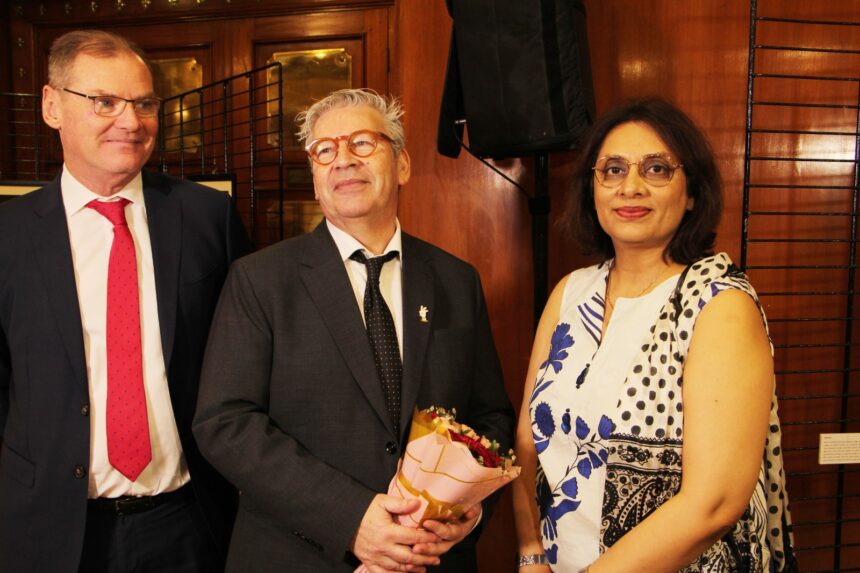
Held at Avari Towers, the opening, or Vernissage, brought together members of Karachi’s diplomatic, cultural and academic communities. The exhibition features 30 portraits by French photographer Isabeau de Rouffignac, each accompanied by a short account from the young woman photographed.
The exhibition is presented in partnership with Avari and supported by the Embassy of France in Pakistan. Following its opening at Avari Towers, it moves to Alliance Française de Karachi from October 1 and will remain on display until October 11, 2026.
The evening began with a video message from de Rouffignac, who spoke about the origins of the project and her year-long work in Sindh and Punjab.
Trained as a graphic designer, de Rouffignac has developed a documentary photography practice focused on people and communities whose experiences often receive limited public attention.
“Through photography, I try to draw attention to people, to places, to stories that are often overlooked,” she said. “This is what brought me to Pakistan, and especially to Sindh and Punjab, where I started working on the impact of climate change on vulnerable communities.”
The exhibition examines how climate-related disasters can deepen existing social and economic pressures, including those that contribute to child marriage.
“Climate disasters don't cause child marriage, but they can make existing problems much worse,” de Rouffignac explained.
The 2022 floods, which affected an estimated 33 million people across Pakistan and left more than 20 million people in need of humanitarian assistance, caused extensive losses of land, homes and livelihoods. In parts of Sindh, the economic pressures created by the disaster placed additional burdens on already vulnerable families.
For some families, the marriage of a daughter became a means of reducing financial pressure while, from their perspective, providing her with greater economic and social security.
The issue, however, extends beyond flood-affected communities in Sindh. UNICEF estimates that 650 million girls and women alive today were married before the age of 18, while approximately 12 million girls enter child marriages each year worldwide.
South Asia accounts for a significant proportion of the global burden, with an estimated 285 million child brides, representing around 44 percent of the global total.
In Pakistan, national data indicate that 18 percent of girls marry before the age of 18, while 4 percent marry before the age of 15. Government survey data for Sindh put the proportion marrying before 18 at nearly 22 percent, with some flood-affected districts reporting significant increases in recent years.
In early 2025, de Rouffignac travelled across Pakistan to meet families affected by these circumstances and photograph their daughters. The resulting portraits form the centrepiece of the exhibition.
For the photographer, each portrait was the result of a personal encounter rather than simply a photographic session.
“For me, this portrait was very important because each came from a meeting, a moment that we spent together,” she said.
De Rouffignac invited each girl to select her own clothes for the photograph, seeking to give the subjects greater control over how they were represented.
“I wanted that this moment to be entirely for them. I wanted to take time for them. I wanted that they enjoy. I wanted them to shine. Give them 30 minutes, one hour, to feel good,” she said.
That approach is reflected throughout the 30 portraits and accompanying dialogues, which place the experiences and voices of the young women alongside the broader statistics.
“I also wanted to give a face to a reality that is too often reduced to numbers,” de Rouffignac said. “I wanted to focus on what we don't always see, and give a voice to people whose story might otherwise go unnoticed.”
At the opening, guests viewed the complete collection before gathering for remarks from representatives of the exhibition’s partner organisations, including the Embassy of France in Pakistan.
The exhibition is open to the public at Alliance Française de Karachi from October 1 to October 11, 2026.
Alliance Française de Karachi is the official French cultural institute in Karachi and part of a worldwide network of more than 850 Alliance Française centres. Based in Clifton, it offers French-language courses, DELF and DALF certification, corporate training and a range of cultural programmes, including exhibitions, film screenings and workshops connecting Karachi audiences with French and wider Francophone culture.