By Rana Farooq Ashraf
Published By:ANI News Agency
Have we ever seriously stopped to think about the kind of Pakistan we are going to leave behind for our children and future generations?
In my view, this should be one of the most important questions in Pakistan’s national debate today. Unfortunately, it hardly finds the attention it deserves. Our political discourse remains largely consumed by the struggle for power, the formation and fall of governments, political confrontation, allegations and counter-allegations. Meanwhile, two major challenges are quietly weakening the foundations of the country: climate change and the economic crisis.
I believe these are not two separate problems. Pakistan’s economic future is increasingly tied to how seriously we respond to the challenge of climate change.
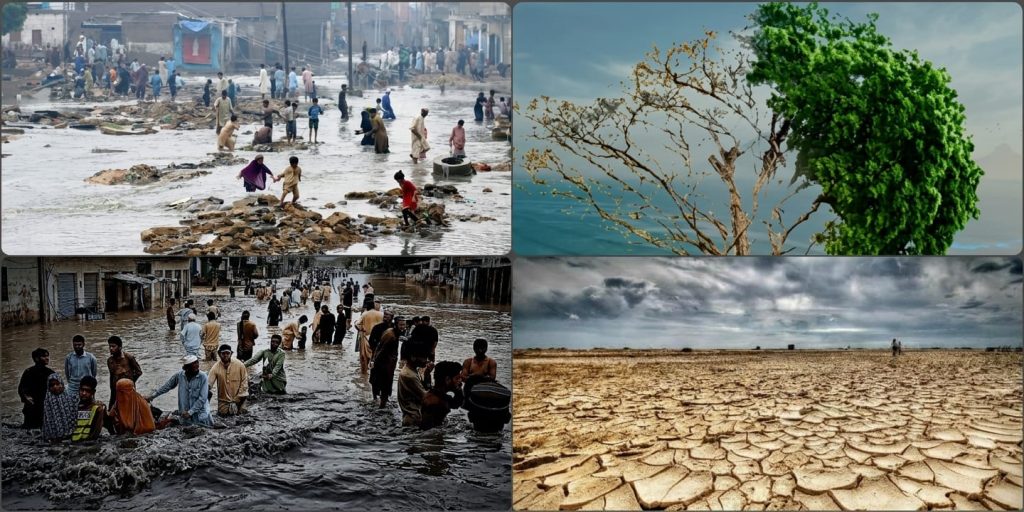
A few years ago, climate change was largely discussed as a threat that belonged to the future. Today, that future has arrived. Extreme heat, unusual rainfall, devastating floods, water shortages, melting glaciers, damage to crops and deteriorating air quality are no longer distant warnings. They are realities that Pakistanis are experiencing in their daily lives.
The Pakistan Economic Survey 2025-26 paints a deeply worrying picture. The year 2025 was Pakistan’s second-hottest year in the past 65 years. The floods that year caused an estimated Rs822 billion in damages, claimed more than 1,000 lives and affected or displaced more than four million people.
These are not merely numbers in a government report. Behind every number is a human story.
When a farmer loses his crop, it is not only his income that disappears; food prices are affected as well. When cotton production suffers, the textile industry and exports come under pressure. When roads and bridges are destroyed, scarce public resources have to be diverted from development towards reconstruction. When electricity, water and basic services are disrupted, businesses and employment suffer.
In other words, a flood does not bring water alone. It brings economic pressure with it.
The International Monetary Fund has also noted that the 2025 floods affected crops, infrastructure and economic activity, putting pressure on Pakistan’s growth prospects. Such disasters can also create additional pressure through food prices, reduced government revenues and increased import requirements.
The question, therefore, is: when will we finally accept that climate change is no longer merely an environmental issue? It is now an issue of the economy, employment, food security, water security and national security.
Pakistan needs to broaden the scope of its political thinking.
We need to ask where our water is going, why groundwater levels are falling, why our cities become vulnerable even during heavy seasonal rains, how farmers can be helped to adopt climate-resilient agricultural practices, and how our forests, wetlands and other natural ecosystems can be protected.
Most importantly, we need to ask why Pakistan still struggles to maintain a consistent, long-term national strategy for dealing with climate change.
This is where political parties have a critical responsibility.
Regardless of who forms the government, who serves as prime minister or who sits on the opposition benches, climate policy should not change with every political transition. Pakistan needs a 20- to 30-year National Climate and Economic Resilience Strategy, supported by all major political forces.
Political differences are natural in a democracy. But water, food security, the environment and the future of our children should not become victims of political rivalry.
There is another powerful force that can shape this debate: the media and social media.
Platforms such as X, Facebook, YouTube, TikTok and others have given ordinary citizens the ability to witness climate disasters in real time. A video of a flooded village, a destroyed crop or a city suffering from extreme heat can reach millions within hours.
Recent research in Pakistan also suggests that media and social media play an important role in shaping young people’s understanding of climate change and their attitudes towards adaptation.
But this power comes with a serious responsibility. Misinformation and unverified claims can spread just as quickly as genuine information. Research examining climate-related misinformation in Pakistan has highlighted the role of mainstream and social media platforms, including Facebook, TikTok, Instagram, WhatsApp and X.
This is why I believe the media must stop treating climate change as a story that matters only when a flood occurs. Climate change deserves sustained coverage, investigative journalism and serious public discussion.
Newspapers should strengthen environmental reporting. Television channels should give greater space to climate and water security. Digital platforms should promote credible information rather than sensationalism.
But ultimately, the greatest responsibility rests with our political leadership.
How long will we continue to think only about the next election?
At some point, we must ask a much bigger question: What are we leaving behind for the next generation?
If we fail to invest today in water security, agriculture, the environment, education, health and economic resilience, climate disasters will make our existing economic difficulties even harder to manage.
We cannot continue waiting for every disaster to happen before seeking international assistance for relief and reconstruction. We must invest in prevention, preparedness, resilient infrastructure and long-term planning.
The world is changing. Economies are changing. The climate is changing. Technology is changing.
If our politics remains confined to the pursuit of power and the defeat of political opponents, Pakistan risks falling further behind in a rapidly changing world.
I believe Pakistan needs a new political conversation.
A conversation that does not ask only:
Who will form the next government?
It must also ask:
How much water will our children have?
How secure will our farmers be?
How liveable will our cities remain?
Can our economy withstand the next major climate disaster?
And, above all:
What kind of Pakistan are we leaving behind for our children?
The struggle for political power may last a few years. But the consequences of national decisions can last for generations.
That is why, in my view, Pakistan’s greatest need today is not the victory of one political party over another. It is a correction of our national priorities.
We must move beyond a politics of power and embrace a politics of the future.
Because if we fail to think about tomorrow today, future generations may one day ask us a very uncomfortable question:
When the danger was clearly visible, what did you do for our future beyond fighting for power?