By: Hursh Shah
A Chamber of Commerce is not merely a building, an office or a place for meetings. It is supposed to be the collective voice of businessmen, industrialists, traders and entrepreneurs. It should help businesses communicate with government, solve commercial problems, promote investment and exports, and guide young entrepreneurs who are trying to establish themselves.
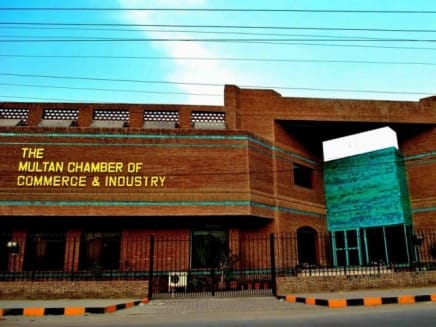
The Multan Chamber of Commerce and Industry (MCCI) has a long history. According to its official record, it was functioning even before Partition and was formally incorporated in 1959. Today, almost 67 years after its formal incorporation, it is time to ask an important question: Has the Chamber grown according to the economic potential of Multan?
At present, the main competition in MCCI politics is being seen between the Founders Group and Friends Group. The Founders Group has remained highly influential in the affairs of the Chamber for many years. Its representatives themselves point to their long-standing role in projects such as the Multan Dry Port and other business-development initiatives. Their historical contribution should be acknowledged wherever it has benefited Multan.
However, a strong institution should never depend permanently on one circle of leadership. Critics of the old system have increasingly raised questions about whether enough opportunities have been provided to new businessmen, young entrepreneurs and emerging industries. A Chamber should not appear to belong to a limited number of families or established business circles. It should open its doors to every genuine businessman who wants to grow.
For many years, MCCI elections frequently ended without real competition. For example, the executive committee candidates were elected unopposed in 2016, office-bearers were elected unopposed in 2021 and 2022, and the president and other senior office-bearers were again elected unopposed for 2024–26.
There was, however, an important exception. In 2018, MCCI witnessed competitive balloting after more than three decades, when the Friends Group challenged the then-established group. This historical fact shows why the renewed competition in 2026 is so important. It can strengthen democracy inside the Chamber and encourage members to participate actively instead of accepting leadership through routine arrangements.
Another serious question is the size of MCCI membership. A figure of around 1,700 members is being discussed in the current local debate. If this figure is confirmed by the Chamber’s final membership records, it deserves serious examination.
Compare this with other major business centres. The Lahore Chamber of Commerce and Industry has more than 46,000 members. The Sialkot Chamber reports more than 23,000 members, while the Gujranwala Chamber represents more than 20,000 active members. The Gujrat Chamber says it represents almost 16,000 businesses.
Multan is the economic centre of South Punjab. It has industries, exporters, agricultural businesses, traders, service companies and thousands of young entrepreneurs. Therefore, a comparatively small Chamber membership should make us think seriously. The solution is not criticism alone. The Chamber must start a large membership campaign, visit markets and industrial areas, create guidance desks for new businesses, organize export training, connect young entrepreneurs with banks and government institutions, and make membership valuable.
In this situation, the Friends Group deserves appreciation for bringing renewed competition and debate into the 2026 election process. Competition should not be viewed as hostility. It is healthy for institutions. When members have a real choice, leadership becomes more accountable.
Multan does not need a Chamber belonging to one group or another. It needs a Chamber belonging to Multan’s entire business community.
The 2026 election should therefore become more than a contest for offices. It should become a movement for greater membership, transparency, fresh leadership, equal opportunity and the economic revival of Multan.