By Syed Sardar Mohammad Khondai/ ANI
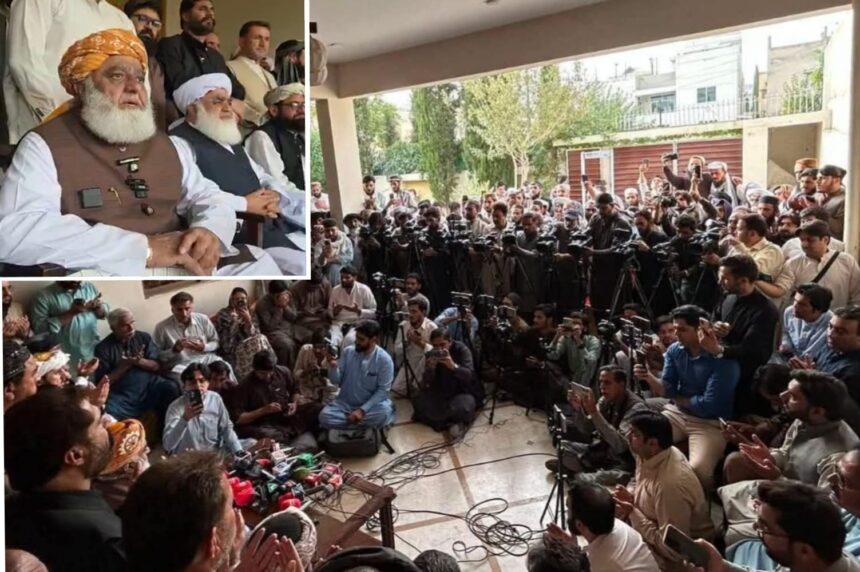
QUETTA—Jamiat Ulema-e-Islam (JUI) Chief Maulana Fazlur Rehman arrived in Quetta on a one-day visit, where he was received at the airport by party leaders, members of the provincial and national assemblies, JUI Balochistan Emir Maulana Abdul Wasey, and party workers.
During his visit, Maulana Fazlur Rehman offered Fateha on the demise of the elder brother of former Speaker of the Balochistan Assembly Malik Sikandar Khan Advocate. He also offered collective prayers for the Balochistan Police personnel and other victims who lost their lives in recent terrorist attacks.
Speaking at an emergency press conference at the residence of Maulana Abdul Wasey, the JUI chief expressed deep concern over the deteriorating law and order situation in Balochistan, describing it as one of the gravest crises facing the province. He said the situation had saddened the entire nation and stressed that mere condemnation was not enough.
Maulana Fazlur Rehman urged the country’s leadership to adopt a serious approach, stating that public grievances and national challenges could not be resolved through the use of force. He emphasized that all stakeholders must work together to steer the country out of its current difficulties.
Responding to remarks by Federal Interior Minister Mohsin Naqvi, he said such statements were inappropriate and reflected an approach that distracted attention from the real issues facing the public. He added that while his party was not opposed to provinces, all nationalities should be taken into confidence. Referring to the merger of the former FATA with Khyber Pakhtunkhwa, he said the process was carried out without adequate planning and many of its problems remained unresolved.
Addressing Opposition Leader Mahmood Khan Achakzai, Maulana Fazlur Rehman urged him to convene a meeting of all opposition parties at the national level to formulate a joint strategy for addressing the country’s political and security challenges.
He further claimed that the government’s writ had weakened across the country, saying that concerns once limited to Balochistan and Khyber Pakhtunkhwa had now extended to Azad Jammu and Kashmir. He maintained that Pakistan’s problems could only be addressed by strengthening elected representatives and political parties, while expressing concern that Parliament had been reduced to a symbolic institution.