BY: Humaira Noreen
Published By: ANI
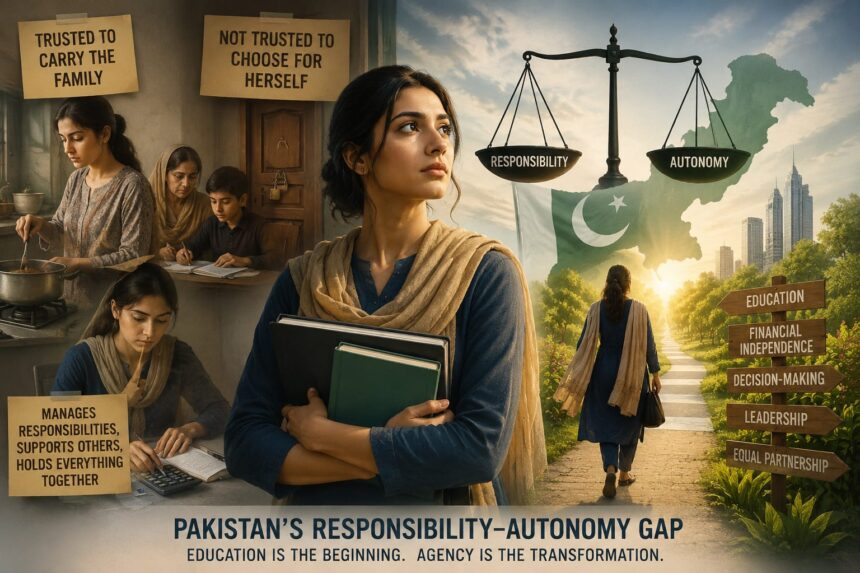
A daughter can be the person a family trusts the most — and still be the person whose choices it trusts the least.
She may be the one who manages household responsibilities, supports younger siblings, accompanies parents through difficult moments, contributes financially, and becomes the emotional backbone of the family. In times of crisis, her maturity and judgment are often unquestioned.
Yet when decisions about her own life arise — her career, finances, mobility, marriage, or future — that same confidence often disappears.
This contradiction points to a deeper social reality in Pakistan: we recognize women’s responsibilities more readily than we recognize their agency.
I know this pattern from my own life. As the eldest child in my family, I was the one who worked and contributed financially — yet I was never the one trusted to decide anything for the household. My younger brother has always held more say in family decisions than I have. I hold two postgraduate degrees earned abroad, and even that made no real difference. Education did not translate into authority. My mother’s life has followed the same pattern, and it has for generations before her.
For decades, discussions around women’s empowerment have focused on access: sending girls to school, increasing employment opportunities, improving financial inclusion. These efforts remain essential. But a harder question remains unanswered: once women gain education and opportunity, do they actually have the power to decide what happens with it?
Because education alone does not guarantee empowerment.
A woman can hold a degree but have limited say in personal decisions. She can earn an income but not control how it is spent. She can manage the household but still be excluded from decisions that shape her own future.
The challenge is not only whether women participate. It is whether they have power.
From Responsibility to Agency
Pakistan has made real progress in girls’ education over the past two decades. But the transition from education to economic and social autonomy remains incomplete. Pakistan’s female labour force participation rate stood at roughly 24 percent in 2024 — compared to a global average above 50 percent, and among the lowest in South Asia. That gap has barely moved in years, even as girls’ school enrolment has climbed.
This tells us something important: opportunity is only one part of empowerment. The other part is a social environment where women are actually allowed to use it.
The same pattern shows up in financial inclusion, an area I have studied closely in my own fieldwork. Pakistan has seen rapid growth in mobile wallets and branchless banking. Yet the 2024 Karandaaz Financial Inclusion Survey found only 14 percent of women had access to a bank account, mobile wallet, or other financial service, compared to 56 percent of men — and just 11 percent of women had a registered mobile money account, against 48 percent of men. Research from CGAP places Pakistan’s gender gap in account ownership at around 30 percentage points, one of the widest in South Asia, closely tracking the country’s low female labour force participation.
Access does not automatically translate into control. A woman may have a wallet in her name and still depend on someone else for permission, information, or the final decision on how it is used.
So the question is not simply: “Does she have an account?”
The deeper question is: “Does she have the authority to use it?”
In more than a decade of fieldwork across Punjab, Khyber Pakhtunkhwa, Sindh, and Gilgit-Baltistan, I have watched this play out in home after home. Women are often the breadwinners of their households, yet men remain the decision-makers. I have met widows who are, on paper, the heads of their families — and yet it is their sons, sometimes much younger than them, who decide for the house.
When Protection Becomes Control
One reason this responsibility–autonomy gap persists is that control is often expressed through the language of care.
Many families genuinely want to protect their daughters. They worry about safety, social pressures, and uncertainty. These concerns are real.
But protection and control are not the same thing.
Protection supports a person’s ability to make informed choices. Control removes those choices.
A daughter who is trusted to hold the family together should also be trusted to make decisions about her own life. Someone capable of carrying responsibility is also capable of exercising judgment.
Different Expectations, Different Futures
From childhood, Pakistani society often prepares sons and daughters for different roles.
Sons are encouraged to become decision-makers. Daughters are encouraged to become responsible caregivers.
A son’s independence is read as preparation for adulthood. A daughter’s adjustment is read as good character.
These early expectations shape adult lives. Women are frequently praised for patience, sacrifice, and endurance. But a society that only celebrates women when they give something up risks confusing sacrifice with success.
A daughter’s value should not be measured by how much she can tolerate. It should also be measured by how much she can contribute — through her ideas, her choices, her leadership.
Why This Matters for Pakistan’s Development
This is not only a women’s issue. It is a development issue.
When educated, capable women cannot fully participate in economic and social decision-making, families and the country lose real human potential. Research across low- and middle-income countries consistently links women’s decision-making power within the household to better outcomes in children’s education, health, and family economic resilience. When women have more say, families tend to do better — not worse.
Expanding women’s agency does not weaken families. It strengthens them.
Strong families are not built on silence or unequal power. They are built on trust, respect, and the belief that every member is capable of contributing.
The Question Pakistan Must Ask
Pakistan does not only need educated daughters.
It needs daughters whose knowledge is respected, whose judgment is trusted, and whose decisions are valued.
The next stage of empowerment is not simply opening doors for women. It is making sure that once they walk through, they have the authority to shape what happens next.
A daughter should not have to spend her entire life proving she is responsible before she is trusted with responsibility over herself.
The very qualities families rely on — her resilience, her intelligence, her care — are the qualities that make her capable of choosing.
The question Pakistan must ask is not whether daughters are ready to decide.
The question is whether society is ready to trust them.
A nation that trusts its daughters with responsibility must also trust them with choice. Pakistan’s future will not be shaped simply by educating women or expanding opportunities for them. It will be shaped by whether society is willing to respect their judgment, value their decisions, and recognise them as equal partners in building stronger families, stronger communities, and a stronger nation. Only then can Pakistan truly unlock the full potential of half of its population.