By: Rana Farooq Ashraf: Published by ANI
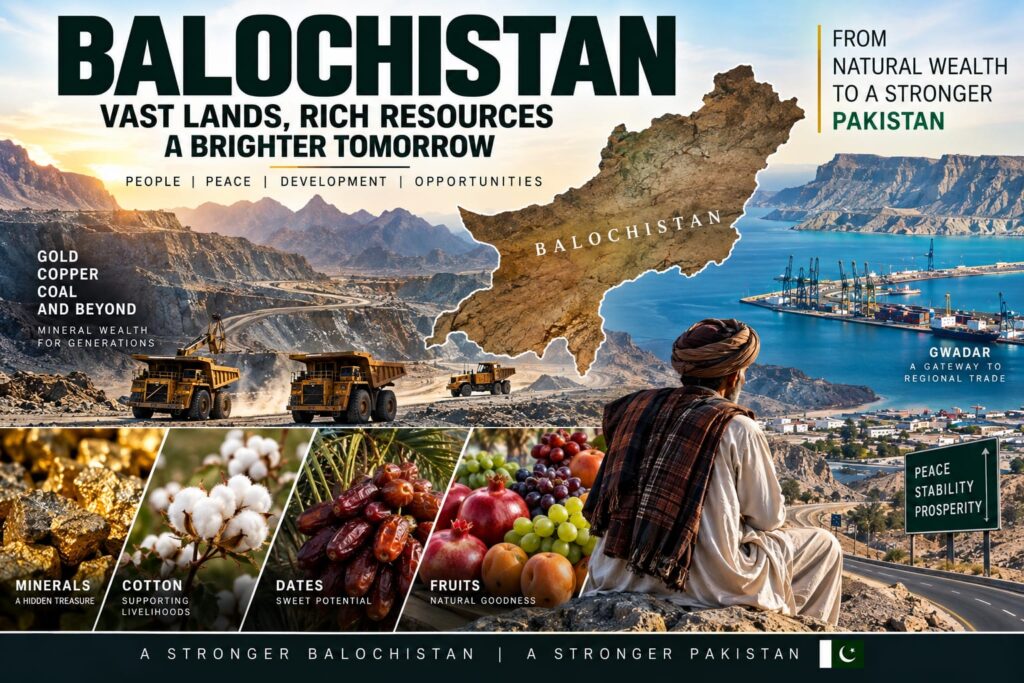
Balochistan is not merely a province of Pakistan; it is an extraordinary national asset in terms of geography, minerals, maritime potential, agriculture, and regional trade. Covering the largest landmass while remaining relatively sparsely populated, the region has yet to realize its true economic potential. From the rich copper and gold reserves of Chagai to coal, chromite, and other precious minerals, Balochistan is positioned to play a foundational role in Pakistan’s future economy. Current developments surrounding the Reko Diq project demonstrate that major global mining investors are taking the region’s potential seriously.
The province’s wealth extends beyond what lies beneath the surface. Various districts produce high-quality fruits, including dates, grapes, apples, and peaches, while agricultural belts generate significant revenue through cotton farming. Unfortunately, due to a lack of cold storage, processing, packaging, and export infrastructure, much of this produce yields far less than its actual market value. The dates sector, in particular, requires immediate investment to establish local value-addition industries.
The primary crisis facing Balochistan is not a scarcity of resources, but rather challenges related to peace, governance, and security. In recent years, the nature of unrest in the province has evolved. The banned Baloch Liberation Army (BLA), whose operational footprint was previously confined to two or three remote districts, now attempts visible disruptions along major transit routes. Hostile elements seek to force extensive deployments of the Pakistan Army and law enforcement agencies across every district. The strategic objective behind this calculated engagement is to inflate security expenditures, thereby straining national finances and weakening the broader economy. Attacks such as the March 2025 Jaffar Express incident highlight the risks posed by this ongoing insurgency.
This hybrid security challenge is further compounded by non-state political movements operating parallel to armed groups. Analysis indicates that organizations like the Baloch Yakjehti Committee (BYC) receive external backing and funding. The establishment of foreign offices, international lobbying, and coordinated digital campaigns abroad suggest a structured effort to build external narratives, fuel domestic instability, and challenge state authority. Substantial evidence points toward significant foreign funding and direct involvement from India in supporting these elements.
Pakistan has consistently acted as a responsible regional neighbor. During heightened tension between the United States and Iran, Pakistan maintained a balanced approach while fulfilling its regional obligations. Despite Pakistan repeatedly identifying terrorist hideouts along border areas, portions of local media across the border continue to view Pakistan with skepticism. Concurrently, global powers maintain distinct strategic interests in the region: the United States focuses on critical minerals and precious metals, while China adopts a cautious approach toward Gwadar Port’s progression through 2032 as it observes regional geopolitical shifts.
Addressing these challenges requires structural administrative and political reforms. Chief Minister Sarfraz Bugti’s governance initiatives and security measures represent a pragmatic approach toward stabilizing the province. Managing a landmass as vast as Balochistan from a centralized administration in Quetta remains impractical; decentralization is essential. Following the reorganization of the province into 11 divisions and 41 districts in July 2026, the next logical step involves adapting the political representation model.
Reconfiguring national electoral boundaries to assign an independent National Assembly seat to each of the 41 districts could transform the political landscape. Under the current model, mainstream political parties rely heavily on traditional tribal leaders (sardars) due to the limited number of seats spread over vast geographic areas. Allocating a dedicated seat to every district would incentivize national parties to establish functional organizational structures at the grassroots level. Increased political competition would foster a new generation of educated, local leaders, encouraging structured political discourse while gradually reducing reliance on traditional tribal patronage.
Gwadar Port, trade corridors connecting Iran and Afghanistan, and international mineral markets position Balochistan to become a major regional economic hub. Achieving this transition requires viewing Balochistan not solely through a security lens, but as Pakistan’s economic backbone. The copper, gold, and mineral wealth embedded in its terrain will yield national prosperity only when paired with lasting security, inclusive political representation, and effective governance.