Written By:Dr. Nasser Hussyn Bukhari
Published By:ANI News Agency
Since its inception in 1947, Pakistan has faced political, economic and social challenges. Difficulties are natural in the life of every nation; what matters is how effectively they are identified and addressed. Successful countries confront the root causes of their problems and pursue consistent, long-term policies. Pakistan, unfortunately, has too often relied on temporary measures while fundamental issues remain unresolved.
Today, Pakistan stands at a critical juncture. Its large population, youthful workforce, natural resources and strategically important location provide enormous opportunities. Yet these advantages cannot be translated into prosperity without addressing the country’s real challenges.
The most important challenge is education. Millions of Pakistani children remain outside school, while many existing institutions suffer from inadequate infrastructure, outdated curricula, weak teaching methods and insufficient resources. Unequal access to quality education perpetuates poverty and social inequality. Education must therefore be treated as a national investment rather than merely a government service. Free, accessible and quality education, combined with modern curricula and critical thinking, is essential for national development.
Closely connected with education is healthcare. Millions of citizens, particularly in rural and disadvantaged areas, still struggle to obtain affordable and quality medical care. Public hospitals frequently face shortages of doctors, medicines, equipment and infrastructure. Preventable diseases, malnutrition and inadequate primary healthcare continue to undermine human development. A healthy population is more productive, and universal access to affordable healthcare should therefore be a central national priority.
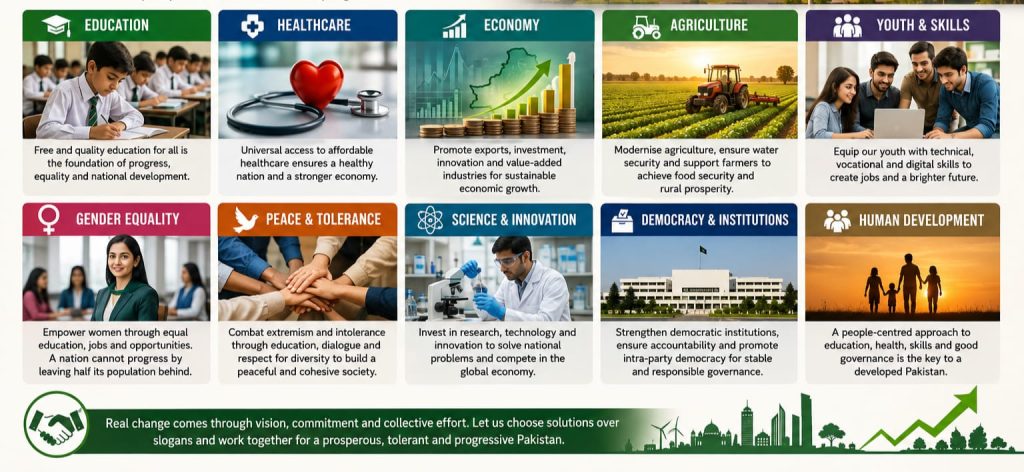
Pakistan’s economy presents another major challenge. Despite agricultural resources, a large labour force and considerable entrepreneurial talent, the country has struggled to achieve sustained and inclusive economic growth. Dependence on imports, a narrow export base, low industrial productivity and inadequate technological innovation constrain economic progress. Pakistan needs policies that promote exports, value-added manufacturing, investment, entrepreneurship and technological advancement rather than repeatedly depending on short-term financial arrangements.
Agriculture, the backbone of the economy, also requires structural reform. Farmers face water scarcity, outdated farming techniques, fragmented landholdings and unequal access to resources and markets. Modern agricultural research, improved irrigation, efficient water management, mechanisation and better access to technology and finance can substantially increase productivity. Meaningful land and agricultural reforms are also necessary to reduce rural poverty and strengthen food security.
Pakistan’s youth population can either become its greatest asset or one of its greatest challenges. Every year, millions of young people enter the labour market, but many lack the technical and vocational skills demanded by modern economies. Unemployment and underemployment can fuel frustration and social instability. Expanding technical, vocational and digital skills programmes, linking training institutions with industry and preparing young people for international labour markets can turn Pakistan’s demographic challenge into a demographic dividend.
Another critical issue is gender equality and women’s empowerment. No country can achieve sustainable development while restricting the participation of half its population. Pakistani women have demonstrated their capabilities in education, science, medicine, business, politics and public service whenever opportunities are provided. Equal access to education, employment, healthcare, economic resources and leadership must therefore be regarded as an essential component of national development.
Pakistan must also confront extremism, intolerance and social polarisation. Security measures alone cannot eliminate these problems. Educational institutions must promote critical thinking, tolerance, civic responsibility, dialogue and respect for diversity. A pluralistic society is more capable of maintaining peace and democratic stability. Addressing the social and educational roots of extremism is therefore as important as addressing its security dimensions.
The country also needs a stronger commitment to science, research and technological innovation. The global economy is increasingly knowledge-based, and nations that invest in research gain economic and strategic advantages. Pakistani universities, research institutions and industries should work together to develop indigenous technologies, solve national problems and improve productivity. Research should not remain confined to academic publications; it must contribute directly to economic and social development.
Equally important is the strengthening of democratic institutions and political culture. Democracy cannot be reduced to elections held at regular intervals. It requires transparency, accountability, rule of law, institutional continuity and genuine participation. Political parties themselves should strengthen internal democracy through meaningful intra-party elections and democratic decision-making. Strong institutions and responsible political leadership are essential for sustainable stability.
These challenges are deeply interconnected. Better education improves health, employability and democratic participation. Economic growth generates resources for education and healthcare. Gender equality expands the productive workforce. Scientific research increases economic competitiveness. Democratic governance improves accountability and policy implementation. Therefore, isolated and short-term interventions cannot adequately address Pakistan’s problems.
Pakistan urgently needs a comprehensive national strategy centred on human development. Educational reform, free and quality schooling, technical and vocational training, healthcare, agricultural modernisation, women’s empowerment, scientific research, technological innovation and democratic institution-building must be pursued as interconnected national priorities.
Such transformation requires political will and continuity of policy. Governments cannot succeed alone. Citizens, political parties, civil society, universities, the private sector and state institutions must share responsibility for national development. Long-term national interests must take precedence over political divisions and short-term calculations.
Pakistan possesses the talent, resources and strategic advantages necessary to become a prosperous, tolerant, democratic and progressive country. The real challenge is not a lack of potential but a failure to consistently address fundamental problems. Pakistan now needs fewer temporary solutions and more permanent reforms. With visionary leadership, strong institutions, quality education and sustained investment in human development, the country can move towards the promise of a modern and prosperous Pakistan where every citizen has the opportunity to participate in and contribute to national progress.