

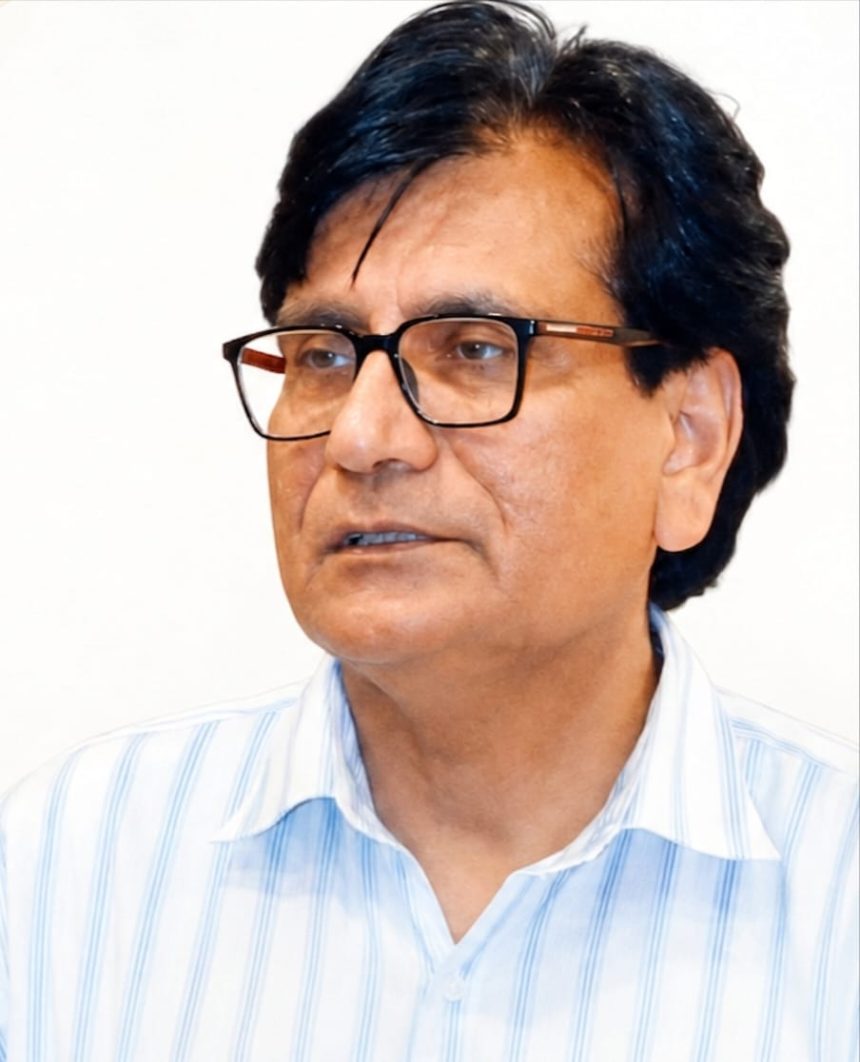
BY : Dr. Nasir Hussain Bukhari : Published By ANI :
As I journey toward Paradise,
My beloved Master has already spoken on my behalf.
Prophet Muhammad Mustafa ﷺ is one of the greatest personalities in human history. He not only delivered a profound spiritual and religious message but also transformed the social, moral, educational and cultural dimensions of human life. His revolutionary struggle was founded not on the principles of force and coercion, but on monotheism, knowledge, love, mercy, justice, equality, tolerance and human dignity. He laid the foundations of a society in which a person’s worth was not determined by tribe, colour, race, wealth or social status, but by character and piety.
One of the most significant aspects of the revolutionary teachings of Prophet Muhammad ﷺ was the importance he attached to knowledge and intellectual awareness. The very first revelation of the Qur’an began with the command, “Iqra” — “Read” or “Recite.” This was a profound indication that the Islamic message began with the eradication of ignorance and the promotion of knowledge and awareness.
The Prophet ﷺ did not restrict knowledge merely to religious information. He encouraged human beings to think, observe, reflect, contemplate and search for truth. He attached great importance to the pursuit of knowledge and encouraged his Companions to acquire knowledge, understand it and transmit it to others.
In Madinah, Masjid al-Nabawi ﷺ was not merely a place of worship; it was also an important centre of education and intellectual development. The Companions of Suffah (Ashab al-Suffah) were a remarkable example of this educational environment. They lived in or around the mosque, devoted themselves to learning the Qur’an and Sunnah, and subsequently carried that knowledge to different regions. In this way, the Prophet ﷺ developed a society in which education was regarded as a fundamental instrument of human development.
The Prophet’s ﷺ treatment of prisoners after the Battle of Badr is another remarkable example of his appreciation for knowledge. Some prisoners who could not afford to pay a ransom were given the opportunity to secure their freedom by teaching children in Madinah how to read and write. This episode reflects the powerful principle that knowledge is a force that liberates human beings.
The Prophet’s ﷺ encouragement to Zayd ibn Thabitؓ to learn another language is also an example of his broad educational vision. He instructed Zaydؓ to learn a foreign language so that Muslims could communicate more effectively and conduct affairs with other communities. This demonstrates that, in the Prophet’s ﷺ vision, knowledge was a living, practical and universal necessity.
The most prominent quality of the personality of Prophet Muhammad ﷺ was mercy. The Qur’an describes him as “a mercy to the worlds” (Rahmatan lil-‘Alamin). His love was not limited to his followers; it extended to human beings, children, women, the weak, the poor, neighbours and other creatures.
The incident of Ta’if is an extraordinary example of patience, tolerance and compassion in human history. When the people of Ta’if severely persecuted the Prophet ﷺ and injured him by throwing stones at him, the Angel offered to destroy them between the mountains. Yet the Prophet ﷺ chose hope and mercy instead of revenge. He hoped that their descendants might one day believe in Allah and follow the path of righteousness. This response demonstrates that his revolution was not a revolution of hatred, but a revolution aimed at bringing human beings closer to one another.
At the Conquest of Makkah, the Prophet ﷺ likewise demonstrated remarkable forgiveness toward his former enemies. Those who had persecuted him and his companions for years expected retaliation when the Prophet ﷺ finally gained complete authority over Makkah. Instead, he chose forgiveness and peace over revenge. This remains an extraordinary example of the conduct of a victorious leader in human history.
The Prophet ﷺ had immense love for Imam Hussainؓ. A narration relates that during prayer, Imam Hussainؓ climbed onto the blessed back of the Prophet ﷺ. Out of affection for him and consideration for his innocent childhood, the Prophet ﷺ prolonged his prostration until Imam Hussainؓ came down himself. This is a beautiful example of the Prophet’s ﷺ love, compassion and tenderness toward children.
This was the nature of the Prophet’s ﷺ educational approach, in which love was not merely an emotion but a means of developing human character. He taught compassion toward children, sympathy for the weak, kindness toward neighbours and a sense of responsibility toward the disadvantaged and vulnerable members of society.
The Prophet Muhammad ﷺ strengthened the rights of women in a society where women had often been deprived of many fundamental rights. He granted women dignity, inheritance, the right to consent in marriage, property rights and social respect.
He regarded kindness and good treatment of women as an important measure of moral excellence. In his own life, he demonstrated love, respect and consultation with his wives. The large number of men and women who learned from Hazrat Aishaؓ is also evidence that women played an active role in the intellectual and educational life of the early Muslim community.
An important aspect of the revolutionary personality of Prophet Muhammad ﷺ was religious tolerance and peaceful coexistence. The Charter of Madinah is a historic example in which the rights, responsibilities and collective security of different religious and tribal groups were addressed. It demonstrates that the social order of Madinah was based not merely on religious identity but also on a structured social agreement, justice and mutual responsibility.
The Prophet’s ﷺ treatment of the Christian delegation from Najran is also regarded as an important example of religious respect. He engaged in dialogue with people of different faiths and respected their religious identity. This establishes the principle that differences in religious belief cannot justify denying human dignity or fundamental rights.
The most fundamental revolutionary message of Prophet Muhammad ﷺ was Tawheed — the Oneness of God. Belief in one God liberated human beings from submitting to other human beings and challenged artificial hierarchies based on race, tribe, wealth and power.
The Prophet ﷺ established the principle in Arab tribal society that all human beings belong to one human family. Hazrat Bilalؓ, who had been a slave and was of African descent, was elevated by Islam to a position of great honour and became the Prophet’s ﷺ Mu’azzin. Hazrat Salman al-Farsiؓ and Hazrat Suhaib al-Rumiؓ also attained positions of great respect in the Muslim community. These examples demonstrate that the Prophet ﷺ challenged distinctions based on ancestry, colour and geography and established faith, character and piety as the true measures of human worth.
In his Farewell Sermon, the Prophet ﷺ articulated principles of human equality and rights that continue to offer profound guidance for human ethics. He rejected the racial, tribal and economic arrogance of the age of ignorance and emphasised mutual respect and the protection of human rights.
The revolutionary struggle of Prophet Muhammad ﷺ was not merely aimed at acquiring political power. Rather, it sought to establish a society in which justice, peace, honesty, compassion and human dignity would be fundamental values.
The Treaty of Hudaybiyyah is a remarkable example of his political wisdom. Although some of its terms initially appeared difficult for the Muslims to accept, the Prophet ﷺ chose long-term peace over immediate emotional reactions. As a result, an environment emerged in which people could understand Islam, interact freely with Muslims and make their own informed choices.
The Prophet ﷺ did not regard the use of force as an objective in itself. Wherever possible, he preferred peace, agreements and dialogue. Therefore, the transformation brought about under his leadership was not merely a political transformation; it was also a profound moral and civilisational revolution.
The revolution of Prophet Muhammad ﷺ was not a revolution designed to frighten human beings; it was a revolution that restored their dignity. It was a revolution that replaced ignorance with knowledge, hatred with love, tribal arrogance with human equality, oppression with justice, and revenge with forgiveness.
Today, when the world is facing religious, racial, political and economic divisions, violence and intolerance, the life and teachings of Prophet Muhammad ﷺ offer comprehensive moral guidance. Nearly fourteen centuries ago, he established a social vision in which knowledge, humanity, justice, tolerance, respect for women, the rights of minorities, protection of the vulnerable and human equality were fundamental values.
Therefore, to view Prophet Muhammad ﷺ merely as the spiritual leader of Muslims would be to limit the profound human and civilisational legacy of his life. His Sunnah and teachings provide humanity with a comprehensive model of mercy, knowledge, morality, justice and peace.
In the truest sense, his revolution was a revolution that transformed the human being from within — a revolution that filled the heart with love, the mind with knowledge, character with morality and society with justice.
Peace and blessings be upon that magnificent personality who taught humanity to respect human dignity, illuminated the path of knowledge, chose love over hatred, and showed the world the way toward peace, justice and mercy.
ﷺ



Thanks for sharing article