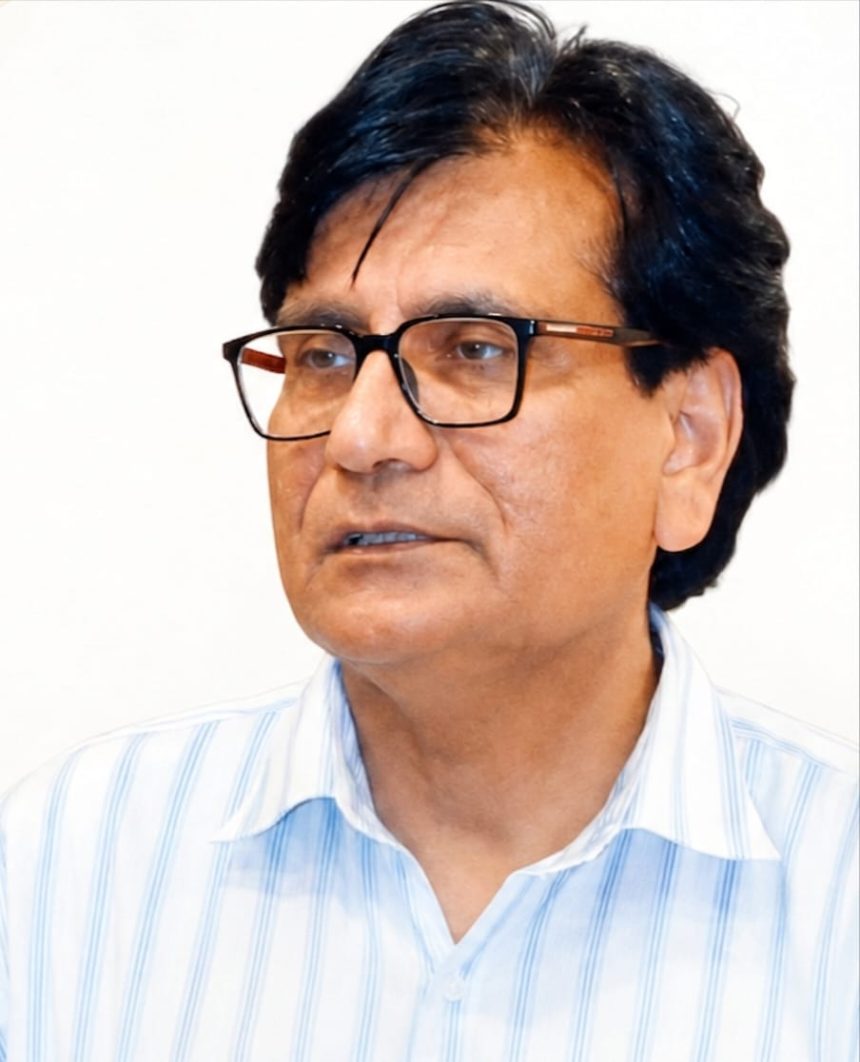
BY:Dr. Nasser Hussyn Bukhari
Published By:ANI News Agency
Every nation is born not only through territory but through an idea. Pakistan emerged in August 1947 amid the violence, displacement and uncertainty of Partition. To understand what its founder envisaged for the new state, it is essential to return to Muhammad Ali Jinnah’s presidential address to Pakistan’s first Constituent Assembly on August 11, 1947. Read through the lens of critical discourse analysis, the speech presents a vision of Pakistan as a democratic, constitutional, tolerant, plural and welfare-oriented state in which citizenship, rather than religious identity, is the principal basis of political belonging. Jinnah’s language places constitutional government above arbitrary power, the citizen above communal identity, and protection of religious belief above religious coercion. His Pakistan was not conceived as a theocracy; it was to be a modern state in which citizens of different faiths enjoyed equal political status and protection of law.
The timing of the speech gives it exceptional significance. Jinnah was addressing the Constituent Assembly that was about to frame the constitutional structure of the new country. His words were therefore not merely descriptive; they were constitutive. He was attempting to establish the political grammar of Pakistan.
Jinnah began by defining the constitutional authority of the Assembly:
“you are now a sovereign legislative body and you have got all the powers.”
The phrase “sovereign legislative body” is fundamental to understanding his political discourse. Political authority is located in a representative constitutional institution. Jinnah does not place the legislature beneath a religious hierarchy or an unelected authority. His language privileges constitutionalism, representation and parliamentary government. Sovereignty is also linked with responsibility: those possessing political power must exercise it for the public good.
He then defined the primary responsibility of government:
“the first duty of a government is to maintain law and order, so that the life, property and religious beliefs of its subjects are fully protected by the State.”
The sentence defines government through its duty to protect. “Life”, “property” and “religious beliefs” are placed within the same protective framework. The state is not presented as an institution whose first responsibility is to impose religious doctrine; rather, it must protect citizens and their beliefs. This is a rights-based conception of political authority.
Jinnah was equally concerned about the quality and integrity of governance. He warned:
“One of the biggest curses from which India is suffering…is bribery and corruption.”
He added:
“Black-marketing is another curse.”
And regarding nepotism, he declared:
“I shall never tolerate any kind of jobbery, nepotism or any other kind of influence or pressure being brought to bear upon the Government servants.”
These statements demonstrate that independence, for Jinnah, was not merely the transfer of power from British rulers to Pakistani rulers. It required a transformation of political culture. Corruption, black marketing, nepotism and influence threatened the foundations of the new state. His discourse connects national development with merit, institutional integrity and public accountability.
Jinnah then moved to the fundamental question of religion and citizenship. His most famous declaration was:
“You are free; you are free to go to your temples, you are free to go to your mosques or to any other place of worship in this State of Pakistan.”
The repetition of “free” is rhetorically powerful. Religious freedom is not presented as a favour granted by a majority; it is articulated as a principle of citizenship. Jinnah immediately adds:
“You may belong to any religion or caste or creed—that has nothing to do with the business of the State.”
This sentence establishes a deliberate boundary between personal faith and state authority. Religion remains important to the individual, but religious identity should not determine the citizen’s relationship with the state. In critical discourse terms, Jinnah replaces a communal political vocabulary with a civic one.
The central concept of this transformation appears in perhaps the most important sentence of the address:
“We are starting with this fundamental principle that we are all citizens and equal citizens of one State.”
The repetition of “citizens” and “equal citizens” is significant. Jinnah does not merely ask the majority to tolerate minorities. He constructs all communities as equal members of the political nation. Tolerance therefore becomes a consequence of equal citizenship rather than an act of majority generosity.
His subsequent words make the distinction even clearer:
“Hindus would cease to be Hindus and Muslims would cease to be Muslims, not in the religious sense, because that is the personal faith of each individual, but in the political sense as citizens of the State.”
This statement is often interpreted selectively. A critical reading shows that Jinnah does not demand the disappearance of religion. He explicitly qualifies his statement with “not in the religious sense”. What should disappear is the political use of religious identity as a basis for unequal citizenship.
The distinction between religious and political identity is therefore central to his discourse. Jinnah acknowledges the importance of personal faith while insisting that the state must treat citizens equally. His vision is neither religious coercion nor the elimination of religion from society. It is a civic order in which religious belief remains personal while citizenship remains equal.
The speech also contains a clear welfare-oriented dimension. Jinnah declares:
“if we want to make this great State of Pakistan happy and prosperous we should wholly and solely concentrate on the well-being of the people, and especially of the masses and the poor.”
The words “well-being”, “masses” and “poor” reveal that prosperity, for Jinnah, was not simply about the wealth of the state or its elite. The ultimate measure of national success was the welfare of ordinary people. His discourse therefore contains the foundations of a democratic welfare state in which economic justice is inseparable from political freedom.
Jinnah also emphasizes impartiality:
“I shall always be guided by the principles of justice and fairplay without any prejudice or ill-will, in all matters.”
The vocabulary of “justice”, “fairplay” and “without any prejudice” reinforces equal citizenship. Government, in this formulation, must not become an instrument of communal, sectarian or personal preference.
His call for reconciliation after Partition is equally significant:
“The past must be buried and let us start afresh.”
He further states:
“If you will work in cooperation, forgetting your past, burying the hatchet, you are bound to succeed.”
The metaphors of “burying” the past and “burying the hatchet” construct reconciliation as a condition of national success. A new Pakistan could not be built upon permanent communal hostility. Cooperation had to replace antagonism.
Jinnah’s broader political thought reinforces other dimensions of this democratic project. His support for women’s participation in national life, his emphasis on education and youth, his commitment to constitutional government and his opposition to the politicization of state institutions are consistent with the modern democratic state suggested by the August 11 address. His foreign-policy outlook also envisaged a sovereign Pakistan maintaining close relations with the Muslim world while pursuing its own national interests.
However, intellectual honesty requires distinguishing these broader themes from the actual text of the August 11 speech. The address itself does not explicitly discuss every question of women’s rights, military intervention in politics, non-alignment or educational policy. Those themes belong to Jinnah’s wider political record and should not be artificially attributed to this particular speech. What the August 11 address unmistakably provides is the constitutional and civic foundation upon which these broader principles can be understood.
The national identity constructed by Jinnah is neither exclusively provincial nor sectarian. A Pakistani is first a citizen of Pakistan. Being Punjabi, Sindhi, Baloch, Pashtun or Kashmiri cannot become a justification for unequal citizenship. Likewise, sectarian or religious identities cannot supersede the common political identity of Pakistani citizenship. Cultural identities may remain meaningful, but the constitutional identity of citizenship must unite all.
This remains one of Pakistan’s greatest unfinished tasks. From the early managers of the state to contemporary political leadership, successive governments and political forces have failed to fully institutionalize the principles articulated by Jinnah. Democratic interruptions, corruption, nepotism, sectarianism, intolerance, ethnic polarization, educational deprivation and socioeconomic inequality demonstrate the distance between the founding vision and political reality.
Had Jinnah’s principles been consistently implemented, Pakistan could have developed into a society in which no child was deprived of education, merit prevailed over patronage, religious tolerance was stronger than sectarian hatred, separatism found less fertile ground, and socioeconomic development benefited the masses. Its universities and academies could have become leading centres of global knowledge and research.
Independence Day should therefore be more than an occasion for ceremonies and patriotic slogans. It should provide an opportunity for the government, political parties, state institutions, civil society and academia to critically examine whether their policies correspond with the political principles articulated by Jinnah.
The most important words of the August 11 address remain:
“we are all citizens and equal citizens of one State.”
That sentence contains a powerful constitutional philosophy. It rejects political discrimination on the basis of faith, caste or creed, places citizenship at the centre of national identity, and demands justice, tolerance, protection of minorities and welfare of the people.
Nearly eight decades after independence, Jinnah’s August 11 address remains not merely a historical document but a political test. Pakistan still has the opportunity to become the democratic, tolerant, progressive and modern country envisaged in its founding political discourse. The task is not to reproduce Jinnah’s words ceremonially but to translate them into institutions, laws, educational policies and political practices.
The real tribute to Jinnah would therefore be to build a Pakistan in which no citizen is treated as less Pakistani because of faith, sect, ethnicity, gender or region; where democracy is stronger than authoritarianism, constitutional institutions stronger than arbitrary power, education stronger than ignorance, tolerance stronger than extremism, and social justice stronger than privilege.
The unfinished promise of Pakistan can still be expressed in Jinnah’s own words: “we are all citizens and equal citizens of one State.”