ISLAMABAD, July 18, 2026: Chairman Pakistan Atomic Energy Commission (PAEC), Dr. Raja Ali Raza Anwar, on Saturday urged young Pakistani scientists to move beyond being users of technologies developed abroad and work towards becoming innovators and creators of indigenous solutions.
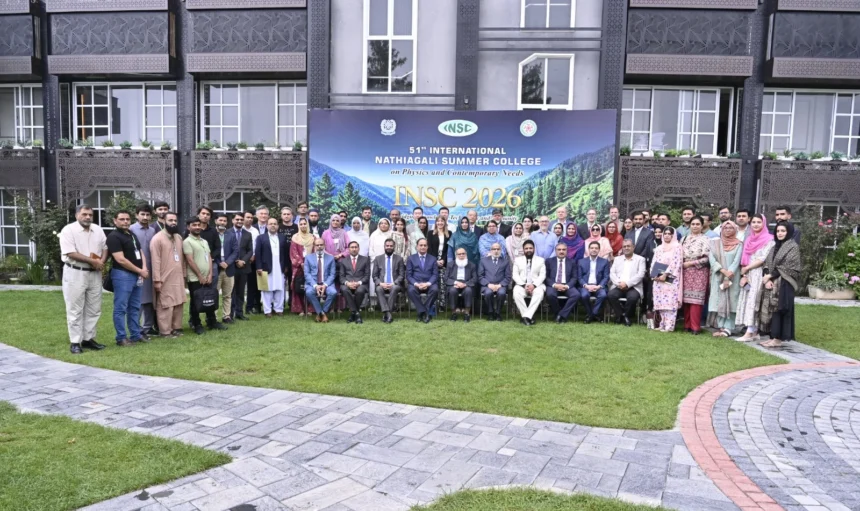
He was speaking at the closing ceremony of the 51st International Nathiagali Summer College (INSC) on Physics and Contemporary Needs, which concluded after two weeks of academic and scientific discussions on emerging areas of science and technology.
Organised by PAEC from July 6 to 18, the Summer College brought together leading scientists, researchers and young scholars from Pakistan and other countries to share knowledge and examine technologies expected to shape the future.
Addressing the participants, Dr. Anwar said the world was passing through a decisive technological transformation led by artificial intelligence, advanced manufacturing, biotechnology and clean energy technologies. He said countries were now competing increasingly through ideas, innovation, talent and technology rather than natural resources.
The Chairman said Pakistan had the talent, institutions and determination required to become a knowledge-producing country capable of developing its own technologies and contributing solutions to global challenges. He stressed that sustained investment in science, research and human resource development was essential to secure Pakistan’s future competitiveness.
He said the International Nathiagali Summer College had, for more than five decades, helped nurture scientific culture by linking young researchers with internationally recognised scientists and encouraging innovation, collaboration and critical thinking. He noted that many former participants were now serving in leading research institutions, universities, industries and strategic organisations, showing the long-term contribution of the College to Pakistan’s scientific progress.
Dr. Anwar said this year’s academic programme focused on areas directly linked with Pakistan’s future needs, including Artificial Intelligence and Machine Learning, Advanced Manufacturing Techniques, Nuclear Techniques in Agriculture and Biotechnology, Nuclear Techniques in Health and Environment, and Advances in Plasma Science and Fusion Technology.
He said these emerging fields could strengthen industrial competitiveness, improve food security, enhance healthcare, protect the environment and support future energy solutions.
The Chairman said the themes of the Summer College were closely aligned with the Government of Pakistan’s Uraan Pakistan initiative, which envisages sustainable economic growth through innovation, digital transformation, industrial modernisation and investment in human capital. He said platforms like INSC supported this national objective by developing highly skilled scientists and strengthening the country’s innovation ecosystem.
Highlighting the international dimension of the programme, Dr. Anwar said the Summer College had produced meaningful outcomes beyond lectures by opening new possibilities for cooperation with the Institute of Cotton Research, Chinese Academy of Agricultural Sciences, Anyang, China, in agriculture and biotechnology.
He said technical meetings with distinguished international faculty also discussed prospects for joint research, technology development and long-term institutional collaboration, thereby strengthening Pakistan’s scientific diplomacy and international partnerships.
This year’s Summer College was attended by 45 distinguished scientists from 20 countries, while around 300 selected participants joined the programme in person. Hundreds of others participated virtually through live streaming facilitated by the Higher Education Commission (HEC).
Reaffirming PAEC’s commitment to peaceful applications of nuclear science and technology, Dr. Anwar said the Commission continued to contribute to Pakistan’s socio-economic development through clean nuclear power generation, cancer care provided by its nationwide network of 21 Atomic Energy Cancer Hospitals, development of improved crop varieties for food security, and advanced research in artificial intelligence, quantum technologies, advanced materials and semiconductor sciences.
Addressing the young scientists, the Chairman said the knowledge gained during the Summer College should be seen as the beginning of a lifelong journey of discovery and innovation. He said Pakistan’s future would be shaped by those who had the vision and resolve to create new knowledge, develop local technologies and convert innovative ideas into practical solutions.
He congratulated the organising committee, international faculty, partner institutions and participants on the successful conclusion of the College and expressed confidence that continued investment in research, innovation and human resource development would enable Pakistan to play a greater role in future technological advancement.
Speaking on the occasion, Member Science PAEC, Dr. Shakeel Abbas Rofi, said the event was organised to explore Pakistan’s emerging needs. He said new courses related to health and environment were added along with emerging technologies, artificial intelligence and the use of nuclear techniques in agriculture to achieve food security.
“Lively discussions over tea, technical meetings, curiosity of the participants and generosity of the faculty in answering those curiosities remained the signature note of the INSC-2026. We were successful in transforming scientific meetings into scientific communities and long lasting partnerships,” Dr. Shakeel Rofi said.
He especially thanked Chinese and Malaysian experts for their contribution in opening new avenues of cooperation with Pakistan in agriculture, environment, isotopic hydrology and fuel cell technology. He also thanked Dr. Gerd Helmer from Medical University Vienna for extending complimentary access to Pakistani research institutes to his AI lab on radiotherapy.
Earlier, Scientific Secretary INSC, Dr. Rahat Ullah, briefed the participants about the key themes of the College and the achievements made during the two weeks of interactive sessions.
A poster competition was also held and evaluated by an experts’ panel comprising foreign faculty. The first prize was won by Ms. Salka Javed from Islamic International University Islamabad for her poster on water quality. The second prize went to Ms. Rubab Mansoor from Quaid-i-Azam University Islamabad for her work on the effects of microplastics on the environment in Northern areas. The third prize was secured by Ms. Amina Zakaullah from COMSATS University Lahore.
At the conclusion of the ceremony, Chairman PAEC Dr. Raja Ali Raza Anwar distributed prizes among the poster competition winners and presented commemorative shields to national and international faculty members.