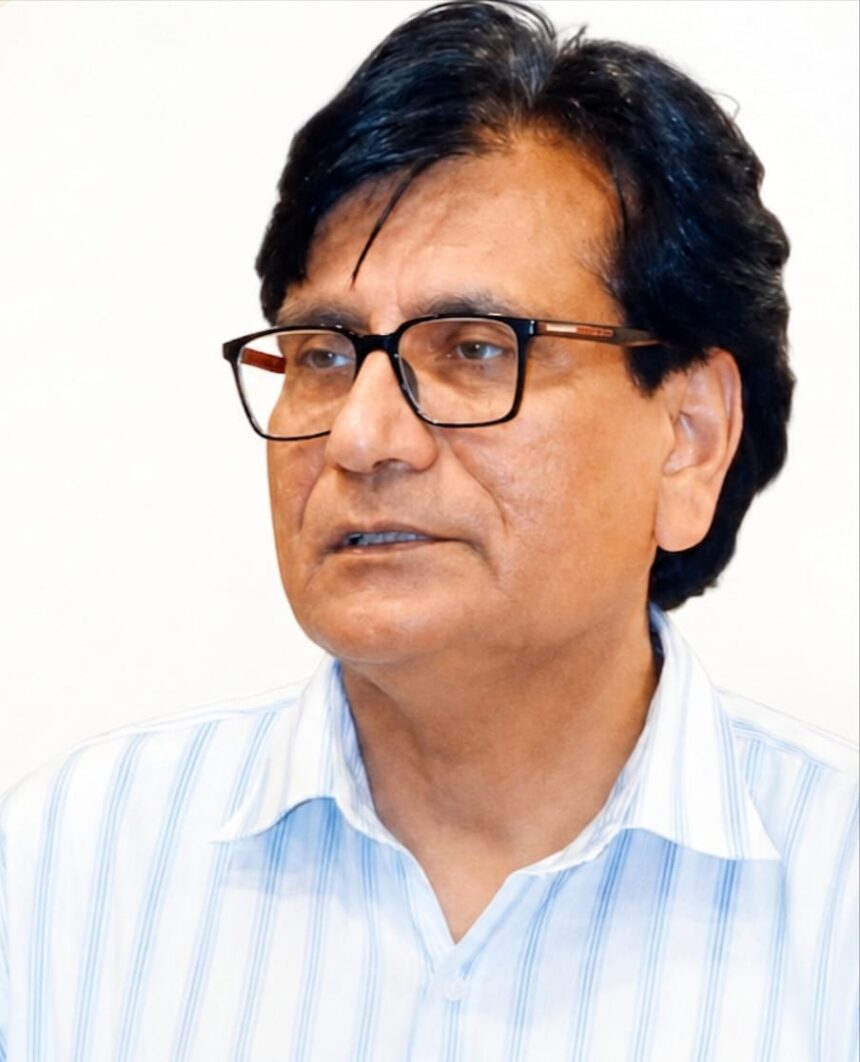
By: Dr. Nasser Hussyn Bukhari
Analyst, writes on Geopolitics, Global and National Issues in Pakistan
Published By: ANI News Agency
The electronic media in Pakistan has no idea what a complex state of mind Sindhis are passing through at this moment. Their present mood resembles that of the Bengalis. To the rest of the country Sindh is merely a province, but to Sindhis it is a homeland. The very thought of dividing it is an agonising feeling, and the media has yet to feel its heat.
Few lands can match Sindh's antiquity. Its people have lived along the Indus for more than five thousand years. Mohenjo-daro and the wider Indus Valley Civilisation, with their planned cities, drainage systems and standardised weights, flourished here around 2500 BCE, when much of the world was still pre-urban. The river gave the land its name: "Sindhu" became "Hindu" in Persian and "Indos" in Greek, and from it the words India and Indus descend. Over the centuries Sindh absorbed Achaemenid, Greek, Mauryan, Kushan and Arab influences, and it was a gateway of Islam into South Asia after 711 CE. Its soil produced the Sufi voices of Shah Abdul Latif Bhittai and Sachal Sarmast, whose message of tolerance still shapes the Sindhi mind. This is a continuous civilisation with its own language, literature and sense of belonging, not an administrative construct.
For a people with such continuity, land is identity. A Sindhi does not say "I live in Sindh" the way one says "I live in a district." He says "Sindh is my mother," and the phrase is meant literally. The prospect of partitioning that mother is felt as bereavement before it is felt as politics. Sindhis also carry a layered memory of loss. Karachi was removed from the province in 1948 to serve as the federal capital. The One Unit scheme of 1955 erased Sindh's provincial identity until 1970. Each episode left the sense that the land was being negotiated by others, and every new proposal for "administrative units" reopens those old wounds. The result is chronic anxiety and a collective fear of being made a stranger in one's own house. Sindhis feel something close to what the Bengalis felt before 1971: that their language, land and resources were treated as bargaining chips, and that their voice was heard only when it was loud.
The social consequences would be just as severe. Sindh's society has long been plural. Sindhis, Baloch, Pashtuns, Punjabis, Saraikis, Memons, Urdu-speaking communities, Hindus and others have lived together, and Sindh's famed hospitality made that possible. A division drawn along ethnic or linguistic lines would harden these identities into borders. Neighbours who share bazaars and weddings would be reclassified as "ours" and "theirs." Mixed districts such as Hyderabad and Karachi would become the frontier of a dispute, and the social trust built over generations could be lost within a single generation. The vulnerable on all sides would pay first.
Culture, too, would suffer. Sindhi is among the oldest living literary languages of South Asia, with a rich tradition of poetry, folk music, craft and festival. Culture needs territory to survive. A shrunken Sindh would deprive the Sindhi language of its largest urban centre, its publishing houses, its media and the cosmopolitan audience that sustains it. Smaller linguistic communities are rarely preserved by dispersal. Sindhis fear that division would begin a slow cultural dilution, ending in folklore preserved in museums rather than a living tongue spoken on the streets of its own capital.
Politically, Sindh's territorial integrity is among the few issues that unite its parties. The strength of this feeling is not a bargaining position. It is a red line. Pushing against it risks radicalising a population that has so far channelled its grievances into constitutional politics. Nationalist movements thrive on perceived injustice, and a division imposed from above would hand them the most powerful argument they have ever had. History, especially 1971, teaches that federations are strengthened by consent and weakened by coercion. A federation does not become more stable by making one of its constituents feel besieged.
The financial stakes are equally high. Karachi is the engine of Pakistan's economy. It hosts the country's main port, its stock exchange, its largest industrial base and its financial headquarters, and it contributes a major share of federal revenue. Sindhis see the city's wealth as the principal basis of the province's fiscal strength. Detaching it would leave the rest of Sindh, with its largely agrarian economy, poor districts and acute water stress, with a fraction of the resources needed to educate, heal and employ its people. Revenue sharing under the National Finance Commission, coastal and port income, and control of resources such as coal and gas would all become matters of contest. Investors prize predictability, and prolonged agitation, strikes and uncertainty over jurisdiction would damage investment in Karachi itself. Even those who might expect to benefit from a new unit would find themselves carrying a heavier administrative burden and weaker fiscal ground. Division would be a loss for everyone, with no clear winner.
The way out of this anguish lies in assimilation, not separation. Seventy-nine years have passed since Partition. Those who came from India to Pakistan in 1947 did so as migrants who had lost their ancestral homes, and Sindh welcomed them with an open heart. But eight decades is four generations. Those who were born in Sindh, educated in Sindh and buried in Sindh are no longer immigrants, and the term "Muhajir" has outlived its meaning.
Across the world, newcomers who choose to settle permanently adapt to the societies that host them. The Huguenots became French, Italians and Germans became Americans, and South Asians in Britain and Canada have become part of the national fabric while preserving their heritage. Assimilation does not mean surrendering one's origins. It means accepting the land you live in as your own, learning its language, honouring its culture and sharing its destiny. Settling permanently in a land carries the responsibility of becoming part of it.
Sindhis must extend full equality and respect to every citizen who calls Sindh home, and Urdu-speaking citizens, in turn, should see themselves as Sindhis in the full sense: proud of its history, fluent in its language, and committed to its unity. A shared homeland cannot be built on separate loyalties. Sindh has absorbed many people across five millennia, and it can do so again.