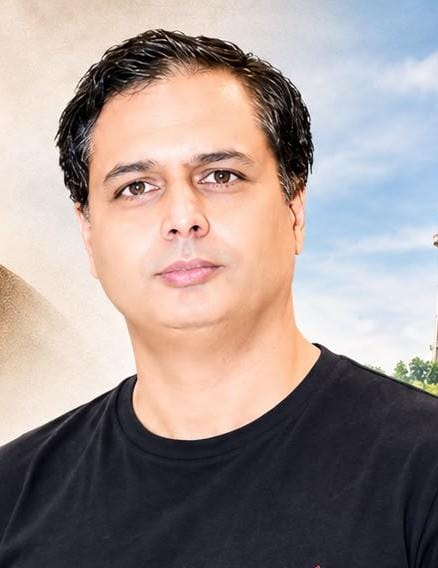
BY: TEHMAS BUTT
Published by: ANI News Agency
Allama Dr. Muhammad Iqbal was one of the greatest intellectual and philosophical figures of the subcontinent. Through his poetry, political vision and philosophy, he awakened a sense of self-awareness, dignity and collective identity among Muslims. Remembered as the Poet of the East, Hakeem-ul-Ummat and the Thinker of Pakistan, Iqbal's ideas continue to inspire generations.
Born on November 9, 1877, in Sialkot, Iqbal received his early education under the guidance of renowned teacher Maulvi Syed Mir Hassan. He later studied at Government College Lahore, completing his Master's degree in Philosophy in 1899 under the academic influence of Sir Thomas Arnold.
In 1905, Iqbal travelled to Europe for higher education. He studied at Cambridge University, earned a doctorate from the University of Munich for his research titled *The Development of Metaphysics in Persia*, and completed his legal education at Lincoln's Inn in London. He returned to the subcontinent in 1908.
His European experience broadened his intellectual outlook. He studied Western philosophy and appreciated scientific advancement, research and discipline, while also criticising materialism and imperialism. He believed that Eastern societies should preserve their spiritual and moral values while embracing modern knowledge and scientific progress.
**Philosophy of Khudi: The Power of Selfhood**
The central concept of Iqbal's philosophy was *Khudi*, meaning self-awareness, confidence, strength of character and recognition of one's potential. He encouraged individuals to overcome despair and inferiority complexes through knowledge, courage and continuous struggle.
His Persian works *Asrar-e-Khudi* (1915) and *Rumuz-e-Bekhudi* (1918) explored individual development and the relationship between the individual and society. Iqbal believed that strong individuals form the foundation of strong nations.
His literary contributions include *Bang-e-Dara*, *Bal-e-Jibril*, *Zarb-e-Kalim*, *Payam-e-Mashriq*, *Zabur-e-Ajam* and *Javed Nama*. His English work, *The Reconstruction of Religious Thought in Islam*, remains an important contribution to modern Islamic philosophical thought.
**Allahabad Address 1930: A Historic Political Vision**
Iqbal's political vision reached a historic milestone on December 29, 1930, when he delivered his presidential address at the annual session of the All-India Muslim League in Allahabad.
In this address, he proposed bringing Punjab, the North-West Frontier Province, Sindh and Balochistan together as a unified Muslim political unit in north-western India. He believed that Muslims needed political autonomy to protect their religious, cultural and political identity.
Although his proposal was not identical to the geographical and constitutional structure of Pakistan established in 1947, the Allahabad Address became a significant milestone in the intellectual and political background of the Pakistan Movement. His vision earned him lasting recognition as the Thinker of Pakistan.
**Relationship with Quaid-e-Azam Muhammad Ali Jinnah**
Iqbal regarded Quaid-e-Azam Muhammad Ali Jinnah as an important leader capable of representing the political interests of Muslims. In 1936 and 1937, he wrote several letters to Jinnah, discussing Muslim political rights, the organisation of the Muslim League, economic challenges and the future of Muslims in the subcontinent.
These letters reflected Iqbal's concern not only with presenting an ideological vision but also with its practical political implementation. Jinnah held Iqbal's ideas in high regard, and their correspondence remains an important historical record.
Iqbal also participated in the Round Table Conferences in London in 1931 and 1932, where he advocated the political rights and constitutional safeguards of Muslims.
Message to the Younger Generation
Iqbal gave special importance to young people, whom he considered the future of the nation. Through the symbol of the Shaheen, or falcon, he promoted courage, freedom, ambition, self-confidence and determination.
He urged young people to avoid blind imitation, pursue knowledge, develop strong character and set ambitious goals. His message remains highly relevant in today's world of technological advancement, economic competition and rapid global change.
Death and Enduring Legacy
Allama Muhammad Iqbal passed away in Lahore on April 21, 1938, and was laid to rest near the historic Badshahi Mosque. He did not live to witness the creation of Pakistan on August 14, 1947, but his intellectual and political contributions helped strengthen the political consciousness and distinct identity of Muslims in the subcontinent.
His poetry and philosophy continue to be studied and admired in Pakistan and across the world.
Iqbal's Relevance Today
The true tribute to Iqbal lies not merely in commemorating his birth anniversary or reciting his poetry, but in applying his teachings to practical life.
At a time when Pakistan faces challenges such as educational shortcomings, economic inequality, intolerance and a lack of national unity, Iqbal's philosophy offers a message of knowledge, discipline, self-accountability and collective responsibility.
He taught that nations achieve progress through education, research, unity, strong character and purposeful action. His philosophy encourages individuals to take responsibility for their destiny and contribute positively to society.
Allama Iqbal was more than a poet; he was a visionary thinker who transformed poetry into a message of awakening, hope and national consciousness. His legacy continues to guide future generations towards self-realisation, knowledge and action.
His timeless words remain a powerful reminder of his philosophy:
"Raise your selfhood to such heights that before every decree of destiny,
God Himself asks you: Tell Me, what is your desire?"
This is the enduring legacy of Allama Muhammad Iqbal a message of dignity determination intellectual growth and faith in human potential.