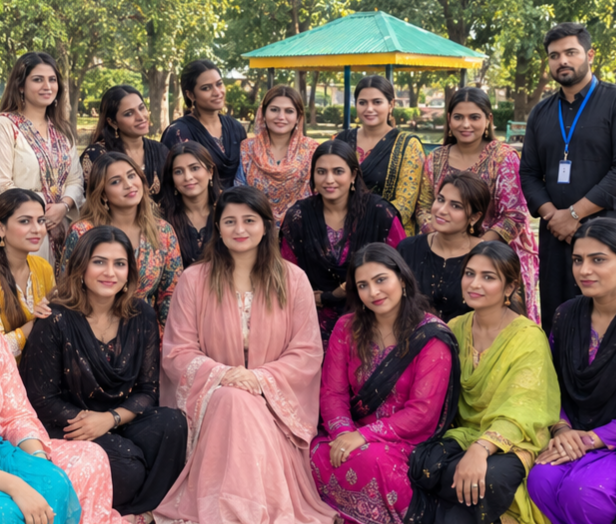
_Transgenders awareness session in Muzaffarabad, highlighting the gap between legal recognition and lived realities_
Report : ANI :
MUZAFFARABAD, AJK –As Pakistan's transgender-rights discourse increasingly moves from legislation and national policy forums toward questions of education, employment, healthcare and social protection, a two-day awareness and community engagement session in Muzaffarabad has brought renewed attention to the realities facing the Transgenders (Khawaja Sira) community in Azad Jammu and Kashmir under the leadership of All Pakistan Media Council (APMC-ISB) Chairperson Qurat ul Ain Ali Khawaja, the two-day engagement at Jalalabad Garden brought together members of the Transgenders(Khawaja Sira) community to discuss rights, educational opportunities, employment, social inclusion and access to public institutions.
The first day focused on interaction with community members from Muzaffarabad, while the second expanded into a regional gathering of distinguish participants from Muzaffarabad and surrounding areas. The engagement comes amid renewed national attention to Transgender Rights. The "Sindh Transgender Summit, held on 28 September 2026" under the theme “From Exclusion to Entitlement: Closing the Rights Gap for the Khawaja Sira Community in Sindh,” brought together government representatives, civil society, legal experts and community representatives to discuss education, healthcare, employment, social protection, safe housing, vocational training and police sensitisation.
Yet the central question remains: what happens when national policy conversations reach the community itself? For AJK, the answer begins with understanding a population that remains significantly under-documented. According to the AJK Bureau of Statistics and Planning & Development Department, the 2017 Census recorded only 152 transgender persons across AJK's ten districts.
Muzaffarabad recorded the highest number at 41, followed by Kotli with 25, Neelum with 18, Mirpur and Bhimber with 16 each, Bagh with 12, Poonch with 10, Haveli and Sudhnoti with six each, and Jhelum Valley with only two. These figures should not be interpreted as the actual size of AJK's Khawaja Sira population. They represent a census count rather than a comprehensive community-mapping exercise. The distinction matters. Stigma, social exclusion, reluctance to disclose identity, changing definitions and limitations in data collection have historically affected transgender population statistics in Pakistan. The National Commission for Human Rights has also highlighted inadequate data and the marginalisation of transgender persons.
The result is a fundamental policy dilemma: what is not properly counted is difficult to plan for, and what is not documented is difficult to represent in public policy. The Muzaffarabad experience also demonstrates why a district-by-district approach may provide only a partial picture.Earlier reporting on the city's Khawaja Sira community documented movement between Muzaffarabad and neighbouring Mansehra, as well as the importance of community networks and Main Leader structures. A 2018 report cited an advocacy-based estimate that approximately 63 percent of transgender people in Muzaffarabad were migrants and 37 percent local. That estimate, however, should not be confused with an official population statistic. The participation of individuals from Mansehra and Garhi Habibullah in the recent Muzaffarabad engagement reinforces the regional character of these networks. Community relationships do not necessarily follow the administrative boundaries established by governments. Policy, therefore, must account for mobility, social networks and cross-district linkages rather than treating each district as an isolated unit.
One of the more sensitive issues emerging from the engagement was the reported hesitation of some community members to participate openly in external programmes and activities. Some potential participants were reportedly reluctant to attend because they believed they required permission from, or remained accountable to, senior figures within their community structure. Such circumstances should not automatically be characterised as a “mafia” without evidence of organised criminal activity. The more meaningful question is whether a structure originally developed for protection can, under certain circumstances, also become a mechanism of control.
The guru–chela system has historically provided belonging, protection and a substitute family for people rejected by their biological families. The National Commission for Human Rights has documented the role of gurus as guardians and community heads, while academic research has examined the social and economic functions of these structures. The policy challenge is therefore not to condemn an entire community structure. It is to examine whether individuals retain meaningful freedom within it. If a person becomes afraid to attend an educational programme, pursue professional training, engage with an outside organisation or explore an alternative livelihood because of anticipated disapproval from a community authority, the issue moves beyond external discrimination. It becomes a question of individual agency and freedom of choice.
Education is central to this debate because it can provide the foundation for economic independence and wider social participation. AJK's overall literacy indicators are comparatively strong. According to the AJK Statistical Year Book, the general literacy rate stood at 74.79 percent in 2017, with male literacy at 84.54 percent and female literacy at 65.83 percent. But these figures reveal almost nothing about the educational status of the territory's transgender population. There is no comparable official district-wise dataset showing how many Khawaja Sira persons have completed primary education, secondary education, higher education or professional training. National studies provide an indication of the broader challenge, although their findings cannot be treated as AJK-specific statistics.
A 2020 study involving 150 Khawaja Sira respondents reported a literacy rate of 45 percent and employment of only 7 percent, with most literate respondents having education below matriculation. A separate 2026 study of 91 Khawaja Sira participants in Islamabad found that 50.5 percent had never attended school. The study reported primary education for 18.7 percent, secondary education for 3.3 percent, intermediate education for 6.6 percent, bachelor's-level education for 16.5 percent and master's-level education for 4.4 percent. These findings demonstrate the scale of the national educational challenge while simultaneously highlighting the need for AJK-specific evidence rather than assumptions based on national averages.
The engagement also raised concerns about the possibility that some community members may face pressure to remain within established occupations and social roles rather than pursue education or professional development. Such observations require careful treatment. Experiences vary considerably, and no single social structure can be assumed to represent everyKhawaja Sira individual. The issue is not the dignity of any particular lawful profession. The fundamental question is choice. A young Khawaja Sira person should be able to decide whether to become a teacher, lawyer, journalist, researcher, entrepreneur, civil servant, designer, technician or business owner. Identity should not determine the ceiling of ambition. Where social expectations or internal authority discourage education and professional development, dependency can become self-perpetuating. An individual already excluded from mainstream society may depend heavily on community structures for family, housing and income. If alternative education and employment pathways are then inaccessible or discouraged, economic independence becomes even more difficult.
*Society Also Bears Responsibility*
However, the responsibility cannot be placed entirely on community structures.
Mainstream society has also played a major role in restricting transgender people's access to formal employment, education, healthcare and social participation. Research in Pakistan has documented employment discrimination and the concentration of many Khawaja Sira individuals in a limited range of livelihood opportunities.
The cycle therefore has two dimensions. External exclusion can create dependency on community structures, while internal restrictions, where they exist, can potentially reinforce that dependency. A serious policy response must acknowledge both realities. Addressing only one side risks treating symptoms while leaving structural causes intact. The participation of people from Mansehra and Garhi Habibullah also highlights another problem: the considerable variation between official and research-based estimates of transgender populations. Mansehra has appeared in different population datasets, but the numbers have varied significantly. Such discrepancies demonstrate why official counts should not automatically be treated as precise measurements of community strength. Changes in methodology, willingness to disclose identity, categorisation and data-collection practices can substantially influence the figures. A decline in an official count does not necessarily mean that the actual community has declined by the same proportion. This makes community engagement and independent research particularly important. Statistics should guide policy but statistics without context can also mislead policy. The Sindh summit similarly focused on closing the gap between formal recognition and practical entitlement.
For AJK, the lesson is straightforward: rights must be accompanied by awareness, accessible institutions and practical opportunities. A person cannot exercise a right they do not know exists, cannot access an opportunity if institutional pathways are unclear, and cannot achieve economic independence without education and meaningful employment options.
"AJK Needs Its Own Evidence"
One of the clearest policy conclusions emerging from the Muzaffarabad engagement is the need for dedicated AJK research. Policymakers need reliable answers to basic questions:
How many Khawaja Sira persons actually live in each district?
How many move between AJK and neighbouring regions?
What proportion have completed different levels of education?
How many possess CNICs and other essential documentation?
How many are employed outside traditional community occupations?
How many seek vocational or professional training?
What are their healthcare needs?
How many experience family rejection?
How many depend on community structures for housing and income?
At present, AJK lacks adequate answers to many of these questions. That is not simply a statistical weakness. It is a policy weakness. A meaningful AJK response should begin with evidence and participation. The success of Pakistan's transgender-rights agenda will not ultimately be measured by the number of summits held or policies announced. It will be measured by whether a young Khawaja Sira person in Muzaffarabad, Neelum, Kotli, Mirpur, Mansehra or Garhi Habibullah can confidently say:
“I know my rights. I can pursue my education. I can choose my profession. I can participate without fear. And nobody inside or outside my community can decide the limits of my future.”
That is when recognition becomes rights.That is when rights become opportunity.And that is when inclusion becomes real.