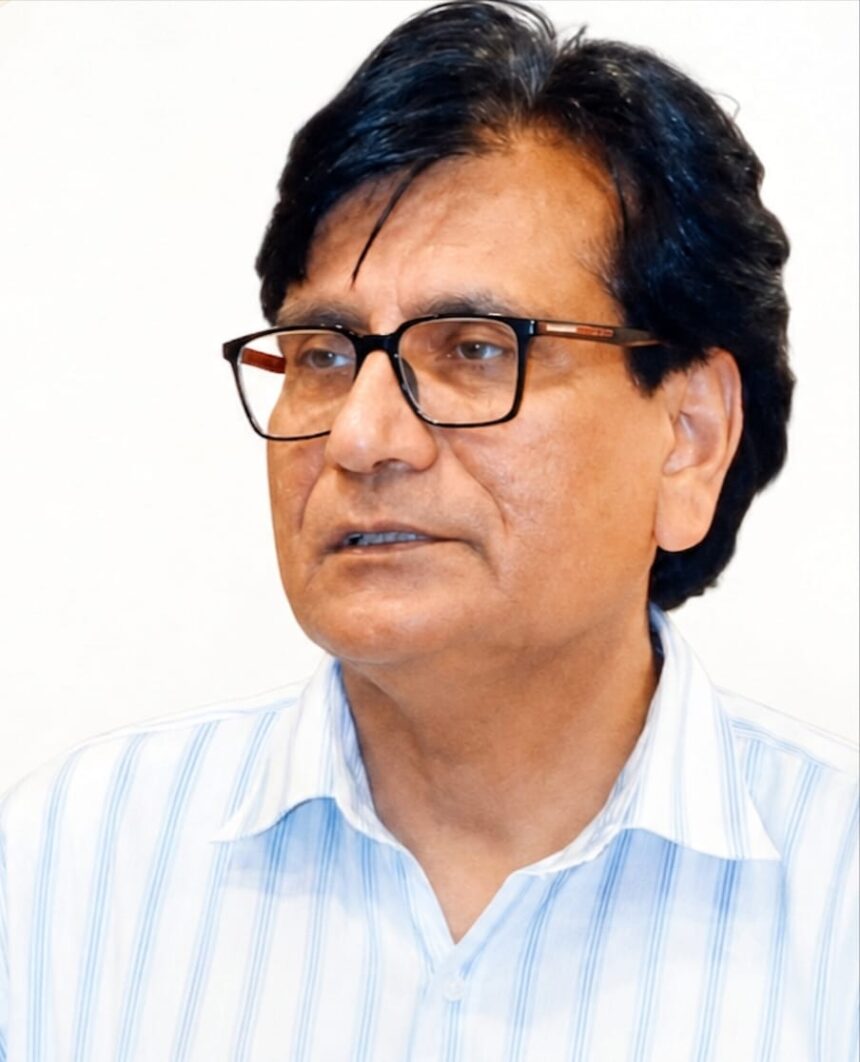
By: Dr. Nasser Hussyn Bukhari
Published By:ANI News Agency
Once again, clouds of grief, pain and uncertainty have gathered over the Middle East. The war is no longer confined to Gaza, Lebanon, Yemen or Iran; its repercussions are now reaching deep into the economic, energy and security systems of the Arab world. The central question is this: after decades of relying on the United States as their security guarantor, where do the Arab states look when the danger reaches their own doorstep?
The foundations of the Saudi-American relationship were consolidated in 1945 following the meeting between President Franklin D. Roosevelt and King Abdulaziz. From the beginning, the core interests were clear: Saudi oil for the United States and political and defence support for Saudi Arabia. Over time, this relationship evolved into a comprehensive security partnership. American arms, military training, intelligence cooperation and the US military presence in the Gulf strengthened Saudi Arabia’s security architecture, while Saudi oil assumed a crucial role in the global economy. Yet the real test of this arrangement, which has lasted for more than seven decades, has always been whether American security guarantees would remain equally effective when Saudi and American interests move in different directions.
When Iraq invaded Kuwait in 1990, Saudi Arabia allowed the deployment of American forces on its soil. A broad international coalition was formed under US leadership, and in 1991 Operation Desert Storm expelled Iraqi forces from Kuwait. According to the historical record of the US Department of State, Saudi Arabia permitted the deployment of American forces to protect the Arabian Peninsula from the Iraqi threat. The war demonstrated the importance of American military power to Saudi security, but it also reinforced a security model in which external powers assumed the central role rather than regional states developing a genuinely collective defence capacity.
Then came the US invasion of Iraq in 2003. Saddam Hussein’s government was removed, but the subsequent collapse of state institutions, sectarian conflict and proliferation of armed groups transformed the regional balance of power. Iran’s regional influence expanded, while a complex competition emerged through various armed groups and political networks in Iraq, Syria, Lebanon and Yemen. The Iraq war highlighted an important distinction: defeating a state militarily and creating a stable regional order afterwards are two entirely different tasks. The consequences of Iraq demonstrated this distinction with particular force.
Yemen provides an even more complicated example. When a revolution against the monarchy broke out in Yemen in 1962, Egypt under Gamal Abdel Nasser sent troops to support the new republican government, while Saudi Arabia backed the royalist forces. Yemen consequently became not merely the scene of an internal political conflict but also an arena for regional rivalry. After years of fighting, Egypt eventually withdrew its forces. Yemen’s mountainous geography and complex local political structures once again demonstrated how difficult it is for an external power to impose a military solution.
The same historical lesson emerged in a different form after 2015. Following the Houthi takeover of Sana’a and the weakening of Yemen’s internationally recognised government, a Saudi-led coalition intervened militarily. Its stated objective was to push back the Houthis and restore the government. Yet almost a decade later, the Houthi movement has not disappeared. It retains control and influence over large parts of Yemen and has acquired the capacity to affect international maritime commerce through its position near the Red Sea and Bab el-Mandeb. Recent developments have further demonstrated the strategic importance of the area, with Houthi advances near Bab el-Mandeb raising concerns for both Saudi security and international shipping.
The most important lesson for Saudi policy is that superiority in modern weapons does not necessarily translate into political victory. Saudi Arabia and its allies possessed sophisticated aircraft, missile-defence systems and substantial military resources. Yet Yemen’s geography, local political realities and the Houthis’ military strategy prevented that military superiority from producing a decisive political outcome. The 2022 truce reduced fighting for a period, but it did not resolve the underlying conflict. The renewed escalation is another indication that the political process remains incomplete.
The current crisis has also raised another fundamental issue for Saudi Arabia: energy security. Amid tensions around the Strait of Hormuz, the Saudi East-West pipeline has acquired even greater strategic importance because it provides an alternative route for transporting crude oil from eastern Saudi Arabia to the Red Sea port of Yanbu. But this infrastructure has also faced attacks, disrupting its operations. The implication is clear: for Saudi Arabia, the threat is no longer confined to oil fields. The routes through which oil reaches international markets can themselves become targets. The Red Sea, Bab el-Mandeb and the Strait of Hormuz are now strategically interconnected, and disruption at one point can increase both the importance and vulnerability of the others.
The attacks on Abqaiq and Khurais in 2019 cannot be ignored either. They severely disrupted Saudi oil production for a period and demonstrated how a relatively limited drone and missile attack could strike critical infrastructure belonging to one of the world’s largest oil companies and send shockwaves through global energy markets. The episode should have made one reality increasingly clear: future wars will not necessarily be fought along conventional battlefronts. Drones, cruise missiles, cyberattacks, proxy forces and attempts to disrupt maritime routes have become central elements of modern security challenges.
The present crisis in Yemen represents another manifestation of this transformation. Reports that Saudi Crown Prince Mohammed bin Salman sought direct American military assistance from President Donald Trump against the Houthis, while Washington refrained from launching direct attacks, illustrate the practical limits of the US-Saudi security partnership. Washington has been prepared to provide intelligence and targeting support, but has avoided entering the conflict directly.
This is precisely where Saudi Arabia needs to reconsider its long-term concept of security. Ending defence ties with the United States would neither be realistic nor necessary. But treating a single external power as the ultimate guarantor of national security also carries risks. The Gulf War of 1991 demonstrated how American military power could help liberate Kuwait; the Iraq war of 2003, however, showed how external military intervention could produce far-reaching and unpredictable regional consequences. Yemen demonstrated that even overwhelming air power cannot produce a lasting settlement when local political realities are ignored.
Against this backdrop, the Saudi-Iran rapprochement of 2023 assumes particular significance. Following talks hosted by China, the two countries agreed to restore diplomatic relations, reopen embassies and pursue dialogue to address their differences. The most important aspect of this development was that Saudi Arabia chose a direct diplomatic channel with its principal regional rival. In the present crisis, keeping that channel open, and perhaps making it more active , has become even more important. China has also recently engaged with Iran following a Saudi request to restrain the Houthis, highlighting Beijing’s growing diplomatic relevance in the region.
Another recurring problem in the history of the Arab world is that regional states often begin to regard one another as threats and consequently become more dependent on external powers. As a result, relations with outside powers grow stronger while regional cooperation remains weak. The Iran-Iraq war from 1980 to 1988 pushed Gulf states to look increasingly towards external powers for their security. The 1990 Kuwait crisis further entrenched the American military presence in the Gulf. The 2003 Iraq war, the devastating civil war in Syria after 2011, the conflict in Libya following the collapse of the Gaddafi regime, and the prolonged war in Yemen have all contributed to persistent instability. Each conflict had its own causes and dynamics, but collectively they reinforced one fundamental reality: instability in one Middle Eastern country inevitably affects the security of others.
The Palestinian question remains the clearest example of this interconnected regional crisis. The war in Gaza has exposed political differences among Arab governments, Western powers and international institutions. It is difficult to imagine lasting stability in the Middle East without addressing the Palestinian issue, because it is directly connected with Arab public opinion, Iran’s regional policy, Israel’s security concerns and American strategy in the Middle East.
For Saudi Arabia, therefore, the central question is not whether America is a friend or an adversary. In foreign policy, permanent emotional labels matter less than national interests. The real question is whether Saudi Arabia can move from dependence on a single external security provider towards a more diversified, multilateral regional security strategy. Its relationship with the United States can remain important; its economic partnership with China can develop further; defence cooperation with Pakistan can continue; and diplomatic engagement with Iran can remain open. Together, these relationships can form elements of a more balanced security architecture.
The defence agreement between Pakistan and Saudi Arabia should also be viewed in this broader context. Yet no defence agreement should be treated as a military solution to every regional problem. Yemen demonstrates that military power cannot substitute for political strategy. Similarly, making confrontation with Iran a permanent policy could create additional difficulties for Saudi Arabia over the long term.
The wars of the past half-century in the Middle East offer a consistent lesson: the balance of power has repeatedly shifted, governments have changed, alliances have been reconfigured and new armed organisations have emerged, but the underlying causes of conflict have rarely disappeared completely. Iraq, Syria, Yemen, Lebanon and Palestine represent different manifestations of this reality.
For the Arab world, therefore, the most urgent requirement is not simply to purchase more weapons but to rethink its collective strategic approach. Secure energy corridors, stronger regional diplomacy, economic diversification, joint defence planning and sustained dialogue with all major neighbouring states, including Iran, could provide the foundations for a new regional security framework.
History teaches us that great powers ultimately make decisions according to their own interests. In 1991, the United States assembled a broad coalition to defend Kuwait, while in 2003 its invasion of Iraq transformed the regional balance of power. In Yemen, Saudi Arabia relied on military power, yet a political settlement remains indispensable. In 2023, Saudi Arabia opened a diplomatic channel with Iran, with China emerging as an important mediator. These examples point to one fundamental conclusion: lasting security cannot depend on a single protector. It requires a balance of power, active diplomacy and greater regional self-reliance.
The Arab world must now decide whether it will continue to bear the consequences of wars shaped by others or seek to build a regional security system in which war becomes the last resort rather than the first response. Geography does not allow Saudi Arabia, Iran, Yemen, the Gulf states and Pakistan to exist in isolation from one another. External powers will come and go, alliances will change, but the region will remain where it is. The future of the Middle East may therefore depend on when its states recognise that their security must ultimately be rooted less in the promises of others and more in their shared interests.