

Written by Rana Farooq Ashraf : Published by ANI
Pakistan has a peculiar habit: we are often impressed by what is visible on the surface, while rarely asking what lies underneath. A freshly paved street, a newly painted road, an inauguration ceremony and a large development banner are enough for us to declare an area “developed”. But the first heavy rain often washes away that illusion.
The torrential rains of August 31 and September 1, 2026, in Rawalpindi and Islamabad have once again exposed the weakness behind our development claims. Roads turned into streams, streets were flooded, traffic was disrupted and residents in low-lying areas faced serious difficulties.
The question is not why it rained. No government can control the weather. The real question is why cities remain unprepared for a phenomenon that returns every year.
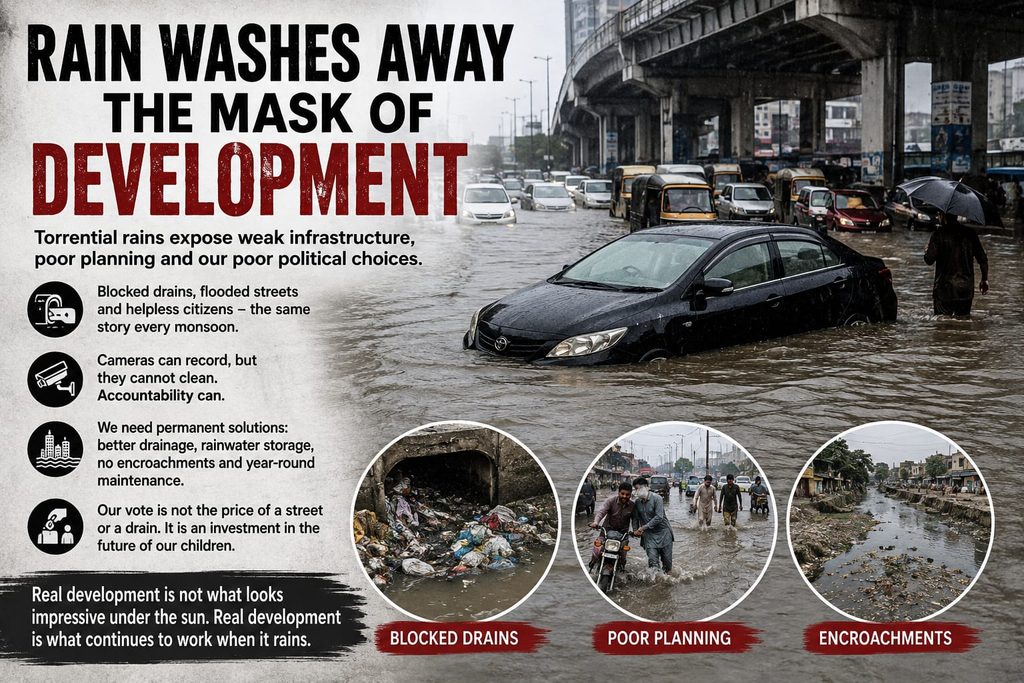
Every monsoon, authorities announce preparations. Drains are reportedly cleaned, machinery is placed on standby and emergency plans are discussed. Yet when heavy rain arrives, the same scenes return: overflowing drains, stagnant water, flooded streets and helpless citizens trying to protect their homes and businesses.
If the same problem occurs every year, it can no longer be described simply as a natural disaster. It is also a failure of urban planning, drainage management and administrative preparedness.
The Punjab government’s Suthra Punjab programme is certainly an ambitious initiative. Considerable public money is being spent on improving sanitation, waste collection and monitoring. The government has also introduced modern methods of supervision, including digital monitoring, cameras and drones.
But there is a simple reality that must not be forgotten: a camera can record a blocked drain, but it cannot clean it.
The real test of Suthra Punjab is not what appears in an official presentation or on a government dashboard. Its real test is what happens in a street when the rain starts.
Cleanliness cannot simply mean collecting household waste. A truly clean city needs functioning sewage systems, open drainage channels, proper storm-water routes and an emergency response system capable of protecting citizens when extreme weather arrives.
The Punjab government must therefore move beyond seasonal cleanliness campaigns and develop permanent solutions. Major cities need comprehensive maps showing natural waterways, storm-water drains, low-lying areas and locations where flooding repeatedly occurs. These vulnerable points should be permanently redesigned rather than repaired every year after the damage has already been done.
Illegal construction and encroachments on natural waterways must also be dealt with without political discrimination. If natural water routes are blocked by roads, markets, buildings or housing schemes, the water will eventually find another route—and that route may be through someone’s home.
Rainwater storage should also become part of urban planning. Where possible, parks, public spaces and government land can be designed to temporarily retain excess rainwater. This can reduce pressure on drainage systems and help recharge groundwater.
Most importantly, drainage systems must be maintained throughout the year rather than being cleaned only when the monsoon approaches. Every district should have measurable targets: how quickly should flooded roads be cleared, how rapidly should water be removed from vulnerable neighbourhoods, and who will be held responsible when the system fails?
But there is another side to this story, and it is uncomfortable for us as citizens.
We cannot blame politicians for everything while ignoring our own political choices.
Every election, our political priorities are often reduced to one question: Who will pave our street? Who will build our drain? Who will repair the road outside our house?
Sometimes a plate of biryani is enough. Sometimes a small personal favour is enough. Sometimes a promise to pave a street becomes more important than a candidate’s ability to legislate, govern or understand economic and social issues.
We then elect representatives on the basis of narrow personal interests and, five years later, complain that the system is corrupt and incompetent.
This is where we must look in the mirror.
The job of an elected representative is not simply to become a contractor for a constituency. His responsibility is to legislate, strengthen institutions, improve education and healthcare, create employment, ensure clean water, improve sanitation and build cities capable of facing the challenges of population growth and climate change.
A paved street may make one neighbourhood look better. A functioning system can change the future of an entire generation.
The rains of August 31 and September 1 have therefore exposed more than flooded roads. They have exposed our development model, our administrative weaknesses and, perhaps most importantly, our political priorities.
The government must move from announcements to implementation, from temporary measures to permanent planning, and from publicity to accountability.
Citizens, too, must change the way they measure political performance.
Our vote should not be the price of a street, a drain, a meal or a personal favour. It should be an investment in the future of our children.
Rain will come again next year.
The question is whether we will once again spend the monsoon pumping water out of our streets—or finally build cities where the rain can fall without bringing the entire system to its knees.
Real development is not what looks impressive under the sun. Real development is what continues to work when the rain begins.



,Rana Sahib has drawn attention to a very serious and important issue. He has said all the things that are on the mind of every citizen. Dealing with a natural disaster is not a matter for anyone. But it is also necessary to take preventive measures. It is absolutely wrong to blame the government alone in this matter. We ourselves choke the drains, demonstrating our negligence and irresponsibility. If we show civic responsibility, many problems can be solved. Rana Sahib, you have used your pen well on a very sensitive issue.
The government works on various projects for the convenience of the people. But after the project is completed, its maintenance is essential. Civic sense is equally important. Supervision of the contractor and quality control officer is also very important.
Thank you, Sir, for your thoughtful and balanced response. I completely agree with you that dealing with a natural disaster is not entirely within the government’s control, and citizens must also accept their share of responsibility.
My article was never intended to blame the government alone. In fact, one of its central arguments is that governance and civic responsibility must go hand in hand. When citizens throw garbage into drains, ignore civic rules or occupy natural waterways, they contribute directly to the problem. At the same time, the government has the responsibility to ensure proper planning, regular maintenance, effective drainage, enforcement of laws, quality control and accountability after a project is completed.
In my view, the real issue is not about finding someone to blame; it is about asking why the same problems continue to occur year after year despite substantial public spending and repeated monsoon preparations.
A road, drain or development project cannot be considered successful merely because it has been completed or inaugurated. Its real success lies in its maintenance, functionality and ability to serve people when they need it most. This is where supervision of contractors, quality control, timely maintenance and accountability become extremely important.
Likewise, civic sense cannot be expected from citizens alone through speeches or campaigns. It has to be strengthened through awareness, enforcement and a system that makes responsible behaviour easier and irresponsible behaviour costly.
So, I fully agree with your point: the solution lies neither in blaming the government alone nor in blaming the public alone. The government must provide competent planning and accountable services, contractors must deliver quality work, officials must ensure proper supervision, and citizens must fulfil their civic responsibilities.
Only when these four elements work together can we build cities that remain functional not only in normal weather, but also when nature tests the strength of our systems.
Thank you again for engaging with the article in such a constructive way. That is exactly the kind of debate we need.