By Rana Farooq Ashraf : Published by ANI
Few chapters in Pakistan’s political and judicial history carry the emotional weight of the final days of Zulfikar Ali Bhutto. His imprisonment, his years in the death cell, his final appearance before the Supreme Court and his execution on April 4, 1979, remain deeply embedded in the country’s constitutional and democratic history.
Bhutto served as President and Prime Minister of Pakistan, founded the Pakistan Peoples Party and played a central role in the making of the Constitution of 1973. He was also one of Pakistan’s most prominent statesmen, representing the country at major international forums and helping shape its foreign policy during a defining period in the country’s history.
Following the military coup of July 1977, however, Bhutto’s political life entered its final and most tragic phase.
On March 18, 1978, the Lahore High Court sentenced Bhutto to death in the murder case involving Nawab Muhammad Ahmad Khan Kasuri. Bhutto appealed to the Supreme Court of Pakistan.
On February 6, 1979, the Supreme Court upheld the death sentence by a narrow four-to-three majority.
That four-to-three decision would remain one of the most consequential and debated judgments in Pakistan’s judicial history.
What makes Bhutto’s final chapter particularly poignant is the account he himself gave of his condition inside prison.
By the time he appeared before the Supreme Court, he had spent a prolonged period in solitary confinement in the death cell. During his defence, Bhutto told the court that after a long period inside his small death cell, he was physically struggling to stand for an extended period.
His counsel, Yahya Bakhtiar, requested an adjournment because Bhutto was exhausted. Bhutto nevertheless indicated that he was prepared to continue if the court wished him to do so.
The exchange revealed an extraordinary human dimension to the proceedings.
A former Prime Minister, once at the centre of national and international politics, was now physically weakened, confined and facing execution. Yet he remained determined to present his case before the highest court of the land.
When the court was scheduled to resume proceedings the following morning, reference was made to Bhutto’s habit of rising early.
His response was striking. He explained that although he had always been accustomed to rising early, the conditions of imprisonment had made it extremely difficult for him to sleep.
Bhutto then described his experiences in prison.
According to his account, while he was held at Kot Lakhpat Jail, mentally disturbed prisoners were kept near his cell and their continuous cries made sleep difficult. After his transfer to Rawalpindi Jail, he said that stones were thrown onto the roof of his cell at night.
He further described hearing the sound of military boots and what he believed to be marching on a nearby roof during the night.
These details should be understood primarily as Bhutto’s own account of his prison experience. Some have subsequently circulated widely in political literature and on social media. A responsible historical account must distinguish between a prisoner’s testimony and independently verified fact.
That distinction, however, does not diminish the significance of his testimony.
Bhutto was describing what it meant to live under a sentence of death.
For a man who had once occupied the highest offices of the state, the transformation into a condemned prisoner was an extraordinary reversal of circumstances.
His prison writings provide another important window into this period.
In If I Am Assassinated, Bhutto recorded his experiences of imprisonment, isolation and life inside the death cell. He sought to leave behind his own account of the political and legal circumstances that had brought him to the point of execution.
His prison record also contains references to health complaints and physical difficulties during his final period of confinement.
Yet what stands out most strongly from his final statements is not simply physical suffering.
It is determination.
His body had weakened, but his resolve to speak had not disappeared.
That distinction is central to understanding the historical importance of his final appearance before the Supreme Court.
The courtroom was not merely the final stage of a criminal appeal. It was also the last major institutional forum in which Bhutto could present his own account of the events that had brought him to the death cell.
The political circumstances surrounding the trial were extraordinary.
Bhutto had been removed from power in a military coup led by General Zia-ul-Haq in July 1977. Pakistan was under martial law, political institutions had been disrupted and the country was experiencing a profound constitutional and political crisis.
It was in this environment that Bhutto’s trial proceeded.
The Supreme Court’s decision to uphold the death sentence by four votes to three meant that three members of the bench dissented. Their opinions raised important questions concerning the evidence and the legal reasoning involved in the case.
The narrow division of the bench became an enduring feature of the historical discussion surrounding the trial.
For decades, the case remained central to debates about constitutionalism, judicial independence and the relationship between political authority and the courts.
In 2011, former President Asif Ali Zardari filed a presidential reference under Article 186 of the Constitution, seeking the Supreme Court’s opinion on questions relating to Bhutto’s trial.
After years of proceedings, the Supreme Court gave its opinion on March 6, 2024.
The court unanimously observed that Bhutto had not been afforded a fair trial in accordance with constitutional and legal requirements.
The significance of this opinion was considerable.
The Supreme Court did not formally overturn Bhutto’s conviction or declare him acquitted. It held that the constitutional mechanism available through the presidential reference did not provide a procedure for simply setting aside the historical conviction.
However, the court acknowledged that the requirements of a fair trial and due process had not been fulfilled.
This gave the case a new constitutional and historical dimension.
The question was no longer limited to whether Bhutto was guilty or innocent.
A broader question emerged:
Was the process through which a former Prime Minister of Pakistan was sentenced to death consistent with the standards of a fair and impartial trial?
That question extends beyond one individual.
It concerns the independence of institutions.
It concerns the protection of constitutional rights during extraordinary political circumstances.
It concerns the responsibility of courts to remain impartial regardless of the political environment.
And it concerns the fundamental principle that every accused person is entitled to due process.
Bhutto’s final days also became part of international historical discourse.
His execution on April 4, 1979, received extensive international attention. In the decades that followed, his trial and execution continued to be examined in the context of Pakistan’s democratic development, military rule, constitutional politics and judicial independence.
The digital age has given this historical chapter another life.
Every year around April 4, excerpts from Bhutto’s speeches, photographs, prison writings and statements attributed to him circulate widely on Facebook, X and other digital platforms.
Some quotations are authentic; others are shortened, edited or incorrectly attributed.
For this reason, Bhutto’s final words should be studied through original court records, official documents, his own writings and credible historical research rather than relying solely on viral social-media posts.
This distinction is particularly important when discussing his prison experiences.
The historical record should be preserved with accuracy because Bhutto’s final days are not merely a matter of political memory. They form part of Pakistan’s institutional history.
His story represents an extraordinary contrast.
The man who had once represented Pakistan before world leaders was now standing before judges while awaiting execution.
The political leader who had addressed enormous public gatherings was confined to a small prison cell.
The former Prime Minister who had helped shape Pakistan’s constitutional framework was fighting for his life through legal arguments.
Yet he continued to speak.
Perhaps that is the most enduring aspect of his final chapter.
The walls of the prison could restrict his movement, but they could not completely silence his voice.
His physical condition deteriorated, but his determination to present his case remained.
More than four decades later, the Supreme Court returned to the historical record and acknowledged that the proceedings had not met the requirements of a fair trial.
History rarely provides complete closure.
But it can provide institutions and societies with an opportunity to reconsider their past.
The Bhutto case is one such moment.
It reminds Pakistan that constitutional democracy cannot depend solely on the personalities occupying positions of power. It depends upon institutions capable of protecting law, due process and fundamental rights even during periods of political upheaval.
A state is strongest not when it defeats its opponents, but when it guarantees justice to every citizen.
A court demonstrates its authority not merely by delivering a verdict, but by ensuring that the process leading to that verdict remains fair, transparent and independent.
And a democracy is judged not only by the strength of its governments, but by the protection it provides to fundamental rights when circumstances are at their most difficult.
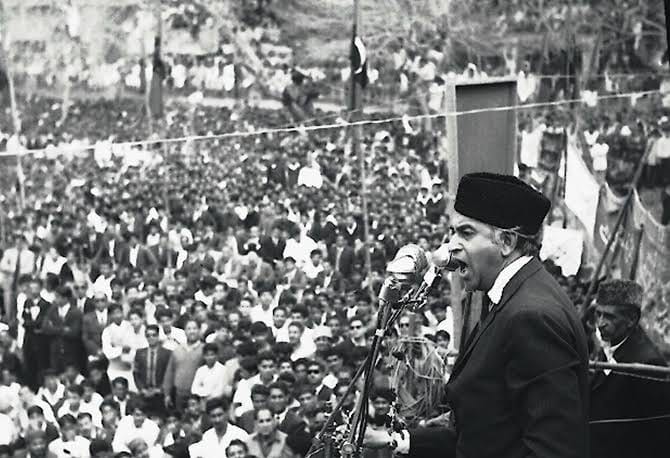
Zulfikar Ali Bhutto was executed on April 4, 1979.
His life ended, but the questions surrounding his trial did not.
Governments changed.
Generations passed.
Political circumstances evolved.
Yet the debate over justice remained.
The Supreme Court’s 2024 opinion gave that debate a new constitutional and historical dimension.
Perhaps that is why Bhutto’s final appearance before the court continues to resonate.
He entered the courtroom physically exhausted, but determined to speak.
He faced a sentence of death, yet continued to defend his position.
And decades later, Pakistan’s highest court revisited the process through which that sentence had been imposed.
The enduring lesson is simple but profound:
Justice is not merely the verdict delivered at the end of a trial. Justice is also the fairness of the journey that leads to that verdict.
From the narrow confines of the death cell to the highest court of the land, Bhutto’s final chapter remains a powerful reminder that political history and judicial history are often inseparable.
Bhutto’s death belongs to the past.
But the question of justice remains alive