Report :Syed Sardar Mohammad Khondai
QUETTA — Leaders of major democratic political parties in Balochistan have announced joint resistance to every attempt to undermine politics, journalism, the judiciary and the democratic process.
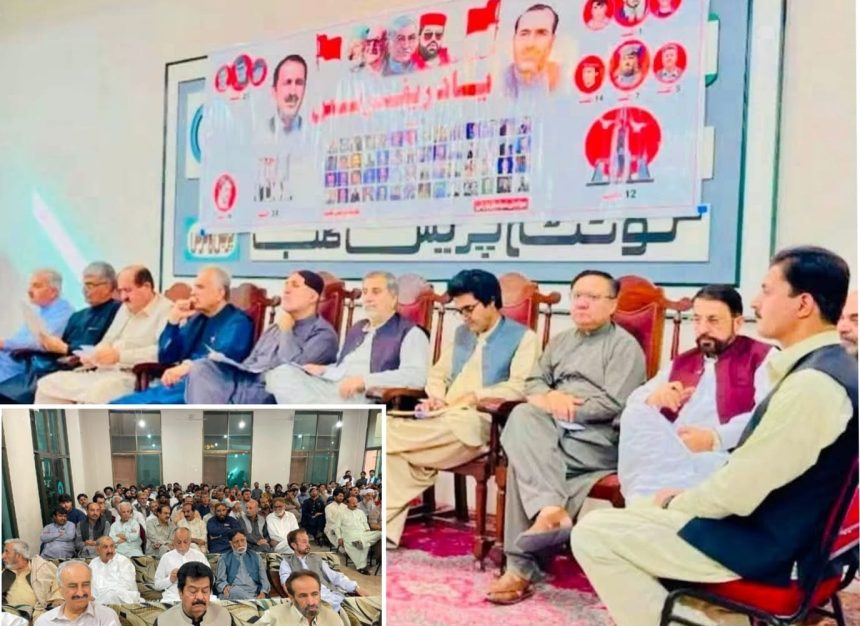
Speaking at a reference organized by the Awami National Party (ANP) at the Quetta Press Club in memory of the Shuhada-e-August, the leaders rejected attempts to create divisions in Balochistan and Pashtunkhwa and warned against administrative decisions concerning new provinces without the consent of the people.
The speakers said that the political, economic and constitutional issues of Balochistan and Pashtunkhwa cannot be resolved through decisions imposed from Lahore, Islamabad or Rawalpindi. They stressed that lasting solutions require political dialogue, genuine representation, democratic processes and respect for constitutional rights.
They said the people of Balochistan and Pashtunkhwa are facing insecurity, unemployment, political marginalization and restrictions on their rights and resources. The speakers maintained that the region’s problems are fundamentally political and cannot be resolved through tribal, strategic or administrative approaches.
Referring to the history of democratic struggles in the region, the speakers recalled the unity demonstrated by political leaders such as Bacha Khan, Wali Khan, Ghaus Bakhsh Bizenjo, Khan Shaheed, Sardar Attaullah Mengal and Khair Bakhsh Marri. They stressed that strengthening political institutions and democratic forces is essential to overcoming the current crisis.
The speakers also condemned the arrests of political workers, restrictions on political activities and the use of the Fourth Schedule to prevent political engagement. They warned that attempts to weaken parliament, disregard the public mandate and create doubts about the electoral process pose a serious threat to democracy.
They said terrorism should not be treated as a sudden calamity, arguing that decades of violence have imposed an enormous human cost on Pashtun, Baloch and Hazara communities. They highlighted the loss of lives, displacement, insecurity and the impact of violence on women, children, youth and ordinary citizens.
The speakers further emphasized that the philosophy of Bacha Khan represents a century-long struggle for peace, democracy, non-violence and the rights of oppressed nations. They described the sacrifices of the Shuhada-e-August as an important chapter in this democratic and political struggle.
They also expressed concern over alleged discriminatory treatment of Pashtun and Baloch citizens, particularly workers and members of the business community, in Sindh, Punjab and Karachi. They called for protection of citizens’ fundamental rights and equal opportunities for employment and economic activity.
The speakers made it clear that the people of Balochistan and Pashtunkhwa would not compromise on their resources, identity, language, culture or democratic right to representation. They said the way forward lies not in force, restrictions or administrative divisions, but in political dialogue, constitutional supremacy, genuine democracy and recognition of the people’s right to govern.
The views were expressed by ANP Provincial President Asghar Khan Achakzai, National Party Central Secretary General Senator Kabir Mohammad Shahi, Balochistan National Party Central Deputy General Secretary Malik Naseer Shahwani, JUI Provincial Finance Secretary Haji Ainullah Shams, Pashtunkhwa Milli Awami Party Provincial General Secretary Kabir Afghan, Pashtunkhwa National Awami Party Central Spokesman Essa Roshan, National Democratic Movement Provincial President Ahmed Jan Khan, Hazara Democratic Party Central Spokesman Qadir Nail, ANP Provincial Parliamentary Leader Engineer Zamrak Khan Achakzai, Jamaat-e-Islami Provincial Vice Ameer Jameel Mushwani, ANP Provincial General Secretary Mabat Kaka, National Lawyers Forum Provincial President Kaleemullah Kakar Advocate, District Quetta President Sanaullah Kakar and others.
At the conclusion, prayers were offered for the elevation of the ranks of the martyrs and political elders, followed by the distribution of langar.