Written by: M Rashid Tabassum
Published By:ANI News Agency
Every year on August 14, Pakistan celebrates Independence Day with flag-hoisting ceremonies, national songs, green-and-white decorations, and patriotic enthusiasm. These celebrations are an important expression of national pride. However, Independence Day should not be confined to festivities or memories of the past. It should also provide an opportunity to reflect on why Pakistan was created, what ideals inspired its creation, and what responsibilities those ideals place upon us today.
The creation of Pakistan was not simply a change of borders or a transfer of political power. Muslims of the subcontinent struggled for a separate homeland where they could preserve their religious, cultural and social identity. Over time, this political struggle developed around the understanding that Muslims constituted a distinct community with their own history, values, traditions and way of life.
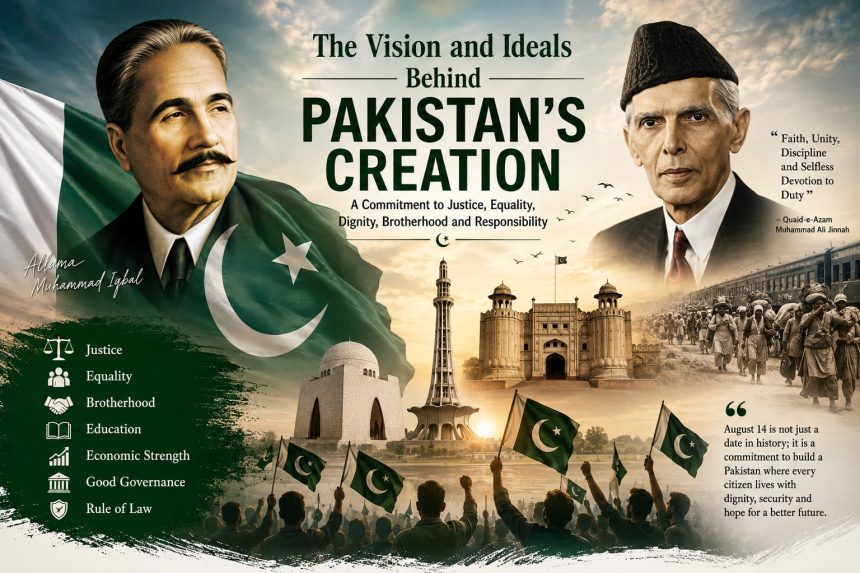
In this intellectual and political environment, Allama Muhammad Iqbal played a significant role in awakening political and cultural consciousness among Muslims. In his historic Allahabad Address of 1930, he articulated the idea of consolidating the Muslim-majority regions of north-western India into a political unit. His vision extended beyond political independence and placed considerable emphasis on Islam as a moral, social and civilisational framework. Later, Quaid-e-Azam Muhammad Ali Jinnah transformed this intellectual and political awakening into an organised constitutional struggle. Iqbal’s intellectual contribution and Jinnah’s political leadership became two important pillars of the Pakistan Movement.
More importantly, the demand for freedom was not merely about acquiring territory. The struggle reflected a desire for a state in which Muslims could shape their collective life in accordance with their faith, values and moral principles. In this context, the message of La Ilaha Illallah Muhammadur Rasoolullah represents a broader vision rooted in the sovereignty of Allah, the guidance of the Prophet Muhammad (PBUH), justice, equality, honesty, brotherhood and social responsibility.
Pakistan, however, was achieved at an enormous human cost. The Partition of 1947 brought mass migration, violence and destruction. Millions of people were forced to leave their homes, livelihoods and ancestral lands and rebuild their lives in a new country. Their sacrifices remind us that freedom is not merely the possession of territory. It carries a profound responsibility to build a state where citizens can live with security, dignity, justice and fundamental rights.
Quaid-e-Azam’s vision of the state remains equally important in this regard. His speeches emphasised the rule of law, equality, religious freedom, honest governance and public welfare. In his August 11, 1947 address to Pakistan’s Constituent Assembly, he articulated a vision of equal citizenship and religious freedom. In 1948, he also spoke about developing Pakistan’s economic system in accordance with Islamic principles.
After independence, this direction received constitutional recognition as well. The Objectives Resolution of 1949 acknowledged the sovereignty of Allah, while the Constitution of 1973 declared Islam the state religion and incorporated important provisions concerning the Quran and Sunnah. Yet the real test of any national ideal lies not merely in constitutional provisions, but in translating those principles into everyday governance, institutions and public life.
Today, Pakistan faces serious challenges, including inflation, poverty, unemployment, corruption, inequality and weaknesses in governance. These realities raise an important question: are justice, honesty, equality and accountability truly reflected in our institutions and society? If not, the problem is not simply a shortage of resources; it is also a weakness of governance and collective character.
An Islamic social order, therefore, should be understood as a system in which the law applies equally to all, rulers remain accountable, the vulnerable are protected, and the state serves its people. Such a vision also places a special responsibility on Pakistan’s youth. Independence Day celebrations should inspire young Pakistanis towards education, hard work, research, discipline, honesty and national service rather than remaining limited to flags, songs and social media trends.
August 14 should remind us not only of when Pakistan became independent, but also of why it was created and what we must do with that freedom. Pakistan’s future depends on a strong economy, justice, the rule of law and responsible citizens.
True Independence Day is therefore a commitment to national renewal: a commitment to transforming the ideals of freedom into practical values and building a Pakistan founded on justice, equality, dignity, brotherhood and responsibility.