BY: Tariq Usmani : Published by ANI News Agency:
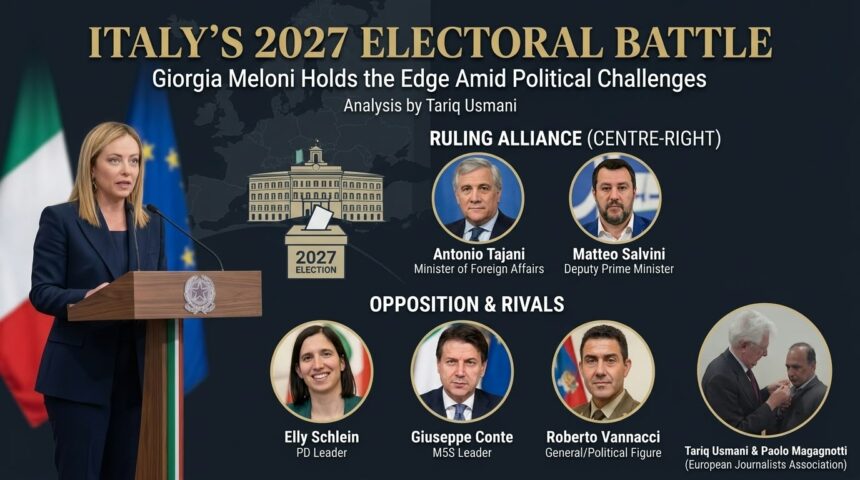
After attending the historic centenary congress of the International Federation of Journalists (IFJ) in Paris in May 2026, I had the opportunity to travel to Italy for a few days. This was no ordinary private trip; rather, it was a rare chance to closely observe and understand the evolving political, social, and journalistic pulse of the European Union’s third-largest economy. During this visit, I held detailed meetings with representatives of the Pakistani community—who have been engaged in business and labor in Italy for decades—as well as discussions with Mr. Paolo Magagnotti, President of the European Journalists Association, and other local journalists in Brescia. My connection with Pakistanis living in Italy and local journalists continues uninterrupted to this day. The firsthand observations and ground realities gathered from them regarding the current political climate indicate that despite countless challenges, Prime Minister Giorgia Meloni’s position will remain prominent in the upcoming elections.
The term of Italy’s current parliament concludes in October 2027, making it a constitutional requirement to hold new general elections before December 22, 2027. However, fresh insights from Italian journalistic circles suggest growing speculation that Prime Minister Giorgia Meloni may call snap elections in April or May 2027 to capitalize on her current popularity. The new electoral law (Stabilicum), passed in October 2026, has made the contest even more intriguing; under its provisions, any coalition securing at least 42 percent of the vote will receive a majority bonus of extra seats to ensure a clear parliamentary majority. During my conversations in Brescia with Mr. Paolo Magagnotti and local Italian journalists, one point stood out sharply: Italy’s electoral system is one of the most unique in the world. Unlike our setup, Italy does not have an independent election commission. Instead, the Ministry of the Interior handles administrative logistics, while the entire authority—from the official counting of votes to the final declaration of results—rests entirely with the independent judiciary. This is precisely why no one can cast doubt on the transparency of the electoral process.
Looking at the current landscape, Giorgia Meloni and her party, "Brothers of Italy" (Fratelli d'Italia), remain the country’s single largest political force with 27 to 28 percent public support. Both Pakistanis residing in Italy and local observers agree that successfully running a government for four years in a historically unstable political environment—while keeping the country steady on economic and diplomatic fronts—is Meloni’s crowning achievement, one that will keep her at the forefront in the coming polls. Nevertheless, it cannot be denied that she faces a mountain of challenges this time around. First, a rift has emerged in the right-wing vote. Former General Roberto Vannacci’s new far-right party, "National Future" (Futuro Nazionale), appears poised to siphon off 6 to 7 percent of the vote, and Meloni has taken a major political gamble by ruling out an alliance with them. Second, unlike the previous election, the opposition is no longer fragmented. Left-wing parties, including Elly Schlein’s Democratic Party (PD) and former Prime Minister Giuseppe Conte’s Five Star Movement (M5S), have forged a broad alliance called Campo Largo (Broad Field), which will select its consensus candidate through primary elections in February 2027. The latest opinion polls from November 2026 show the opposition alliance touching 43 to 44 percent, which could pose a severe test for Meloni’s coalition.
My visit to Italy and continuous dialogue with representatives of the Pakistani business community, rooted there for decades, make it clear that our community is no longer a silent spectator; it keeps a keen eye on Italian politics and holds pragmatic views. According to Pakistani circles, the primary reason for Giorgia Meloni’s popularity is her strong leadership and business-friendly policies, though the community's own political preferences are split into two camps. The working class employed in factories, agriculture, and the service sector, along with families seeking relaxed citizenship laws (particularly Ius Scholae for school-going children) and easier family reunification visas, view the Democratic Party and the center-left coalition as their allies. On the other hand, Pakistani entrepreneurs and community representatives who have spent years running businesses, restaurants, and construction firms in Italy openly support Giorgia Meloni’s policies due to tax cuts, an increased quota for legal work visas, and the protection of traditional family values, viewing her as a strong contender in the next election as well.
Whether at the Paris Congress or during my meetings in Brescia with Mr. Paolo Magagnotti and other Italian journalists, the foremost concern among journalists across Europe is foreign interference in elections and disinformation spread through Artificial Intelligence (AI). A recent warning by Italian Foreign Minister Antonio Tajani confirms fears that pro-Russian cyber networks may attempt to influence Italian voters by exploiting domestic issues such as inflation and the war in Ukraine. At the same time, the European Union’s fiscal rules and the defense priorities of the United States and NATO continue to exert indirect pressure on Italian politics.
Overall, Italy’s upcoming election is a major referendum on public trust in Giorgia Meloni’s leadership. On one side stand serious challenges such as a united opposition front, the impact of inflation, and a split in the right-wing vote; on the other, Meloni’s political stability, tax reforms, and firm grip keep her prominent in the electoral race. Which side Italian voters—including newly naturalized Pakistanis—choose to throw their weight behind will determine the future direction not only of Italy, but of all of Europe.