Report: ANI
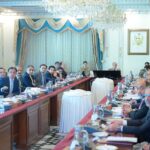
Islamabad: A seminar was held at Jammu Kashmir House to mark Jammu Martyrs’ Day, jointly organised by the All Parties Hurriyat Conference, Jammu and Kashmir Liberation Cell (Rawalpindi Centre) and the Kashmir Institute of International Relations.
The seminar was chaired by Hurriyat Conference Convener Ghulam Muhammad Safi, while Speaker of the Azad Jammu and Kashmir Legislative Assembly Chaudhry Tariq Farooq attended as the chief guest.
Former AJK President Sardar Masood Khan, former Hurriyat Conference conveners Muhammad Farooq Rehmani and Mahmood Ahmed Saghar, Chairman of the Kashmir Institute of International Relations Altaf Wani, Dr. Aamir Jahangir, Shamim Shawl, Ghulam Muhammad Butt, Sheikh Mateen, Imtiaz Wani, Raja Imtiaz Kamal, Director Kashmir Liberation Cell Raja Khan Afser Khan, Khawaja Imran-ul-Haq, Raja Rashid Raza and a large number of students and people from different walks of life also attended.
Addressing the seminar, Chaudhry Tariq Farooq said the tragedy of November 6, 1947, was a grave human tragedy. He said the killings of Muslims in Jammu began in August 1947, with one of the major massacres taking place on November 6. He alleged that the RSS, Indian forces and the Maharaja’s forces were involved in the killings.
He said Jammu and Kashmir remained an unresolved issue of the Partition of the subcontinent and that the people of the region continued their struggle for the right to self-determination. He added that India and its media were attempting to undermine the identity of Kashmiris, but would not succeed in erasing their distinct identity.
Farooq said Kashmiris and Pakistanis shared deep ideological, religious, geographical and intellectual ties, adding that Pakistan had consistently stood by the people of Kashmir despite various challenges. He paid tribute to the elders who had supported the decision to remain associated with Pakistan and urged young people to promote their cause through dialogue, reason and informed debate.
Former AJK President Sardar Masood Khan said the people of Kashmir must remain steadfast and continue highlighting the Kashmir dispute at international forums. Referring to the events of 1947, he cited historical accounts that reported large-scale killings and displacement of Muslims in Jammu. He said the violence had drastically altered the region’s demographic composition and urged the younger generation not to forget the sacrifices of their forefathers.
Masood Khan also called for unity among political and social groups, stressing that young people should contribute to Pakistan’s development and serve as ambassadors for the Kashmir cause. He said education, research, historical awareness and the responsible use of modern technology were essential to effectively highlight the right to self-determination.
Other speakers paid tribute to the martyrs of Jammu and called for the establishment of a memorial to honour their sacrifices. They also urged greater historical research, promotion of tolerance and constructive dialogue, and the use of modern technology to highlight the Kashmir issue.
At the conclusion of the seminar, Director Kashmir Liberation Cell Raja Khan Afser Khan presented a resolution, which was unanimously adopted. Altaf Wani conducted the proceedings, while former Hurriyat Conference Secretary General Sheikh Abdul Mateen offered a special prayer for Pakistan’s progress and prosperity, the elevation of the ranks of Kashmir’s martyrs and the Pakistan Armed Forces, and the success of the Kashmir freedom movement.