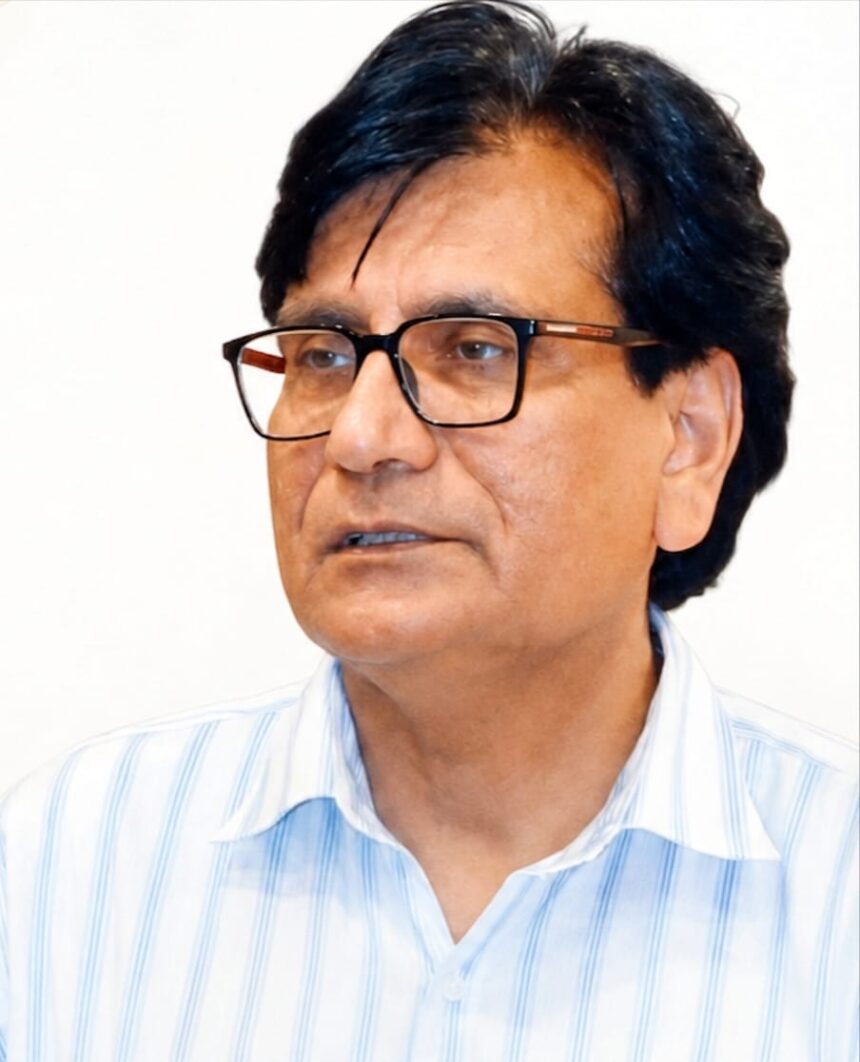
By:Dr. Nasser Hussyn Bukhari
Published By:ANI News Agency
European history offers us an important lesson: when authority is placed over knowledge and questioning is treated as rebellion, societies can become intellectually stagnant. Describing medieval Europe simply as a “Dark Age” would be a historical oversimplification, because religious institutions also preserved many traditions of learning during that period. Yet it is equally true that, at certain points in history, religious authority came into serious conflict with independent intellectual inquiry. When established ideas were placed beyond the reach of questioning and experimentation, intellectual progress was constrained.
The case of Galileo Galilei is a prominent example of this conflict. Galileo supported a view of the universe based on astronomical observation and evidence that challenged the dominant religious and intellectual understanding of his time. His trial before the Roman Inquisition in 1633 became symbolic of a much larger question: could human beings challenge an established conception on the basis of observation, evidence and reason?
Later, the Renaissance, the Scientific Revolution and the Enlightenment transformed Europe’s intellectual landscape. This transformation did not occur simply because religious authority declined; political, economic, scientific and institutional factors also played significant roles. But one fundamental lesson emerged: knowledge must never be afraid of questions.
And this brings us to the question facing Pakistan today: Why are we afraid of asking questions?
There are many reasons for this problem in Pakistan. Family upbringing, teacher-centred education, a rote-learning examination system, social hierarchies, the culture of unquestioning obedience to authority, weak research infrastructure and a limited research culture in universities all contribute to the problem.
Among these factors, a form of clericalism that seeks to restrict questioning, disagreement and inquiry in the name of religion is certainly an important and sensitive issue. But an immediate objection arises: does this mean that all religious scholars in Pakistan are opposed to knowledge and research? The answer is clearly no. Islamic civilisation has a remarkable intellectual tradition in medicine, mathematics, astronomy, philosophy and many other fields. Many Muslim thinkers regarded reason, observation, questioning and rational argument as important means of acquiring knowledge. The criticism, therefore, is not directed at religion itself but at an intellectual attitude that uses religion to restrict legitimate questioning.
Another objection is that not every question is necessarily acceptable. That is correct. Questions must also be responsible. Insulting an individual, spreading false information or making an unsubstantiated allegation is not scholarly inquiry. However, suppressing a serious intellectual question merely because it challenges an established idea is contrary to the spirit of research. A question should be answered through evidence and reasoning, not by silencing the person who asks it.
Another concern is that if children are given freedom to question everything, they may stop respecting their parents, teachers and social values. This concern is also misplaced. Questioning and disrespect are two different things. A student can disagree with a teacher while continuing to respect the teacher. Critical thinking does not mean rudeness; it means learning to disagree through reason and evidence. We should teach children that they can say, “I do not agree with you,” but they should also be able to explain, “Here is my evidence and here is my argument.”
A fourth objection is that questions about religion may create social conflict. The answer is that suppressing questions does not make them disappear; it merely pushes them underground. If young people cannot find credible answers to their questions in educational institutions and reliable intellectual forums, they may turn to unverified sources, social media or extremist material. Open intellectual dialogue is not necessarily a source of disorder; it can be a defence against misinformation.
The real issue, therefore, is not clericalism versus science. It is authority versus inquiry. If a religious scholar presents an argument based on evidence and reasoning, that scholar is participating in intellectual dialogue. If a scientist presents a hypothesis as an absolute truth without sufficient evidence, that hypothesis should also be questioned. In an intellectual society, it is not the personality of the speaker but the strength of the evidence that should matter.
Our education system does not adequately teach this principle. Students are often trained to memorise what is written in a textbook and reproduce it in an examination. They are taught much less frequently how to formulate a new question when the existing answer is incomplete.
The world is now confronting new questions in artificial intelligence, genetic research, biotechnology, climate change, space science and cybersecurity. In the social sciences, poverty, unemployment, migration, urban expansion, the digital society and social inequality require serious local research. But if our research remains limited to producing theses and papers merely for degrees or promotions, we will be producing academic documents rather than new knowledge.
The solution is clear. The curriculum must give greater importance to questioning, research, experimentation, discussion and problem-solving. Students should be assigned research projects. They should learn how to collect data, evaluate sources, formulate hypotheses and draw conclusions. Teachers should be trained to understand that a student’s question is not a challenge to their authority; it is a sign that meaningful learning is taking place.
Universities should establish Research and Innovation Clubs, expand scholarships and research grants for young researchers, and make national and local problems an integral part of university research. Religious institutions and scholars should also play their role in encouraging intellectual dialogue, questioning and research. If religious leadership frightens young people away from questioning, it will not eliminate the questions in their minds. If, instead, it guides them towards evidence, reason and responsible inquiry, it can contribute to a stronger society.
There is another important objection that must be addressed: does freedom of inquiry mean that every tradition, belief and institution should constantly be viewed with suspicion? No. Critical thinking does not mean rejecting everything; it means evaluating every claim according to the appropriate standards of evidence and reasoning. A tradition may deserve respect, but a scholarly claim remains subject to evidence.
Pakistan does not need to move away from religion; it needs to move away from intellectual stagnation. We need a generation that understands its cultural and religious heritage but is not afraid to ask questions; that respects teachers but can disagree with them through reason; that reads books but also conducts new research.
The logical conclusion is clear: if we suppress questions, research will be restricted; if research is restricted, the production of new knowledge will decline; and if new knowledge declines, we will remain consumers of the knowledge produced by others in technology, economics, education and social policy. Therefore, the problem cannot be solved simply by blaming one particular group. We must create a culture of intellectual inquiry at home, in the madrassa, school, college, university and wider society—a culture in which questioning is not treated as rebellion but recognised as the first sign of learning.
Perhaps our educational reform should begin with one simple sentence:
“Ask questions, seek evidence, conduct research—and where no answer exists, create new knowledge.”
Because developed societies are not those that already know the answers to every question; they are those that have the freedom to generate new questions, tolerate disagreement and search for their answers.