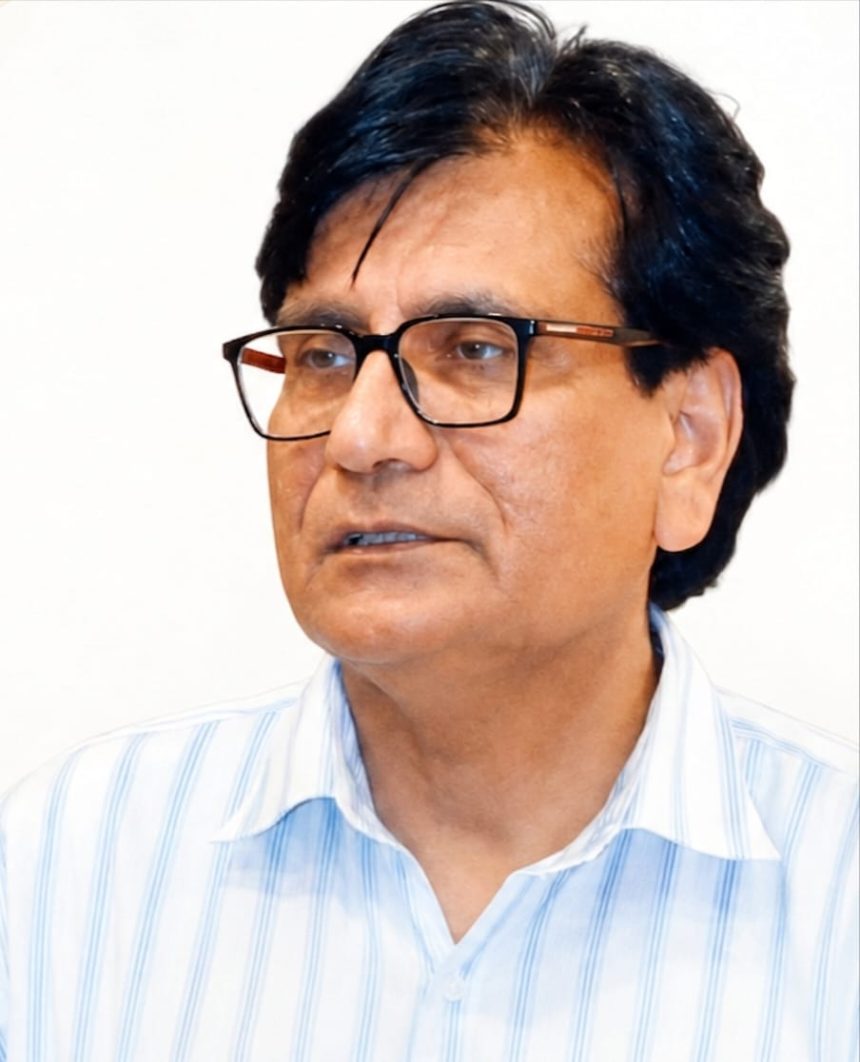
Written By:Dr Nasser Hussyn Bukhari
Published By:ANI News Agency
The Federal Board of Intermediate and Secondary Education (FBISE), Islamabad, has long been regarded as one of Pakistan’s more credible examination bodies. Its jurisdiction extends across the country as well as to Pakistani educational institutions operating abroad. Over the years, it has earned a reputation for relatively high academic standards, structured procedures and institutional discipline.
That reputation also places a greater responsibility on the board to ensure that changes in examination policy strengthen, rather than disrupt, the educational process.
The recent policy allowing students who have passed their Secondary School Certificate (SSC) or Higher Secondary School Certificate (HSSC) examinations to reappear in subjects for grade improvement has raised concerns among educationists, parents and educational institutions. The intention behind the policy may be understandable. Students should have opportunities to improve their grades and remain competitive in an increasingly examination-driven education system.
But the central question is not whether students deserve a second chance. They do. The real question is whether that second chance should come at the cost of regular learning.
This is where the present arrangement deserves serious reconsideration.
Improvement examinations held during an ongoing academic session can create a fundamental conflict between examination preparation and classroom learning. Students who have already passed their examinations may choose to appear again in the hope of securing higher marks. In preparing for these examinations, some may remain away from their schools or colleges for extended periods while their institutions continue teaching the next stage of the curriculum.
The result is a paradox: a student leaves the classroom to improve an examination result, only to return with gaps in the coursework that is essential for the next stage of education.
Education is not simply a collection of marks that can be improved independently of the learning process. It is cumulative. Concepts build upon one another, particularly at the SSC and HSSC levels. Mathematics, sciences, languages and other subjects require sustained classroom engagement, regular practice and continuous interaction with teachers. Missing several weeks of instruction cannot easily be compensated for through independent study or a few additional classes.
The danger, therefore, is that an examination policy intended to improve academic performance may inadvertently weaken it.
There is another contradiction that deserves attention: the conflict between attendance requirements and examination arrangements. Educational institutions are expected to enforce minimum attendance requirements, yet students are simultaneously given reasons to remain absent from regular classes because of board examinations.
This places schools and colleges in an uncomfortable position. Should an institution strictly enforce attendance when a student is preparing for an officially sanctioned examination? Or should it accommodate the absence and somehow compensate for the lost teaching time?
Either option creates difficulties.
Institutional discipline depends on consistency. Students need to understand that classroom attendance is an essential part of education, not an optional activity. If they begin to view board examinations as a routine reason for missing classes, the authority of the institution can gradually be weakened.
The problem becomes particularly serious in Grades 10 to 12, when students are preparing for important academic transitions. At this stage, interruptions in learning can have consequences for subsequent studies.
The policy also has a psychological dimension. Young people already face considerable pressure over grades, university admissions, careers and parental expectations. Repeated opportunities to improve marks can unintentionally reinforce the belief that every grade must be maximised and that an already satisfactory result is somehow inadequate.
A student who has passed may begin to feel compelled to appear again simply because classmates are doing so or because a higher percentage is perceived as essential for future success. Improvement then stops being an opportunity and begins to feel like an expectation.
This can contribute to a cycle of examination anxiety. Students prepare for one examination, return to regular classes, sit another examination and then face the possibility of trying to improve yet again. Instead of encouraging meaningful learning, the system risks turning education into a continuous competition for higher numerical scores.
Parents, too, can become part of this cycle. In an environment where marks increasingly influence perceptions of ability and future prospects, many parents may feel compelled to support repeated examination attempts. Private tuition and coaching can then become the default solution for students trying to recover the learning they missed in the classroom.
This has an important social consequence. Families with greater financial resources can afford additional tutoring, while others cannot. An examination policy intended to provide greater opportunity could therefore unintentionally widen educational inequality.
Teachers are also placed under considerable pressure. When students return after prolonged examination-related absences, teachers have to balance the progress of the regular class with the needs of students who have missed lessons. They may be expected to provide remedial instruction without additional time or resources.
This is not merely a question of workload. It can affect the quality and pace of teaching for the entire class.
The wider institutional environment suffers as well. Schools and colleges require predictable academic calendars. Teaching, assessments, co-curricular activities and examinations are planned around a structured academic year. Repeated mid-session examinations can disturb this rhythm and create uncertainty for administrators, teachers and students alike.
None of this means that students should be denied a reasonable opportunity to improve their academic record. Circumstances change, students mature, and an examination result obtained at one point in life should not permanently define an individual’s academic potential.
But opportunity must be designed around learning, not against it.
A better policy would therefore separate improvement examinations from the regular academic calendar. Students who wish to improve their grades should be given a clearly defined opportunity at a time that does not require them to abandon ongoing classroom instruction. The number of attempts, subjects and eligibility conditions could also be rationalised to prevent the system from becoming an endless pursuit of higher marks.
Most importantly, any major change in examination policy should be preceded by meaningful consultation. Educationists, principals, teachers, psychologists, parents and students should have a voice in assessing its likely consequences. Examination policy cannot be designed successfully from an administrative perspective alone; its real test is what happens inside the classroom.
The issue, ultimately, is one of priorities.
If the education system rewards students primarily for repeatedly improving examination scores, it risks sending the wrong message: that marks matter more than learning. But if examinations are organised to complement the academic calendar, they can provide genuine opportunities without undermining classroom education.
FBISE should therefore review the timing and structure of its improvement policy.
The objective should not be to deny students a second chance, but to ensure that the second chance does not damage the first responsibility of an educational institution — to provide continuous, meaningful and effective learning.
An examination system must serve education, not compete with it. Students should leave the classroom better prepared for examinations, not leave the classroom in order to prepare for them.