BY: Rana Farooq Ashraf : Published by ANI News Agency
A few days ago, an Indian journalist asked Pakistan’s renowned journalist Hamid Mir an intriguing question: “How does Pakistan manage to keep America and China, Saudi Arabia and Iran, all happy at the same time?”
The question may have sounded simple, but it captured one of the most remarkable features of Pakistan’s foreign policy: its ability to maintain relationships with countries that are often strategic competitors or even adversaries of one another.
Pakistan’s real achievement is not that it keeps everyone happy. It is that it keeps talking to everyone.
This distinction matters.
For decades, Pakistan’s geography has compelled it to maintain relationships with competing centres of power. China remains Pakistan’s most important strategic partner, with the China-Pakistan Economic Corridor at the heart of bilateral economic cooperation. At the same time, the United States remains a major global economic, diplomatic and security power with which Pakistan cannot afford to sever ties.
The challenge becomes even more complicated when Saudi Arabia and Iran are added to the equation.
Saudi Arabia is one of Pakistan’s oldest strategic and defence partners, while Iran is its immediate western neighbour, sharing a long border and deep historical, cultural and economic connections with Pakistan.
For Islamabad, therefore, choosing one camp against the other is not a luxury. It can be a dangerous strategic mistake.
Pakistan’s approach has increasingly been based on a simple principle: national interest should determine foreign policy, rather than permanent alignment with any single power.
Afghanistan provides perhaps the clearest example.
During the long Afghan conflict and the subsequent peace process, Pakistan maintained channels with Washington, Beijing, Moscow, the Taliban and the Afghan government. Islamabad’s ability to communicate with multiple sides became particularly important during the Doha peace process, when diplomatic engagement was required between actors who had spent years fighting one another.
That experience has now given Pakistan another potentially important role: facilitating communication between Washington and Tehran.
During the 2026 crisis, Pakistan positioned itself as a supporter of dialogue and diplomacy rather than confrontation. Islamabad’s message has remained consistent: regional disputes cannot be resolved permanently through military force alone.
This is where Pakistan’s strategic value becomes apparent.
Its strength is not simply its military capability. It is also its diplomatic access.
Pakistan can speak to Washington without abandoning Beijing. It can maintain a strategic relationship with Riyadh without severing communication with Tehran. It can cooperate with China while continuing to engage the United States.
That balancing act is extremely difficult.
Pakistan’s relationship with Saudi Arabia has also entered a new phase. In September 2025, the two countries signed a Strategic Mutual Defence Agreement, under which aggression against one country would be treated as aggression against both.
In 2026, Pakistani military and air assets were deployed in Saudi Arabia amid escalating regional tensions. Whatever the precise number of personnel and aircraft involved, the strategic message was unmistakable: Pakistan’s defence relationship with Saudi Arabia is no longer merely symbolic.
Yet this should not automatically be interpreted as Pakistan abandoning Iran.
That is precisely where Pakistan’s diplomacy becomes more interesting.
Islamabad has continued to maintain diplomatic communication with Tehran while deepening its security relationship with Riyadh. In conventional geopolitical thinking, these positions may appear contradictory.
For Pakistan, they are not necessarily contradictory.
They are the consequence of geography.
Iran cannot be moved somewhere else. Saudi Arabia cannot be ignored. China cannot be replaced. America cannot simply be wished away.
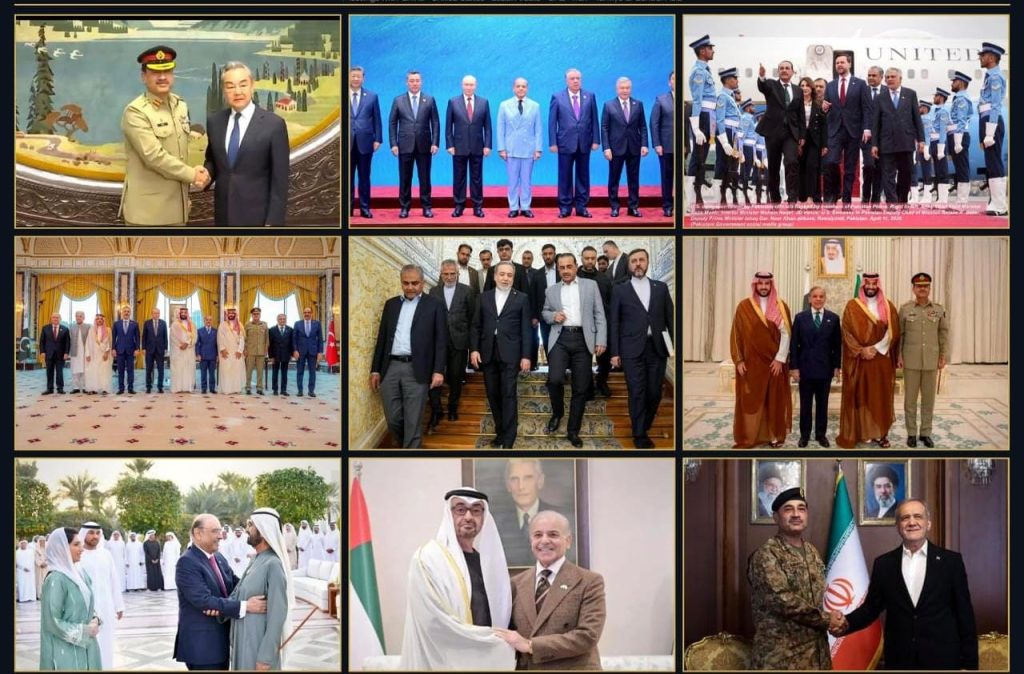
Pakistan therefore has little choice but to develop the diplomatic ability to deal with all of them simultaneously.
This is perhaps what some observers have misunderstood for decades.
Pakistan is not necessarily successful because it is “pro-American,” “pro-Chinese,” “pro-Saudi” or “pro-Iranian.” Its most sustainable position is to be pro-Pakistan.
The real test, however, is whether Islamabad can convert this diplomatic balancing act into a coherent long-term national strategy.
That requires more than military strength. It requires economic stability, political continuity, institutional credibility and a foreign policy that survives changes of government.
The contrast with 1999 is striking.
On October 25, 1999, Time magazine famously placed Pakistan on its cover with the question: “Can Pakistan Be Saved?”
The question reflected a country facing severe economic and political pressures, international isolation and the consequences of its nuclear tests.
Twenty-seven years later, the question has changed dramatically.
It is no longer simply about whether Pakistan can save itself.
The emerging question is whether Pakistan can use its geography, diplomatic relationships and strategic capabilities to help prevent a wider regional conflict.
That does not mean Pakistan can single-handedly “save the world.” Nor should Islamabad imagine that balancing rival powers is an unlimited diplomatic superpower.
Every balancing strategy has risks.
Washington will have expectations. Beijing will have interests. Riyadh will have security concerns. Tehran will have its own red lines.
Pakistan will inevitably disappoint some partners at some point.
But diplomacy is not the art of making everyone happy.
It is the art of ensuring that disagreements do not become disasters.
Pakistan’s greatest strategic asset may therefore be its ability to remain in the room when others leave it.
If Islamabad can strengthen its economy, maintain political stability and preserve strategic autonomy, its geography can become an asset rather than a burden.
Its relationships with competing powers can become diplomatic capital rather than strategic contradictions.
And its borders can become bridges rather than battlefields.
In 1999, the world asked whether Pakistan could be saved.
Today, perhaps a more appropriate question is:
Can Pakistan turn its unique ability to talk to everyone into the diplomatic strength needed to help keep a deeply divided region from going to war?
That may ultimately be Pakistan’s most important test—and perhaps its greatest opportunity.