By Rana Farooq Ashraf
Published By:ANI News Agency
The defence agreement signed in Makkah on August 7 by Pakistan, Saudi Arabia and Türkiye is rapidly evolving from a three-country pact into a structured regional security framework. At their first meeting in Istanbul on August 31, the three countries agreed to establish a permanent secretariat in Saudi Arabia, with Pakistan providing the Secretary-General for the first three years.
The decision gives Islamabad more than a symbolic role. It places Pakistan at the centre of the alliance’s institutional development and gives it an opportunity to shape its priorities, procedures and long-term direction.
For now, Pakistan, Saudi Arabia and Türkiye remain the founding members. The framework, however, is open to other regional states that accept its principles. Egypt has emerged as a potential participant, but it is not yet a formal member.
At the heart of the agreement is collective defence: an external armed attack against one member is to be treated as an attack against all three. This has inevitably prompted comparisons with NATO’s collective-defence principle. Yet calling the Makkah Defence Alliance a “Muslim NATO” would be premature. Unlike NATO, its command structures, deployment arrangements and detailed military-response mechanisms have yet to be fully developed.
Its significance nevertheless extends well beyond a mutual defence pledge. Pakistan, Saudi Arabia and Türkiye have agreed to deepen military cooperation, improve defence capabilities, expand training and pursue cooperation in defence technology and joint production. A permanent secretariat could give these commitments continuity and turn political declarations into an organised programme of cooperation.
The three countries also bring complementary strengths. Pakistan contributes experienced armed forces, nuclear deterrence and decades of operational experience. Türkiye brings an increasingly sophisticated defence industry and growing technological capabilities. Saudi Arabia contributes financial strength, energy significance and considerable political influence in the region.
The strategic potential lies in combining these strengths.
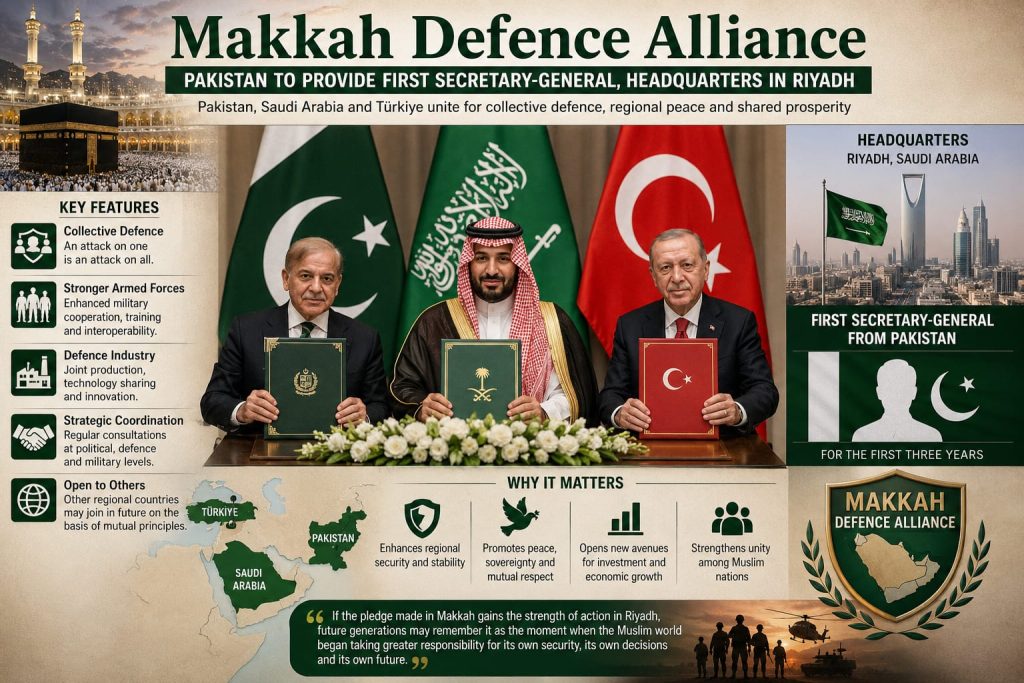
For Pakistan, the appointment of the first Secretary-General is particularly significant. It provides Islamabad with a direct role in coordinating the alliance and helping define its institutional priorities. Prime Minister Shehbaz Sharif’s political leadership, Field Marshal Syed Asim Munir’s military engagement and Pakistan’s diplomatic efforts have helped deepen the strategic relationship with Riyadh and Ankara.
The agreement also carries a potential economic dimension for Pakistan. Greater defence cooperation could create opportunities in manufacturing, technology, training, investment and employment. Much will depend, however, on whether the three partners move from political commitment to concrete projects and sustained institutional cooperation.
For ordinary Pakistanis, the value of the alliance should ultimately be measured not by headlines but by outcomes: stronger national security, greater technological capacity, industrial opportunities and a more influential diplomatic position for Pakistan.
Internationally, the message is equally significant. Three major Muslim states are seeking to strengthen their security through a permanent framework rather than ad hoc cooperation. If the alliance remains defensive, respects national sovereignty and contributes to regional stability, it could become an important instrument of deterrence without turning into another bloc defined by confrontation.
Its real test, however, begins now. Alliances are not sustained by signing ceremonies; they are sustained by institutions, resources, clear rules and political trust.
Pakistan therefore faces both an opportunity and a responsibility. As the first Secretary-General, it can help determine whether the Makkah agreement becomes another diplomatic declaration—or develops into a credible and lasting regional security institution.
If the pledge made in Makkah acquires the strength of action in Riyadh, history may remember it not simply as a defence pact, but as the moment when the Muslim world began taking greater responsibility for its own security, its own choices and its own future.