Written:By Hurish Shah
Published BY: ANI
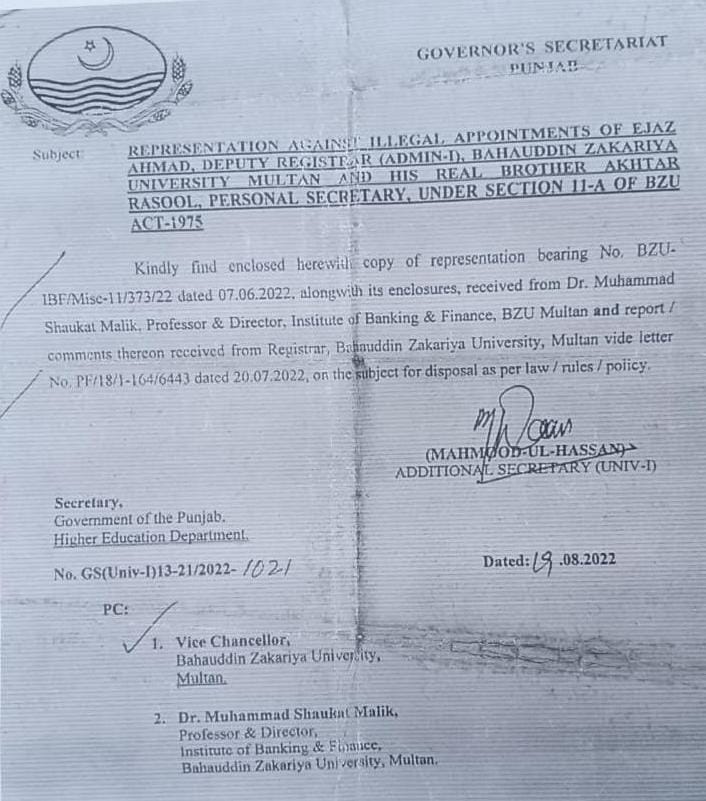
Justice is not denied only by an unfair decision. It is also denied when no decision is made for years. Every public institution has a legal and moral responsibility to decide complaints and statutory representations within a reasonable time. Delayed justice weakens public confidence, encourages speculation, and creates the impression that influential individuals may receive special treatment. In a democratic system, transparency and accountability are not optional; they are essential principles of good governance.A striking example is a representation submitted by former Prof. Dr. Shoukat Malik, former Director of the Institute of Banking and Finance, Bahauddin Zakariya University (BZU), Multan. On 7 June 2022, he filed a representation under Section 11-A of the BZU Act, 1975, alleging irregularities in the appointments of Mr. Ejaz Ahmad, then Deputy Registrar (Admin I) and now Acting Registrar, and his real brother, Mr. Akhtar Rasool, then Personal Secretary and now serving as Assistant Treasurer. The representation, titled “Representation Against Alleged Illegal Appointments,” was accompanied by supporting documents and annexures.According to the official record, the university administration submitted its para wise comments on 20 July 2022. Subsequently, on 19 August 2022, the complete case was forwarded to the Secretary, Higher Education Department, Punjab, for disposal in accordance with the applicable law, rules, and government policy. Since then, years have passed, yet no final decision has reportedly been communicated.This prolonged silence has now become more significant than the original representation itself. The central issue is no longer whether the allegations are ultimately found to be correct or otherwise. The real question is why the competent authority has not decided the matter despite having the complete record before it for such a long period. Administrative delay of this magnitude cannot be regarded as routine bureaucracy. It raises legitimate concerns regarding institutional accountability and good governance.The Higher Education Department owes an explanation to the public. If the representation lacks legal merit, it should be dismissed through a reasoned order. If the allegations warrant further proceedings, the department should proceed in accordance with the law. Keeping the matter pending indefinitely serves neither justice nor the credibility of the department.Moreover, prolonged inaction inevitably creates a public perception that certain officials may be receiving institutional protection. Whether such a perception is justified or not is not the issue. The issue is that continued silence allows unnecessary doubts to persist. The Higher Education Department could remove such uncertainty simply by issuing a lawful, transparent, and reasoned decision based on the available record.Universities are expected to uphold merit, integrity, and the rule of law. Their administrative affairs should remain transparent and beyond reasonable suspicion. Whenever matters concerning senior officials remain undecided for years, the confidence of faculty members, students, and the wider public is inevitably affected.The purpose of highlighting this issue is not to declare anyone guilty or innocent. Determining responsibility rests solely with the competent authority after examining the available evidence and applicable law. However, delaying that responsibility for years cannot be justified. Justice requires timely action, and public administration demands accountability. No individual should remain under unresolved allegations indefinitely, and no complainant should be left waiting endlessly for a lawful decision.The Higher Education Department should now examine the record, complete any remaining legal formalities, and issue a speaking order based solely on law and evidence. Regardless of the outcome, such a decision would strengthen public confidence in the administrative process and reaffirm the government’s commitment to transparency, accountability, and the rule of law.The credibility of public institutions is measured not by protecting influential individuals but by applying the law equally to everyone. Justice delayed ultimately becomes public distrust. A transparent and timely decision in this long pending representation is no longer merely an administrative necessity; it is a test of the credibility, impartiality, and integrity of Punjab’s higher education governance.