The Centre for Afghanistan, Middle East & Africa (CAMEA) at the Institute of Strategic Studies, Islamabad (ISSI) hosted the launch of a special report titled The U.S., Iran Confrontation and its Regional Fallout.
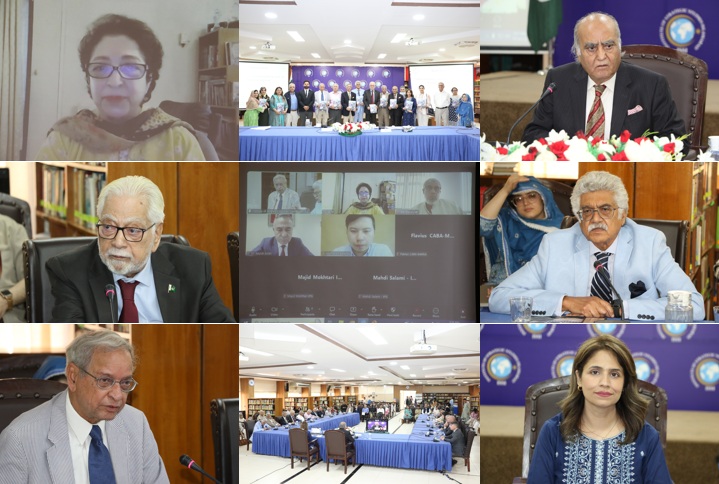
The event was addressed by Ambassador Maleeha Lodhi, who attended as chief guest, along with Ambassador Khalid Mahmood, Chairman, Board of Governors, ISSI, and Dr. Amina Khan, Director, CAMEA, ISSI, who also spoke on the occasion.
Ambassador Maleeha Lodhi appreciated CAMEA ISSI’s efforts in bringing together what she described as an important and timely report. She called it a wide ranging assessment of the U.S., Iran war and commended the diversity of its contributors. She also noted the report’s discussion of Pakistan’s mediatory role and said Pakistan continues to enjoy the trust of both the United States and Iran, allowing it to play a constructive diplomatic role.
She stressed that regional security cannot depend solely on external actors, since their involvement does not necessarily guarantee long-term stability. She underscored the importance of greater regional cooperation and highlighted Pakistan, Egypt, Turkiye, and Saudi Arabia as an important grouping capable of contributing to regional peace and stability.
Reflecting on the conflict, Ambassador Lodhi said the agreement that ended the four month war demonstrated the limitations and failure of military force in resolving complex political disputes. She noted that while the United States entered the conflict as a war of choice, for Iran it was an existential struggle. She added that the idea that might is right had been challenged, and that military superiority alone could not achieve political objectives. She said the United States did not achieve its stated objectives, including regime change or the complete destruction of Iran’s nuclear infrastructure.
Ambassador Lodhi also said that although threats and ultimatums were issued by the U.S. President, diplomacy continued alongside the conflict. She raised the broader question of whether the confrontation had reduced U.S. dominance in the international system, saying this remains an important issue for further assessment. She added that intense diplomatic efforts continued throughout the crisis and ultimately contributed to de escalation.
She concluded that rising geopolitical tensions are reshaping the international landscape and that the world is passing through a period of considerable uncertainty. She said the special report offers valuable insight into evolving regional tensions and helps deepen understanding of the challenges facing the region.
Ambassador Khalid Mahmood said the Middle East remains central to global peace, security, and economic stability, making the U.S., Iran confrontation one of the most consequential issues affecting the region and beyond. He noted that the recent Islamabad Memorandum of Understanding between the United States and Iran represents an important diplomatic opening that has created space for de escalation, dialogue, and renewed engagement, while highlighting Pakistan’s constructive role in facilitating the process.
Reaffirming Pakistan’s position that disputes should be resolved peacefully through dialogue, respect for sovereignty, and adherence to the UN Charter, he said the special report is a timely and valuable contribution that provides balanced analysis of the evolving regional security environment. He commended Dr. Amina Khan and the CAMEA team for producing a study that will benefit policymakers, diplomats, scholars, and practitioners.
Dr. Amina Khan said the confrontation between the United States and Iran has emerged as one of the most momentous geopolitical developments shaping the contemporary Middle East. She noted that what began as a bilateral strategic rivalry has increasingly become a defining factor in regional security, diplomacy, economics, and energy politics, with repercussions extending far beyond the Gulf region.
She added that persistent conflicts, shifting alliances, intensifying geopolitical competition, and evolving economic and security challenges continue to reshape the regional landscape. These developments, she said, have far reaching consequences for international security, regional stability, maritime trade, energy markets, and global diplomacy.
The event concluded with an interactive discussion and question and-answer session, during which participants exchanged views on the special report’s key findings and the evolving regional security environment. Former Foreign Minister Ambassador Inam ul Haq, practitioner Mr. Ziad Allahdad, scientist Mr. Shaukat Hameed Khan, several contributing authors, and others took part in the discussion and shared their perspectives.
The event was attended by diplomats, academics, researchers, students, members of the strategic community, and representatives of the media.