Report: ANI :
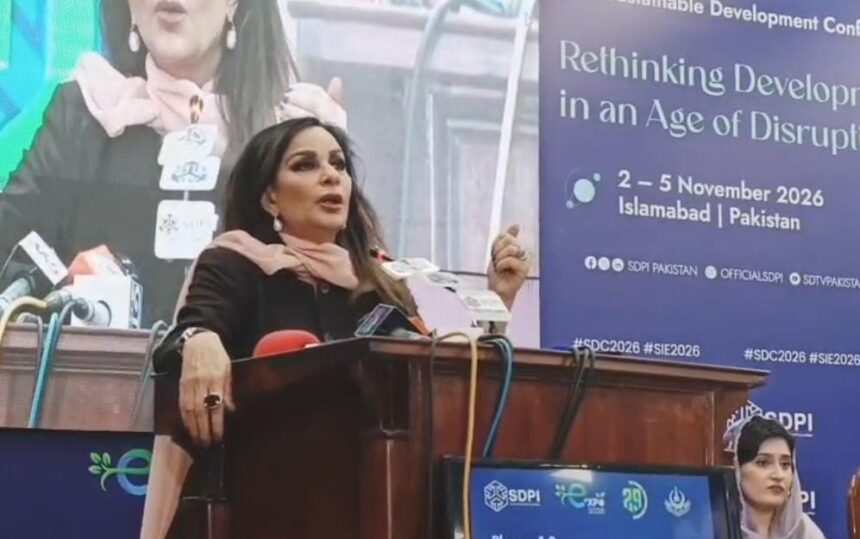
ISLAMABAD — Pakistan Peoples Party (PPP) Vice President Senator Sherry Rehman has said that the world is entering a new era of transformation and uncertainty, with climate change, artificial intelligence and energy security emerging as major global challenges.
Addressing the 29th Sustainable Development Conference organised by the Sustainable Development Policy Institute (SDPI), Senator Rehman said climate change was among the biggest crises facing the world, while the effects of El Niño were severely impacting the region.
She said floods and other climate-related disasters were becoming increasingly common in Pakistan, recalling that one-third of the country had been submerged during previous floods. The time available for recovery after natural disasters was also shrinking.
Referring to environmental challenges, she highlighted the impact of smog in Lahore and said climate justice required providing resources and international support to countries most affected by climate change.
Speaking about artificial intelligence, Senator Rehman said AI was no longer merely an assisting tool but had become an integral part of businesses and systems. It was influencing human thinking and cognitive processes, while transparency remained limited regarding water consumption by data centres and supercomputing facilities.
She observed that artificial intelligence was evolving into autonomous agents capable of making decisions, but cautioned that AI did not automatically guarantee equality or equal opportunities for everyone.
On energy security, she described dependence on fossil fuels as an addiction that the world needed to overcome. She noted that approximately $7 trillion in annual subsidies were being provided to fossil fuels globally.
She said Pakistan's energy challenges were not as complicated as they were often portrayed, adding that the country was paying the price for an outdated and inefficient electricity system.
Senator Rehman said Pakistan was emerging as a leading country in renewable energy, with solar power adoption increasing rapidly. She stressed that the future belonged to renewable energy and decentralised local energy systems.
She further said that battery technology and energy storage would bring the next major revolution in the energy sector. She also called for establishing electric vehicle charging stations across the country and providing additional subsidies for electric motorcycles and three-wheeled vehicles.
Highlighting the impact of global tensions, she said progress on environmental targets had slowed, while the coming era could be marked by scarcity and limited resources.
She added that Pakistan had adopted a balanced diplomatic strategy to navigate global crises in an increasingly multipolar world. West Asia, she said, needed to develop its own security system and regional security framework.
Senator Rehman concluded that despite being the world's fifth most populous country, Pakistan had made significant progress in addressing its energy challenges through domestic solutions and had positioned itself not merely at the centre of global crises but as part of their solutions.